
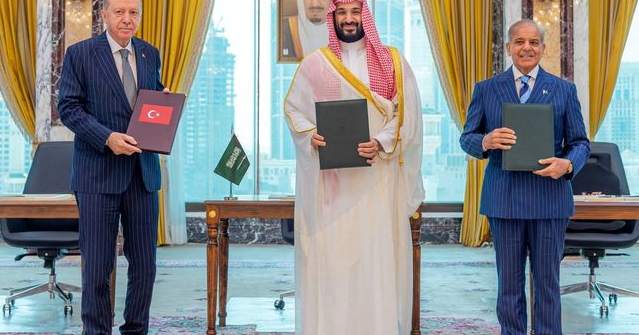
The 71-year-old former commander-in-chief of the Revolutionary Guards was appointed secretary of the Supreme National Security Council after Mohammad Bagher Zolghadr resigned little more than four months into the job.
Supreme Leader Mojtaba Khamenei separately appointed Rezaei as his representative on the council, consolidating his position in a body central to decisions on war, diplomacy and Iran’s confrontation with the United States.
The appointment adds another chapter to a career spanning command of the Revolutionary Guards through most of the Iran-Iraq war, decades in senior political institutions and four attempts to become president.
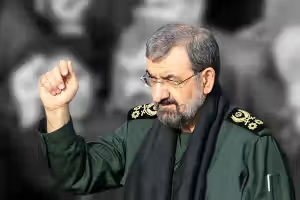 Rezaei named Iran’s top security chief and Khamenei representative
It also returns to prominence a figure whose record encompasses one of Iran’s most disputed wartime operations, an Interpol Red Notice over the 1994 bombing of a Jewish community center in Argentina and years as a recurring subject of satire among Iranians online.
From Islamist militant to Guards commander
Born Mohsen Sabzevar Rezaei Mir-Ghaed in 1954, Rezaei became involved before the 1979 revolution with Mansouroun, an armed Islamist organization opposed to the monarchy.
Following the revolution, Mansouroun and six other Islamist organizations joined to form the Mojahedin of the Islamic Revolution Organization.
Rezaei’s ascent through the new political order was rapid. Ruhollah Khomeini appointed him commander-in-chief of the Revolutionary Guards in 1981, when Rezaei was 27 and Iran was a year into its war with Iraq.
He remained in command until 1997, overseeing the Guards for almost the entire eight-year war and during its transformation from an armed organization into one of Iran’s principal centers of military power.
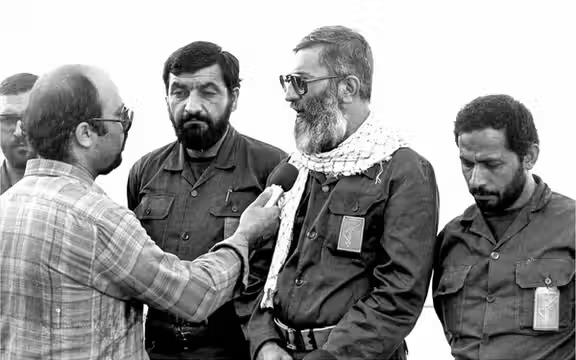 Mohsen Rezaei (second from left) alongside Ali Khamenei (center) during the Iran-Iraq War.
Rezaei left military command in 1997 and moved into the Expediency Council, becoming its longtime secretary. He later served as vice president for economic affairs under President Ebrahim Raisi.
Politics did not deliver the electoral success he sought.
Rezaei entered presidential contests repeatedly, running in 2005 before withdrawing shortly before voting, and contesting elections in 2009, 2013 and 2021 without winning. His repeated appearances on presidential ballots eventually generated a running joke on Persian-language social media that wherever an election was taking place, Rezaei would inevitably become a candidate.
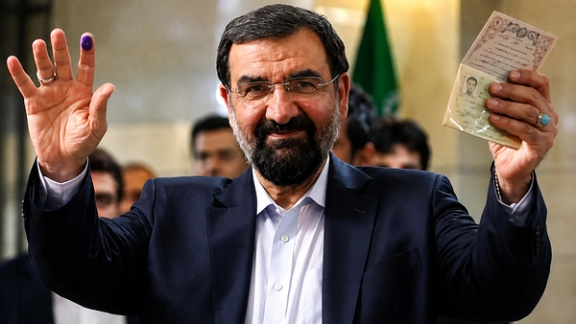 Mohsen Rezaei displays his identification document and inked finger as he registers to run in Iran’s presidential election.
Karbala-4 and a dispute that followed him for decades
No episode of Rezaei’s military career has generated more lasting controversy inside Iran than Operation Karbala-4, launched against Iraqi forces in December 1986.
Rezaei was commander of the Revolutionary Guards when Iranian forces embarked on the operation. Accounts from commanders and participants later indicated that Iraqi forces had obtained advance knowledge of the offensive.
Akbar Hashemi Rafsanjani, who commanded Iran’s war effort at the political level, later recalled learning shortly before the operation that it had been compromised.
Precise casualty figures remain disputed. Rafsanjani’s wartime accounts put the toll at around 1,000 killed, 3,900 missing and 11,000 wounded.
The operation acquired renewed public significance decades later, particularly after the remains of 175 Iranian combat divers were returned to Iran in 2015.
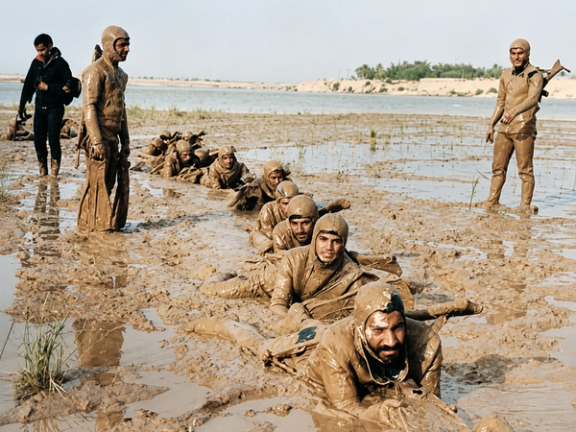 File photo of Iranian forces preparing for Operation Karbala-4 during the Iran-Iraq War.
Rezaei reopened the controversy in 2018 when he wrote that Karbala-4 had been conducted to deceive Iraq before Iran launched the larger Karbala-5 offensive days later.
The description prompted criticism from veterans, former officials and military figures who argued that Karbala-4 had been designed as a genuine major offensive rather than a diversion.
Rezaei later clarified his remarks, saying Karbala-4 had indeed begun as a main operation but had subsequently been turned into a deception after the decision was made to withdraw.
An audio recording of Rezaei speaking to division commander Hossein Kharrazi during the opening phase also attracted attention because Rezaei could be heard instructing forces to continue advancing.
For critics, the episode became a wider argument over wartime accountability: whether commanders persisted with an operation despite evidence that Iraqi forces were prepared for it, and whether the later characterization of it as deception obscured the original plan.
Wanted in Argentina over AMIA bombing
Rezaei’s years commanding the Guards also left him facing an international arrest request.
Argentina has sought him in connection with the July 1994 bombing of the AMIA Jewish community center in Buenos Aires, which killed 85 people and injured hundreds.
Interpol’s Executive Committee approved a Red Notice for Rezaei and five other suspects in 2007 following a request from Argentina. Its General Assembly upheld the decision later that year.
Argentine authorities say Rezaei participated in a meeting at which the attack was decided. Rezaei and Iran have rejected Iranian responsibility.
His international travel has periodically revived the dispute. Argentina sought his arrest when he visited Qatar in 2022, without success.
Hostages for billions
Rezaei’s public comments have also periodically generated controversy at home.
In 2015, he suggested that if the United States attacked Iran, Iranian forces could capture at least 1,000 Americans in the first week and demand billions of dollars for each one’s release.
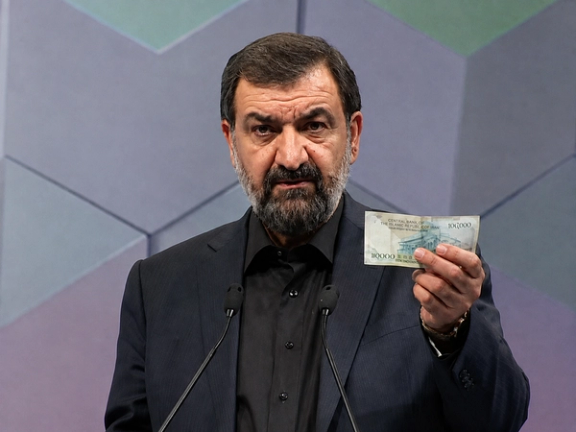 Mohsen Rezaei holds a banknote during a televised debate in Iran.
The proceeds, he suggested, could solve Iran’s economic problems.
Such remarks, combined with his unsuccessful presidential campaigns and frequent television appearances, helped create a second public persona far removed from the image of the young wartime commander.
For some users on Persian-language social media, Rezaei became a stock character for political jokes.
That response resurfaced when Mojtaba Khamenei appointed him military adviser following the 2026 war. Users mocked everything from his return to office to the positioning of his belt buckle, which has itself become a longstanding internet meme.
Appointment revives criticism and ridicule online
Rezaei’s return to a senior security position prompted criticism and satire on X, where Iranian users revisited his wartime record, repeated presidential campaigns and controversial public remarks.
“Is Mohsen Rezaei’s military record, particularly during the war with Iraq, really defensible?” one user wrote. “Where does this extraordinary desire come from? From calling the Karbala-4 failure a deception operation, or from his idea of taking hostages to make money?”
Another user invoked the casualties of Karbala-4 more directly.
“Do you know that a huge number of young people in Operation Karbala-4 never saw the next morning?” the user wrote. “Yes, guess who the commander was. That’s right, Mohsen Rezaei.”
Some users instead interpreted the appointment through Iran’s internal power struggles.
One argued that the Revolutionary Guards had gained influence during the war while technocrats controlled the government, leaving the clergy with diminished power. The user portrayed Rezaei, a veteran Guards commander long removed from operational command, as a possible vehicle for restoring some of that influence.
Another suggested Rezaei’s appointment could strengthen parliament speaker Mohammad Bagher Ghalibaf, himself a former senior Guards commander.
Other posts sought to connect the reshuffle to reports of friction involving President Masoud Pezeshkian, with one user asking whether Rezaei’s appointment made previous reports about the president considering resignation more credible.
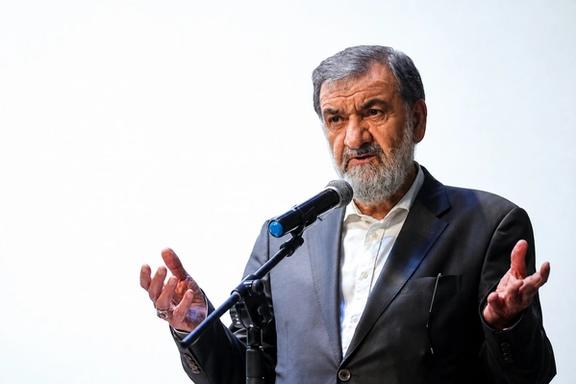 Mohsen Rezaei, Iran’s new secretary of the Supreme National Security Council, speaks at an event.
Speculation over Pezeshkian’s position had begun before Rezaei’s appointment.
Mohammad Bagher Kharrazi, secretary-general of the Hezbollah of Iran political group, predicted the security council reshuffle in remarks circulated widely on social media, portraying it as part of an effort to constrain President Masoud Pezeshkian.
Kharrazi said that Pezeshkian had resigned or threatened to resign 28 times and that Supreme Leader Mojtaba Khamenei had grown frustrated with him and warned that another resignation would be accepted.
“That is why they are changing the Supreme National Security Council, moving Mr Zolghadr and replacing him with Mr Mohsen Rezaei,” Kharrazi said.
The prediction gained renewed attention after Zolghadr stepped down and Rezaei was appointed in his place.
Pezeshkian and Supreme Leader Mojtaba Khamenei’s office have denied accounts that the president repeatedly offered or threatened to resign.
A survivor returns
Rezaei’s latest promotion comes at a markedly different moment from the one in which he first accumulated power.
The Supreme National Security Council has undergone rapid leadership changes following the killing of its former secretary Ali Larijani in March and Zolghadr’s brief tenure afterward.
Rezaei now takes charge as Iran confronts the consequences of war and negotiations over the Strait of Hormuz, where he has taken an uncompromising public position.
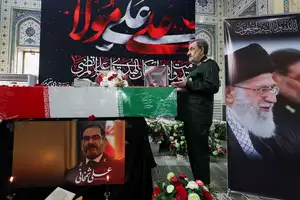 Military adviser appointment by Khamenei Jr draws online mockery
He said in July that control over the waterway was “more important than dozens of atomic bombs,” and more recently said Iran would not accept an unauthorized shipping route through the Strait.
The appointment nevertheless puts a familiar figure back at the center of the system he helped build: a commander whose career has survived military setbacks, electoral defeats, international accusations and decades of political change, and who now again occupies one of the most consequential seats in Iranian national security policy.