
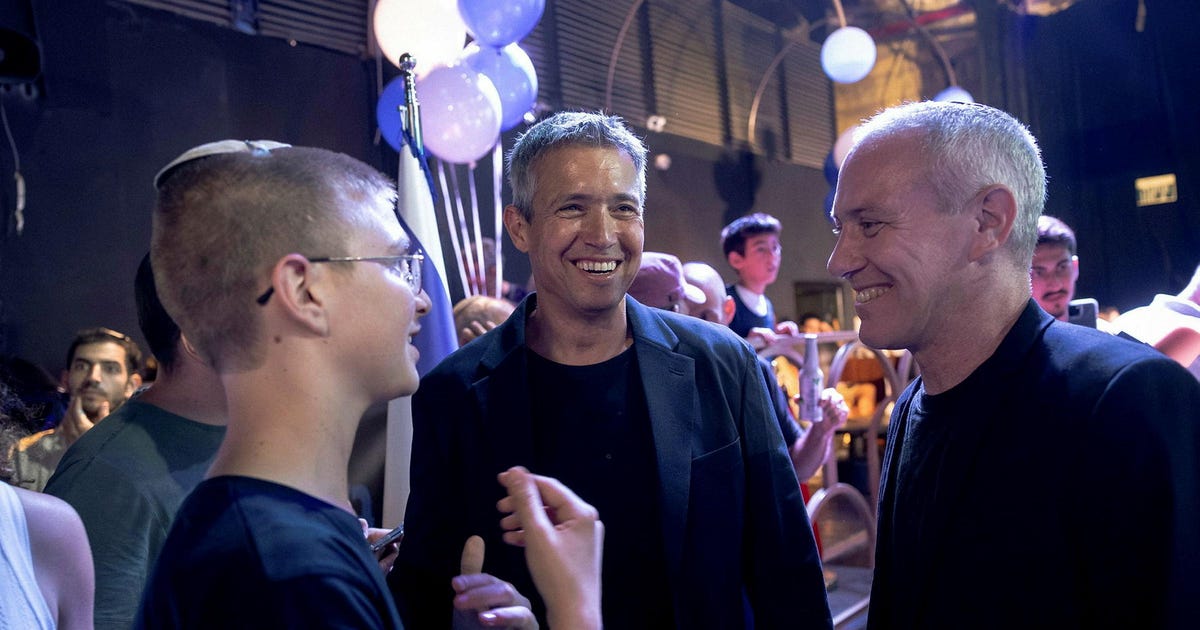
On an early, warm July evening in Tirat Zvi, a religious kibbutz in northern Israel, about 40 people were sitting opposite two Knesset candidates from the Zionist Home–Reservists list in a hall. They were mostly older men wearing skullcaps with some women in pants, other women with head coverings, and very few young people. Facing them, by a table covered with a white tablecloth and water bottles, stood the candidates, Chili Tropper and Shira Shapira.
“What’s the difference between you and Lieberman and Gantz?” asked an older man who introduced himself as Moishele, revferring to Yisrael Beiteinu’s Avigdor Lieberman and Kahol Lavan’s Benny Gantz. “Everyone wants unity and enlistment, what’s different about you?”
Tropper quickly declared that he “doesn’t talk about others.”He then replied that his party appeals to Israelis feeling politically homeless – “people who voted for the coalition and don’t want to vote for them again, but don’t feel comfortable voting for the parties you mentioned.” The other parties, he added, might agree on army enlistment, but not necessarily on the cohesion his party addresses.
“What Israel needs now is an alliance of Zionists, of those who serve. We won’t be able to face all the challenges without a broad Zionist government,” he said. This message was repeated throughout the evening. “Everyone says no ultra-Orthodox and no Arabs,” Moishele pressed. Tropper insisted, “Not sure, and in any case, not everyone speaks the language of Zionist parties.”
 Close
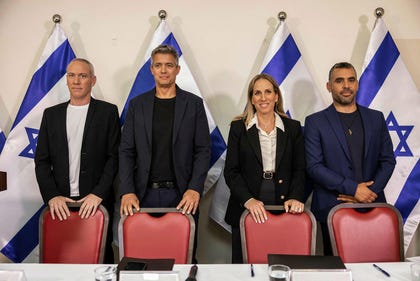
From left: Chili Tropper, Yoaz Hendel, Shira Shapira and Elyasaf Peretz announcing their joint Knesset run, last month. Credit: Itai Ron
From left: Chili Tropper, Yoaz Hendel, Shira Shapira and Elyasaf Peretz announcing their joint Knesset run, last month. Credit: Itai Ron
Hendel has been through quite a few elections and parties, but he doesn’t see that as a problem. On the contrary. “In my view, a party is a tool for implementing policy, and I’m very happy that I’m ideologically consistent,” he says.
In early July, Tropper, who recently left Gantz’s party, and former Communications Minister Yoaz Hendel, who founded the Reservists party, announced a merger. Shapira, an architect and urban planner whose son Aner was murdered on October 7, joined them. Last week, they launched the party at Jerusalem’s Boiler club, where they reiterated their primary goal as “a broad Zionist government.” Another founding member is Elyasaf Peretz, son of educator and Israel Prize winner Miriam Peretz and brother of fallen IDF officers Uriel and Eliraz Peretz.
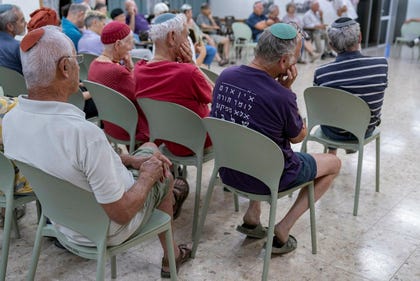
There seemed to be quite a few supporters of the idea in Tirat Zvi. Tropper and Shapira were warmly received, even by a veteran member who proclaimed he “would vote for Bibi anyway.” Many remained in the building after the meeting to speak with them. But the question is not just whether there are enough buyers for this message in the wounded and divided Israel of 2026, but mainly whether, after the October 7 government, there is room for a party that could impede its replacement?
Not ruling out Bibi
Some polls suggest the party will pass the electoral threshold. In such a case, if the Zionist opposition parties secure, say, 59 Knesset seats, it could assemble a coalition of 63 seats. However, the insistence on “a broad Zionist government” means the party could also be the one to prevent the ousting of Netanyahu and the Likud, who were at the helm during the October 7 debacle and the failures that followed. Alternatively, it could emerge as a kingmaker, refusing to back a narrow government and dragging the country into repeated elections.
They are evasive about their willingness to sit with Netanyahu. “We’ll support whoever brings the most Zionist seats,” Hendel told Haaretz when asked whom they would recommend to form the government. “We don’t hide that we want Netanyahu to go home, but our criteria are objectivity, principles. We want a Zionist government. We won’t support a 61-seat ultra-Orthodox government for Bibi, because we oppose forming a government with non-Zionist parties.”
 Close
Members of Tirat Zvi meeting with Tropper and Shapira in late July. They gave the candidates a warm welcome. Credit: Daniel Rolider
Members of Tirat Zvi meeting with Tropper and Shapira in late July. They gave the candidates a warm welcome. Credit: Daniel Rolider
The message is consistent, but it’s hard to extract concrete answers regarding its implementation. The party’s “Magen David” platform was full of clichés that could just as easily have suited Yisrael Beiteinu or the new party launched by Gilad Erdan and Yuli Edelstein.
The first section in the executive summary sent to journalists, for example, sets a goal of “strengthening public education so that every child has an equal opportunity to succeed.” Other clauses include limiting public funding to schools that teach the core curriculum, “creating advancement tracks that will attract excellent people to the system” and “huge investments in early childhood.”
The section on national service calls for “military, national, or civilian” service for every citizen, with “adapted tracks for different population groups” and a detailed list of benefits for those who serve (including full funding for bachelor’s and master’s degrees). It also lists, in red, sanctions against draft dodgers (including revocation of driver’s licenses and travel bans). The section on the cost of living discusses support for working parents and reservists. It lists declarations like “encouraging competition, dismantling monopolies and breaking up centralization.” It also makes vague statements like “trusting businesses and opening the economy” or “openness to the world and removing barriers.”
The settlement section talks about “a plan to strengthen Kiryat Shmona, the Galilee, the Gaza-border communities, the Negev and the communities along the eastern border” (meaning the West Bank) within 90 days of forming the government. It advocates “huge investments in the Negev, the Galilee, the Jordan Valley, and Judea and Samaria” and “expanding agricultural settlement.” The plan also proposes “governance” (including “establishing a Shin Bet unit to thwart Arab crime” and “addressing the personnel problem”).
 Close
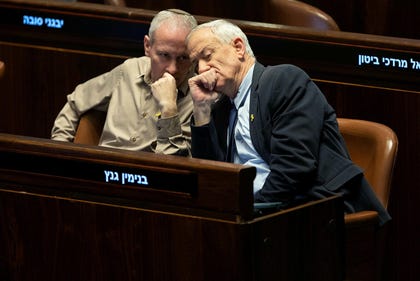
Tropper with Gantz in the Knesset in 2025. Credit: Sraya Diamant
Tropper with Gantz in the Knesset in 2025. Credit: Sraya Diamant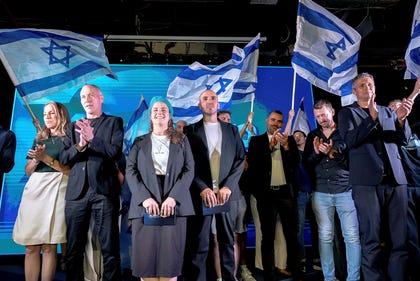 Close
The conference marking the party’s launch, in Jerusalem last week. Credit: Itay Cohen
The conference marking the party’s launch, in Jerusalem last week. Credit: Itay Cohen
The rehabilitation and revival section advocates dedicated funding for the rehabilitation of wounded IDF and security forces, as well as “creating a support system for bereaved families.” It also mentions “strengthening identity and belonging.”
The section on checks and balances between authorities talks about “creating a Zionist constitution” and limiting the terms of elected officials. However, it also echoes the extensive move led by the outgoing coalition, with a clause for “responsible reform of the justice system.” The party’s full platform, provided at Haaretz’s request, advocates a Basic Law on Legislation but also specifies: “We will regulate the boundaries of the Supreme Court’s judicial review powers over Knesset legislation and government decisions. We will establish a balanced and agreed-upon mechanism for selecting judges, combining professional and public considerations, which both ensures judicial independence and reflects Israel’s social and ideological diversity on the bench.”
Dr. Ariel Finkelstein, a researcher at the Israel Democracy Institute, says Tropper and Hendel’s party appeals to the religious public that is dissatisfied with the coalition but struggles with the opposition. “They either perceive them as not right-wing enough, or they distance themselves from non-religious parties like Yisrael Beiteinu or Yesh Atid. Sometimes they distance themselves from individuals like Naftali Bennett due to past experience,” he says. “Benny Gantz and the party of Erdan and Edelstein also appeal to this audience.”
Finkelstein notes that in the last elections, about 80 percent of the non-Haredi religious public voted for the coalition parties. He forecasts that this figure will likely decrease in the upcoming elections. “The main reason is the alliance with the Haredim on the army issue,” he says. “This audience also seeks unity and love of all Jews, and finds it difficult with the line of the coalition parties, especially Religious Zionism. There are also those who struggled with the judicial reform, not necessarily because of the content but because of the rollout.”
 Close
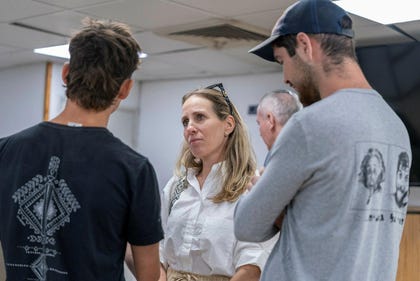
Shapira at the meeting in Tirat Zvi in late July. The question of “Who is a Zionist to you?” arises among audiences of potential voters. Credit: Daniel Rolider
Shapira at the meeting in Tirat Zvi in late July. The question of “Who is a Zionist to you?” arises among audiences of potential voters. Credit: Daniel Rolider
He says the main difficulty is voting for what is perceived as the left. “For many people, it’s a question of what’s more important: the fear of the left – a Palestinian state, evacuation of outposts and such, issues where the last government’s conduct is seen as positive – or the alliance with the Haredim,” Finkelstein says. “From this angle, such an audience finds it easier with parties that appeal to the center.” He expects most religious Jews to still vote for the outgoing coalition parties in October, but adds that about 20 percent potentially won’t do so.
These are the votes the new party aspires for. “As a right-winger, I understand from my close acquaintances and family that they don’t want to vote for a coalition that calls itself right-wing but encourages mass draft evasion,” Hendel said in a conversation with Haaretz. “Settlement, aliyah and absorption and defending the homeland make up the basis of Zionism. So even if these parties – [Bezalel] Smotrich, [Itamar] Ben-Gvir, the Likud – have merits regarding settlement and defense of the homeland, backing anti-Zionist legislation with anti-Zionist parties is a fundamental heresy. It’s both religious heresy and a betrayal of Zionism.”
Related Articles
Hendel said these voters will face a dilemma if they have only two options: right-wing parties that join with anti-Zionist Haredim who pass draft evasion legislation or center-left parties that will go with anti-Zionist Arab parties. “It will probably end in a repeat of the previous five election campaigns – unless there is an alternative, and that’s what we’re trying to be,” he said. “Alongside right-wingers who cannot vote for the outgoing coalition, we also appeal to centrists whose views aren’t within the Democrats’ sphere.”
Still, your platform could sound like that of any other liberal right-wing party. What’s the difference between you and Lieberman or Erdan’s new party?
“I suggest not relying on election promises, because they say all parties ostensibly are in favor of enlistment in the IDF. Ultimately, the difference is in the test of action. I ask myself, and this is my test for others, what have you done since October 7? What responsibility did you take? Did you sit and talk in TV studios or did you take the country on your shoulders when this government disappeared and hid in a bunker? And that’s what’s important.”
Hendel has been through quite a few elections and parties, but he doesn’t see that as a problem. On the contrary. “In my view, a party is a tool for implementing policy, and I’m very happy that I’m ideologically consistent,” he says. “I find it much more disgraceful to remain in the Likud during the disengagement and claim you’re against it, to say you’re for IDF enlistment and then support mass draft evasion laws, or to be in Shas for years while you damage the State of Israel. In general, I suggest counting my reserve duty days, not the parties. That’s much more significant.”
Asked about potential alliances with parties or politicians who express similar views, Hendel replied: “We’re based on principles, not on people or parties. If there’s alignment on principles – forming a Zionist government without Haredi and Arab parties, passing an enlistment law, restoring governance, and so on, we’re there.”
Hendel said the United Arab List will be no more legitimate as a potential coalition partner if Yoav Segalovitz joins it. “I don’t relate personally but pragmatically,” he said. “In the previous coalition, Ra’am struggled with West Bank regulations. It struggled even during the coalition negotiations, which it froze because of a military operation. If such a challenge doesn’t work, it seems to me that after October 7, things are even clearer. A government of Zionist forces is needed to pass monumental decisions, which is what Israel needs to get out of this mess.”
 Close
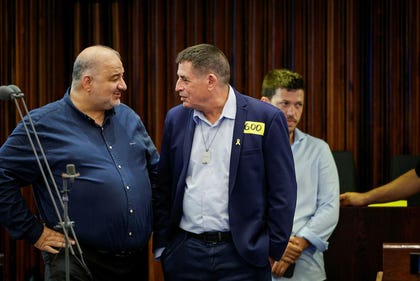
Yoav Segalovitz and Mansour Abbas in the Knesset in 2025. Credit: Noam Moskowitz/Knesset Spokesperson’s Office
Yoav Segalovitz and Mansour Abbas in the Knesset in 2025. Credit: Noam Moskowitz/Knesset Spokesperson’s Office
After the last four years, does the Likud seem like a Zionist party to you?
“There are many people in the Likud who served in the army and have Zionist views, but I think this alliance with the ultra-Orthodox parties is a serious mistake. The moment you form an alliance with non-Zionist parties, you are dragged into non-Zionist decisions. There’s no other explanation for how, just before the election, the government gives hundreds of millions to Haredi institutions with draft dodgers instead of to the wounded, to bereaved families, to the rehabilitation of communities in the south and north. There’s no logic or Zionist basis in this. This is what happens when you make a non-kosher alliance, an anti-Zionist alliance.”
The question “Who is a Zionist to you?” also arises when the party’s candidates meet with potential voters. At a meeting about two weeks ago in the Efrat settlement, Tropper was asked if he considered the Democrats party Zionist, and he replied in the affirmative. “In your reserve duty, don’t you have someone in your tank who votes for the Democrats? I can bring you plenty,” he said.
 Close
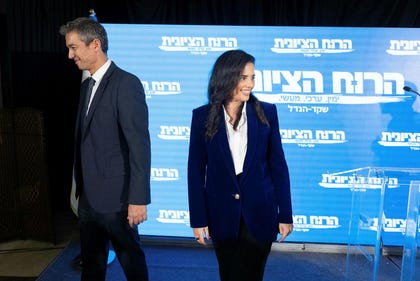
Hendel and Ayelet Shaked announcing their political party in 2022. Credit: Tomer Appelbaum
Hendel and Ayelet Shaked announcing their political party in 2022. Credit: Tomer Appelbaum
“Haredim, too,” someone from the audience replied, and Tropper qualified, “There are some Haredim.” He added that the problem is with their leadership. “I have a thousand disagreements with Yair Golan, but on October 7, he went to the front,” he said. “The Democrats’ leadership is Zionist.”
When he spoke about unity, an attendee remarked, “Bibi also says he wants a national unity government.” Tropper didn’t rule it out. “If a national unity government of Eisenkot, Bennett, Netanyahu, and Lieberman is formed, I’d certainly be part of that, but I don’t know how likely it is,” he said. He then mentioned that Netanyahu talks about a national unity government including the Haredim, commenting: “That’s an interesting definition of national.”
 Close
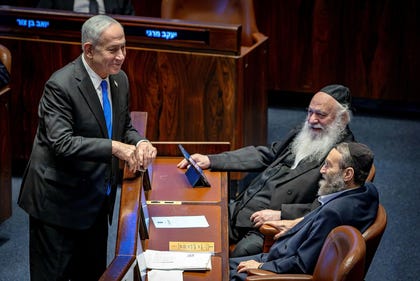
Netanyahu with Haredi MKs Yitzhak Goldknopf and Moshe Gafni in the Knesset after the vote to enact the Basic Law on Torah Study passed last month. Credit: Olivier Fitoussi
Netanyahu with Haredi MKs Yitzhak Goldknopf and Moshe Gafni in the Knesset after the vote to enact the Basic Law on Torah Study passed last month. Credit: Olivier FitoussiObstacle: The electoral threshold
Rachel Azaria, founding CEO of the HaOgen organization for reservist families, a former Kulanu lawmaker and a prominent liberal religious Zionists, wonders who a party like Zionist Home-The Reservists appeals to. “Some people find the rift in Israeli society very difficult,” she says. “It’s a values-based rift, but it’s created by the political structure, the politicians. These people understand this rift has a price. It’s a strong sentiment – we want to find a way to work together.” However, she admits, “Such parties haven’t really succeeded – not only electorally but also practically, like how Gantz agreed to sit with Netanyahu.”
One of the challenges for a party expressing these ideas, Azaria says, is the high electoral threshold. “This makes it difficult for ideas that could be important and have public support to be expressed, due to people’s fear that their vote will be wasted,” she explains. “Often, one needs to come with a new idea that needs time to germinate for significant political change to occur.” When the electoral threshold is high, the fear of failure often prevents such germination from happening at all. “If the electoral threshold were one or two seats, meaning one would need 35,000 or 70,000 voters, that would be more logical and would allow for an objective assessment of whether these ideas have an audience and potential.”