
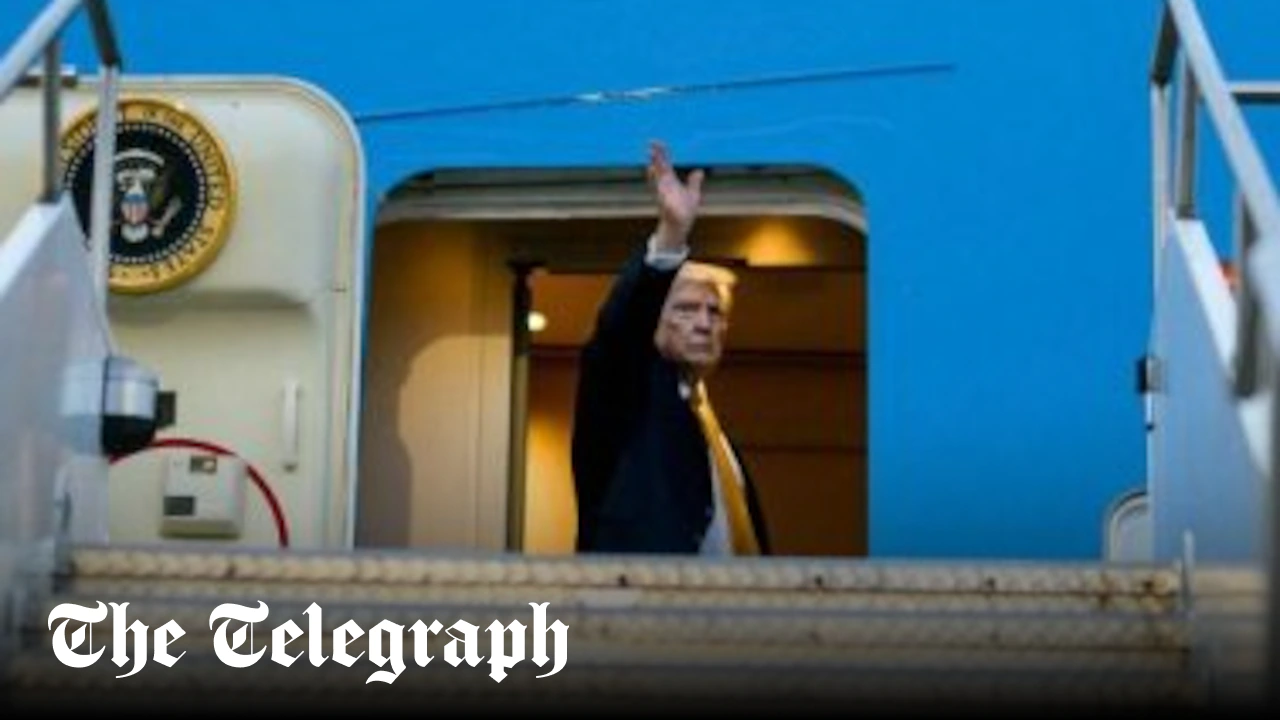
Pictures shared by the travelling press pool, the rotating group of journalists that accompany the president, show the unassuming catering truck lingering by Air Force One.
According to those on the ground, the event did not seem particularly out of the ordinary.
White House staff and journalists boarded the decoy aircraft in the usual manner and were greeted with bags of sweets bearing the presidential seal at their seats.
Among the journalists on board were ABC’s Michelle Stoddart, who acted as the TV pool producer, and Megan Messerly, a senior White House reporter from Politico, who acted as the print pooler.
Once on board, journalists were instructed to keep the window blinds closed. Moments before take-off, a Secret Service agent came back to the press cabin to remind journalists to keep the shades down.
At the time, Mr Trump suggested that this was done as a security precaution.
Blinds order ‘a deliberate ploy’
In hindsight, it seems like a deliberate ploy to prevent the travelling press corps from laying eyes on the president as he switched planes, which would have scuppered the plan.
David Axelrod, a former adviser to Barack Obama, said it was “stunning to think that all those on the [regular] plane were sort of a decoy, and were not told that the president wasn’t on board, and that the deception was continued even after he was safely returned to Washington”.
“That’s hard for me to understand,” he added.
Mid-flight, the decoy plane switched its transponder to broadcast the “AF1” call sign to draw attention away from the US president’s actual location.
On a 2000 trip from India to Pakistan, Bill Clinton’s presidential jet was used as a decoy while Mr Clinton travelled separately on an unmarked plane.
At the time, at least one journalist knew about the switch. When Air Force One touched down in Islamabad, a Secret Service agent who looked like Mr Clinton exited, keeping up the ruse.