
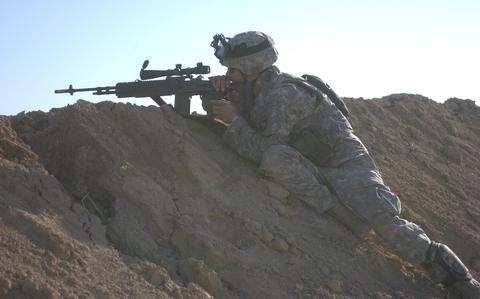
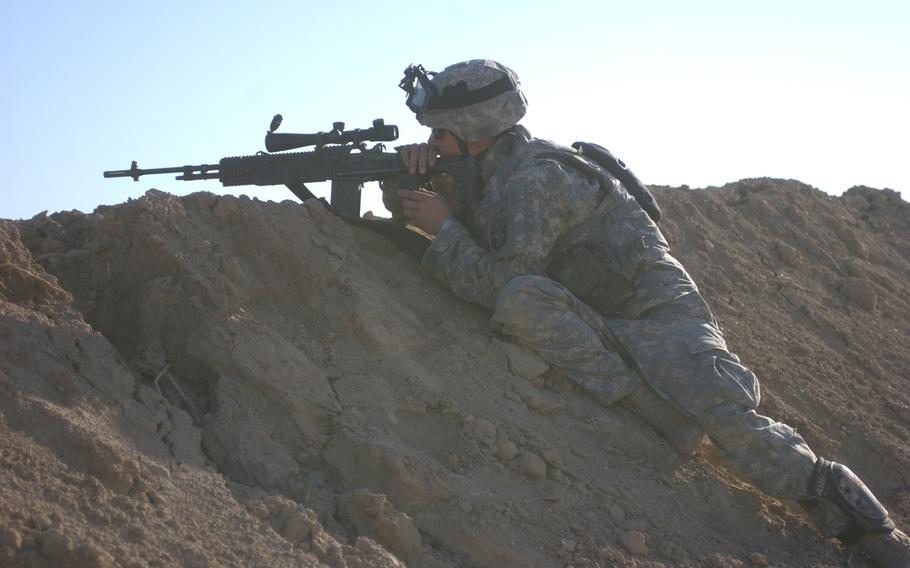
Spc. Brandon Griffis, Company A, 1st Battalion, 502nd Infantry Regiment uses his M14 rifle to scan for enemy insurgents during operation Glory Light in March 2006 in Iraq. (Karl Johnson/U.S. Army)
More than 100,000 Cold War-era M14 rifles will be sold to the public early next year by the federally approved distribution program.
The Civilian Marksmanship Program, a federally chartered nonprofit, plans to sell the rifles that were the mainstay rifle of U.S. armed forces between the World War II-era M1 Garand and the Vietnam-era M-16.
The rifles would sell for about $2,000 each, according to CMP. Buyers would be limited to two rifles per person.
“We will modify them, make them permanently and irreversibly semiautomatic, and then make them available for sale to eligible U.S. citizens,” CMP CEO Jerry O’Keefe said in a video statement marking the announcement.
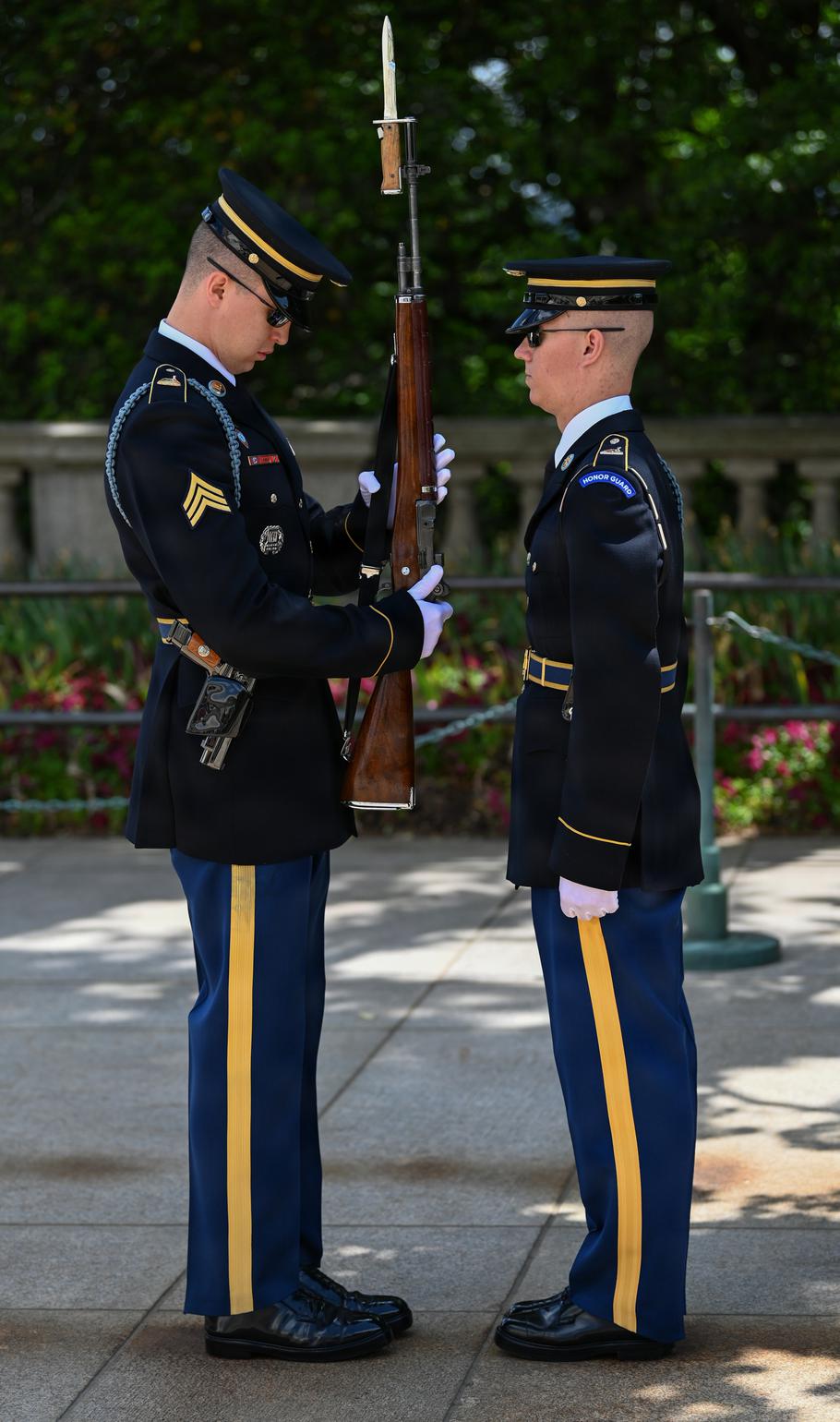
A U.S. Army Tomb Guard has his M14 rifle inspected during the changing of the guard at the Tomb of the Unknown Soldier, at Arlington National Cemetery in Arlington, Va., on April 30, 2026. (Robert Vondersaar/U.S. Army)
O’Keefe said the government would keep some for operational and ceremonial use. For example, the M14 is the rifle carried by the honor guard at the Tomb of the Unknown Soldier at Arlington National Cemetery.
“But they’re going to transfer the overwhelming majority of them to us, and we have a pretty good idea of what that number is,” O’Keefe said. “It’s going to be well over 100,000.”
The sales are expected to begin in January.
The rifle’s optional automatic-fire setting will be removed so that guns can only be fired semiautomatically — one bullet fired for each pull of the trigger. The government has to be satisfied that the guns are rendered unable to be converted back to automatic fire.
Developed after World War II, the M14 was meant to supplant not only the M1 Garand infantry rifle, but the M1 Carbine; Browning Automatic Rifle; M1 Thompson submachine gun; and M3 “Grease Gun” submachine gun.
The M14 was chosen as the American standard-issue infantry rifle in 1957. The U.S. bought 1.38 million M14s.
By that time, the rifle had received a chorus of criticism — too heavy and unwieldy when fired on full automatic.
Firearms expert John Lachuk, writing in Gun Digest in 1965, called it a “monumental mechanical failure for U.S. Army Ordnance.”
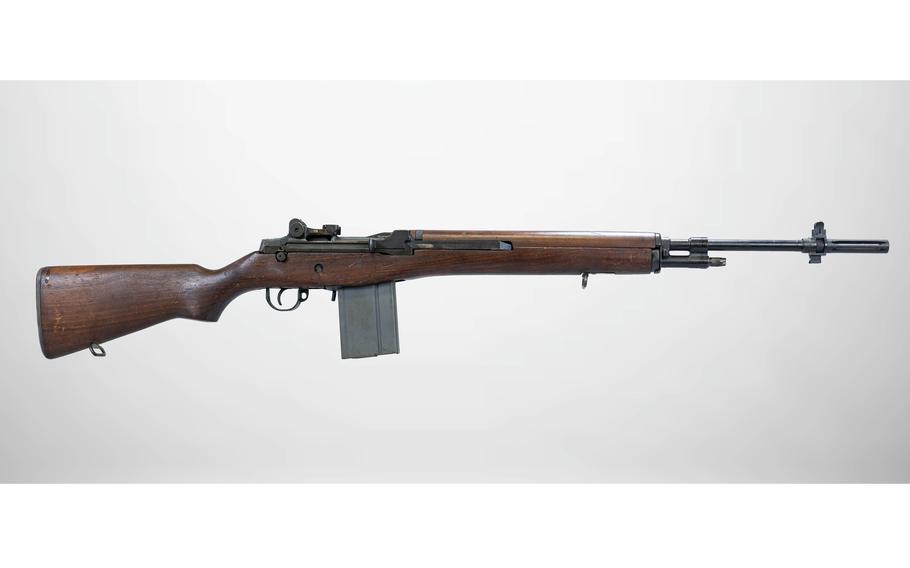
An M14 displayed at a National Museum of the Marine Corps in Quantico, Va., July 1, 2025. (James Stanfield/U.S. Marine Corps)
By 1967, Defense Secretary Robert McNamara killed the military procurement of the M14 in favor of the lighter M-16, which would become the signature U.S. infantry weapon of the Vietnam War. More than 8 million M-16s were manufactured according to Colt, the main manufacturer.
The CMP has previously been the intermediary for sales of formerly military M1903 Springfield and M1 rifles, M1 carbines and 1911 .45 semiautomatic pistols.
The Army had transferred more than 700,000 surplus rifles and pistols through the CMP for sale to the public, according to a 2019 Government Accountability Office report. The total sales at that time were $196.8 million, the report said.
CMP was chartered in 1903 to promote marksmanship training among civilians. Since 1996, its been a private nonprofit. Profits from the sales go to promoting firearms safety, gun proficiency training, marksmanship contests and outreach to youth groups.
Along with the M14, CMP will also sell a limited number of refurbished military shotguns in the coming months a limited number of refurbished military shotguns.
“We’re expecting between 2,000 and 3,000 shotguns from the Army,” O’Keefe said, “and 438 of those are the 1897 Winchester trench shotguns. Those are magnificent pieces of history, and we can’t wait to see what those look like.”