
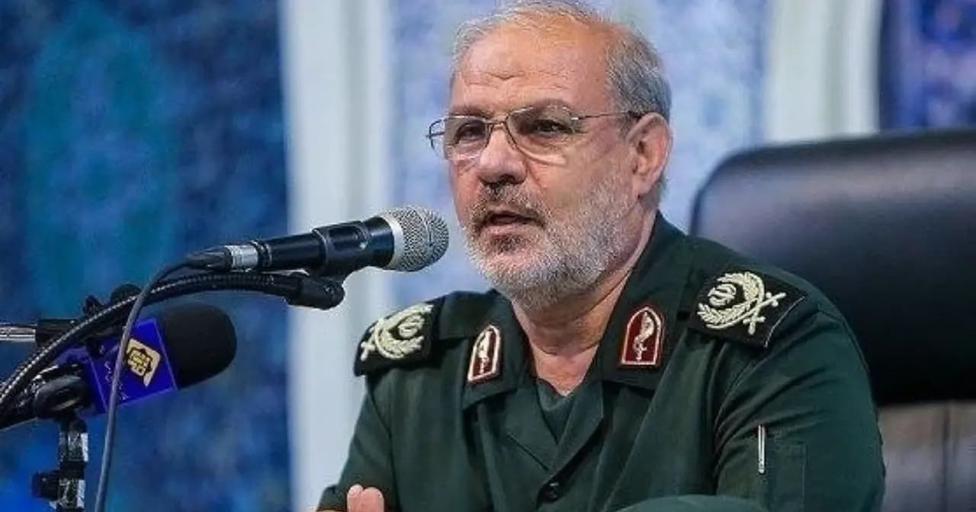
Hossein Mohebbi, spokesperson for the Islamic Revolutionary Guard Corps (IRGC), has threatened that, in the event of a renewed attack on Iran, energy transmission lines, power plants, U.S. and non-U.S. systems, and internet-connected global infrastructure will be targeted.
Concurrently, Mohammad Reza Naqdi, advisor to the IRGC Commander-in-Chief, announced a shift in the organization’s doctrine from “defensive” to “offensive,” stating that the IRGC must prepare to conduct operations on foreign soil.
Speaking on Tuesday, August 11, at an event in Qom, Mohebbi stated that if threats against the Islamic Republic materialize, Iran’s response will not be limited to military targets alone. He asserted that energy transit lines, power grids, and internet-connected systems are all vulnerable, adding that the Islamic Republic will take retaliatory measures against any threat. The IRGC spokesperson further claimed that hundreds of thousands of miles of energy transmission lines, thousands of power plants, and all U.S. and non-U.S. systems could serve as targets. In another part of his remarks, Mohebbi claimed that no U.S. warships are currently present in the waters of the Persian Gulf.
These statements coincided with remarks by Mohammad Reza Naqdi regarding the shift in the IRGC’s military doctrine. Speaking on Iranian state television, Naqdi said the decision had been made to move from a “defensive” to an “offensive” doctrine, noting that recent appointments of senior IRGC commanders were made specifically to prepare for the implementation of this policy. He stated that the IRGC must be capable of executing “smart operations” inside foreign countries and, if ordered, bringing the war directly to “enemy” territory.
According to the advisor to the IRGC Commander-in-Chief, the new doctrine relies on “hybrid warfare,” utilizing military capabilities alongside diplomacy, propaganda, economic leverage, and social resources to achieve common objectives. Naqdi also claimed that the Islamic Republic’s missile and drone production rates exceed its consumption rates, asserting that the IRGC’s missile stockpiles will not run out even if the war continues for several years. While acknowledging that the U.S. possesses capabilities that Iran lacks, he claimed that the indigenous nature of Iran’s weaponry allows for technical modifications during battle.
The IRGC officials’ remarks came one day after U.S. President Donald Trump stated that he does not trust the Islamic Republic, accusing its officials of “lying” to him. Trump also claimed that the Strait of Hormuz is under the control of the U.S. Navy and that Tehran exercises no control over the waterway, a claim that conflicts with Tehran’s stance on managing the strait, as well as the IRGC spokesperson’s assertion regarding the absence of U.S. vessels in the Persian Gulf.
Tensions persist as the United States continues the second phase of its naval blockade on Iranian ports and coastal areas, initiated on July 14. CENTCOM previously announced that during this period, U.S. forces had diverted 51 commercial vessels, disabled two ships, and inspected two others. Meanwhile, Islamic Republic officials have repeatedly threatened in recent weeks that the Strait of Hormuz will not return to pre-war conditions until the U.S. accepts Tehran’s terms.