
NATO plans to send new weapons to the Pacific and pose a “threat to Russia” in the region, Russian President Vladimir Putin said on Wednesday.
“Unfortunately, the potential for conflict is growing here,” the Kremlin leader said, according to state media readouts. “NATO is making inroads here.”
It’s not clear which weapons systems Putin was referring to, but the United States, NATO’s most influential member, is moving its attention toward the Indo-Pacific as China’s military swells.
Read More on World
The U.S. permanently deployed advanced F-35 fighter jets, which are capable of launching some of the most sophisticated weapons in the U.S. arsenal, to northern Japan for the first time in late March and test-fired a long-range missile from a Typhon system in the Philippines in May. The Typhon system, also known as the Mid-Range Capability, fires Tomahawk cruise missiles able to travel roughly 1,000 miles and the U.S.’s shorter-range SM-6 missile.
Other NATO states have sent ships, planes and troops for rotations in the Pacific this year. Italy sent a ship specializing in air defense to the region in early May.
Thirty nations, including NATO members, also carried out joint exercises with the U.S. Pacific Fleet until the end of July.
Although many of the U.S.’s allies have been rattled by President Donald Trump and his administration’s hostility toward the U.S.’s traditional partners, North Korea’s burgeoning nuclear and missile programs—as well as its new closeness to Russia— have pushed countries like Japan and South Korea to surge their military spending while remaining enmeshed with the U.S.
“New weapons systems that also create threats to our country are being deployed and are planned for deployment here,” Putin said on Wednesday.
A NATO spokesperson told Newsweek the alliance is purely defensive and “poses no—zero—threat to Russia.”
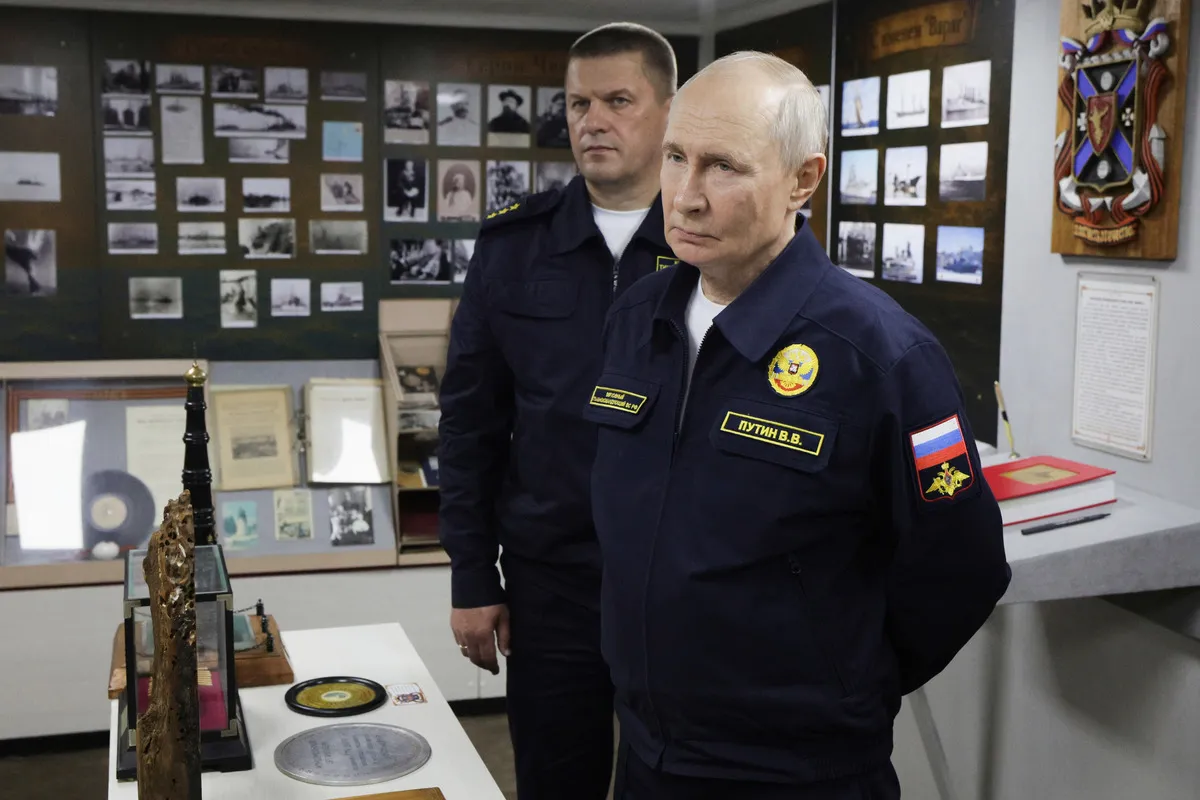
Putin was observing Russia’s Pacific Fleet carry out drills near Yuzhno-Sakhalinsk, the largest city on Sakhalin Island, which sits just north of Japan.
Last week, it emerged that Russia had placed new anti-drone nets at its Rybachiy submarine base, the main hub for its Pacific Fleet in the country’s far eastern Kamchatka Peninsula. Rybachiy is home to much of Russia’s nuclear submarine fleet, including those capable of firing nuclear-armed weapons.
Russia has draped nets over more of its submarines at the site, Business Insider reported, in the months since May, when satellite imagery showed two submarines covered in anti-drone protection.
Roughly 4,600 miles from Ukraine, Kyiv is unlikely to be able to launch the type of drone attacks it has coordinated to menace Russia’s Black Sea fleet in annexed Crimea and at Novorossiysk, in mainland Russia.
But the move does indicate an anxiety among Russian officials that its high-value, advanced submarines could be at risk of an operation like Ukraine’s now-infamous Spiderweb in June 2025.
Kyiv planted and remotely detonated drones near Russian airfields and said it had damaged 41 Russian aircraft during the mission, which was 18 months in the making. Ukrainian President Volodymyr Zelensky said on Wednesday that Ukraine had struck the Novorossiysk naval base overnight using jet-powered drones, Neptune long-range cruise missiles and unmanned boats.
The base is over 180 miles from the front lines of southern and eastern Ukraine, Zelensky said, and is “the last major stronghold of the Russian fleet in the Black Sea.”
After repeated Ukrainian strikes on Sevastopol, the main Russian Black Sea fleet base in Crimea, the Kremlin started moving its ships to Novorossiysk, another base further away from Ukraine but still in the Black Sea.
Moscow annexed Crimea from Ukraine in 2014, and Kyiv has vowed to reclaim the territory.
In March 2024, the British Defense Ministry shared a satellite image it said showed one of Moscow’s Kilo-class submarines with a smaller, decoy silhouette drawn alongside it at Russia’s Novorossiysk base in an attempt to disrupt Ukrainian attacks.
Contact Newsweek editors on this story: Tobias Meyjes and Sam Wilson.