
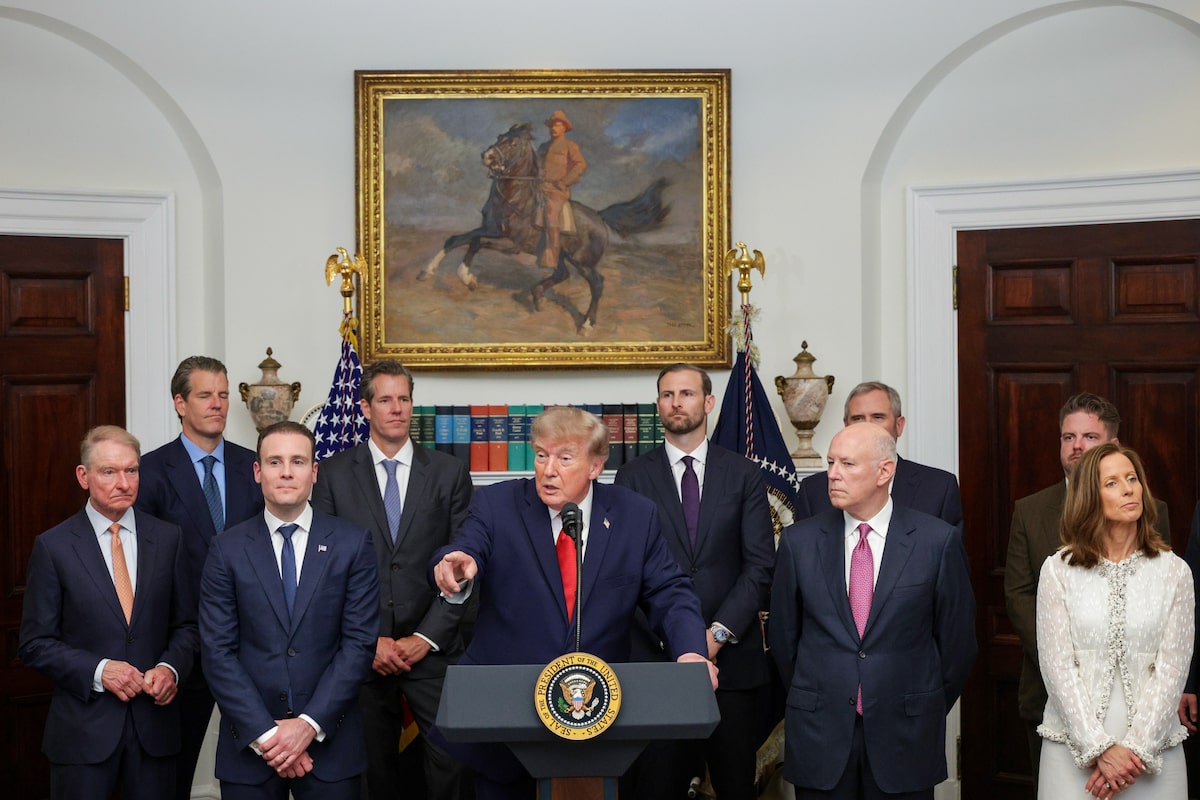
U.S. President Donald Trump delivers remarks, joined by (from left to right, front) chairman of the U.S. Securities and Exchange Commission Paul Atkins, Commodity Futures Trading Commission chairman Michael Selig, chairman of the NYSE and CEO of Intercontinental Exchange Jeffrey Sprecher, and Nasdaq CEO Adena Friedman, during a summit of crypto and technology leaders, in the White House, on Wednesday.Alex Wong/Getty Images
For the better part of two years, U.S. President Donald Trump has behaved as though he can push Canada around without consequence.
The language of the President, and his inner circle, hasn’t left much room for nuance.
Mr. Trump: “Canada’s nasty. One of the nastiest countries to deal with.”
Senior trade adviser Peter Navarro: “Some of the most dishonest people I’ve ever met.”
Commerce Secretary Howard Lutnick: “They suck.”
Since Mr. Trump returned to the White House last year, it has felt to many in Canada like they are under siege from a country suddenly hostile to its very existence. This sentiment is echoed by the MAGA faithful who seem to blame Canada for all the ills of the world.
Campbell Clark: What’s on the table? Trump’s talk doesn’t sound quite like Canada’s
His anti-Canada campaign is based in the belief that there is only upside, no cost – either economic or political. So why not tariff at will? Antagonize the entire country while you’re at it. It’s not like he’s faced an outpouring of resistance stateside. Even if they oppose the trade war, few U.S. business leaders have dared go out on a limb for the sake of their northern neighbours. They have been mostly silent, too afraid to speak out against a vengeful president.
But there are downsides and they’re getting harder to ignore, especially for a deeply unpopular President vulnerable to pocketbook issues.
The costs to the U.S. of poisoning its relationship with Canada are measurable. We see them in high U.S. inflation, the billions lost to U.S. tourism, disrupted trade with border states dependent on the Canadian market, a major hit to the bottom line of Detroit’s automakers, and the collapse of exports for the American booze industry.
Increasingly, Americans with the most to lose from a continental rift are pushing back.
A few weeks ago, the United Steelworkers – one of the largest private-sector unions in the U.S. – made waves when it broke with Mr. Trump over his treatment of Canada, saying the latest tariff threats could “drive a further wedge between our nations.”
Opinion: Trump thinks tariffs will tear Canada apart. The evidence proves him wrong
U.S. automakers have also been quietly pressing the case that tariffs harm their competitiveness. Tariffs cost them US$12.5-billion last year alone, according to one report. New rules requiring a minimum of 50-per-cent U.S. content to qualify for lower tariffs would add another US$2-billion in annual costs for each company, according to another.
Canada has more friends in American business and politics than perhaps we realize. A slew of American policymakers have also recently spoken up in Canada’s defence after Mr. Trump’s latest tariff salvo.
“Canada is Kentucky’s No. 1 trading partner, and they have been a good trading partner,” Kentucky Governor Andy Beshear said in an interview this week on CNN.
“But because he has demeaned them, because he has questioned their sovereignty, they have taken Kentucky bourbon off their shelves, which hurts our economy.”
Frustration is mounting, largely because Mr. Trump’s treatment of Canada is harming Americans.
“Our tourism is down about 40 per cent,” Vermont Senator Peter Welch said at a U.S. Senate hearing last month. “A lot of that has to do with the rhetoric that the President has used.”
Canada plays with a weak hand against Trump. Ottawa’s making it worse
Travel boycotts have clearly left a mark, with Canadians making 7.1 million fewer trips to the U.S. in 2025 than the year prior.
Same goes for provincial alcohol bans. One U.S. industry group said liquor exports to Canada were down 73 per cent last year. Wine shipments have dropped by 78 per cent since 2024.
And of course, tariffs on Canadian goods entering the U.S. are themselves a tax borne by the American consumer. A U.S. Federal Reserve study found that there was nearly a dollar-for-dollar pass-through from tariffs to goods prices. The cost to the average household is about US$1,200 a year, according to Yale University’s Budget Lab.
Mr. Trump has done his best to turn Americans against Canada. The question heading into midterm elections is, how willing are voters to foot the bill for the President’s economic war of choice?