
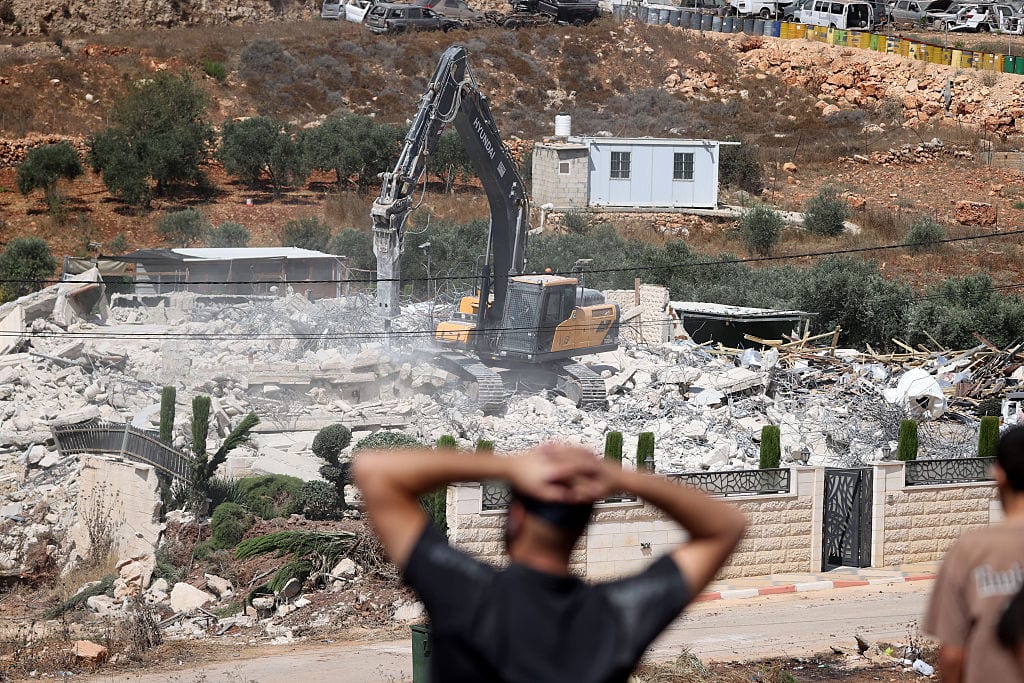
Many rely on those advocacy efforts. Yusra Qwaider, a 97-year-old Palestinian bed-ridden in al-Bustan, recently told The Guardian that she had been served a notice of her home’s imminent demolition. Her doctor warns that removal will kill her, a brutal end to a life spent searching for safety. Born in Jaffa, Israeli militias forcibly displaced her family during the 1947-49 Nakba that displaced hundreds of thousands of Palestinians upon the creation of Israel. Her family was again violently and forcibly displaced from Yalo, near Amwas, during the 1967 Six-Day War that established today’s illegal occupation and apartheid system, to Jerusalem’s Old City and, finally, Silwan. Where will she go now?
Al-Bustan’s community is tightly knit by extended families. Twenty years of negotiations through lawyers and in direct meetings with the municipality were recently called off by the authorities, who now deny residents any alternative accommodation or compensation as they face the loss of their homes. Years of meetings with town planners, costing the community tens of thousands of dollars, promises by successive mayors not to demolish and false pledges that the government would respect their land rights are over.
Officials have stepped up demolition orders, giving residents two options: government demolition or self-demolition. The latter option saves Palestinian residents the substantial expense of bulldozers, plus police overtime and their lunches, which are charged to homeowners. Yet certain costs cannot be avoided. Fines are levied for “illegal building,” averaging $35,000. Expenses to build and furnish a new home are substantial.
Imagine the feeling of taking a sledgehammer to your home’s kitchen, bathroom or child’s playroom. Each demolition generates a legacy of understandable hatred on which terror thrives. That may explain why the Border Police, a semi-military force policing East Jerusalem, including demolitions, operates within the Israeli Ministry of Defense. Their surveillance cameras’ gaze is so invasive that it feels like you are being watched while sleeping.
Many visitors understand the plight of the residents of al-Bustan. There is a warm solidarity from Global South diplomats, who perhaps sense an affinity with their communities. Yet they also experience the loud music and aggressive behavior of Jewish settlers increasingly taking up residence here, a reminder that they refuse to join the community as good neighbors. Asked why they have taken over the homes of long-standing residents, they respond: “But they built illegally!” Of course, the overused line ignores that 13% of East Jerusalem zoned in 1968 for Palestinian residence was almost fully built upon already.
The settlers, coordinating closely with the Israeli state, work overtime to ensure that Jerusalem is a city where coexistence is denied. They hope to establish Greater Jerusalem, a Jewish-only entity defined by apartheid policies that extend to planning, demolitions, services, road systems, affordable housing, evictions, legal systems and policing. In this reality, Palestinians are told that they are unwelcome in their homes, communities and land, across all aspects of society.
As an Israeli witnessing these developments firsthand, I sense that today’s Israel bears only a dim relationship to Judaism’s core values.
Israel has repeatedly proven its rejectionist foundation. It has rejected the internationally recognized two-state solution, just as it rejects sharing Jerusalem with Palestinians, let alone any genuine effort to create a viable Palestinian state. In doing so, it signs its own death warrant as a sustainable society integrated within the international community, hailed as a liberal democracy with citizens welcomed throughout the world.
Rahm Emanuel, an American politician and long-standing supporter of Israel, last month warned Israelis that their country has become a territorial pariah. His speech echoed an earlier warning by Vice President JD Vance to Israel: “You cannot just kill your way out of solving every single national security problem.” It should speak volumes that two prominent U.S. politicians, traditionally very pro-Israel in rhetoric and action, now criticize the Israeli state.
It does not. Rhetoric alone has long failed to end the nightmare that Palestinians have faced for decades. The international community’s statements of concern, or outright complicity in Israel’s genocide of Gaza, after 77 years of Israeli impunity, stain our collective conscience. Until the world commits to action, leveraging accountability and justice mechanisms for Palestine, Israel will continue its downward spiral toward global isolation as Palestinian suffering worsens.
Today’s Israel is often cited as the Third Temple, yearned for by Jews worldwide for generations. Yet many Jewish readers may now hear the tragic echoes of 70 CE, when decades of Jewish messianic hubris led the Roman Empire to destroy the Second Temple and, 65 years later, enforce Jewish exile from Jerusalem. What irony, then, that in forcing Palestinians to take a sledgehammer to their homes today, Jewish messianics — including Kahanists Bezalel Smotrich, Itamar Ben Gvir and Arieh King — are slowly but surely destroying the foundations of the third temple they hoped to rebuild.
The views and positions expressed in this article are those of the author(s) and do not necessarily reflect the views of DAWN.