
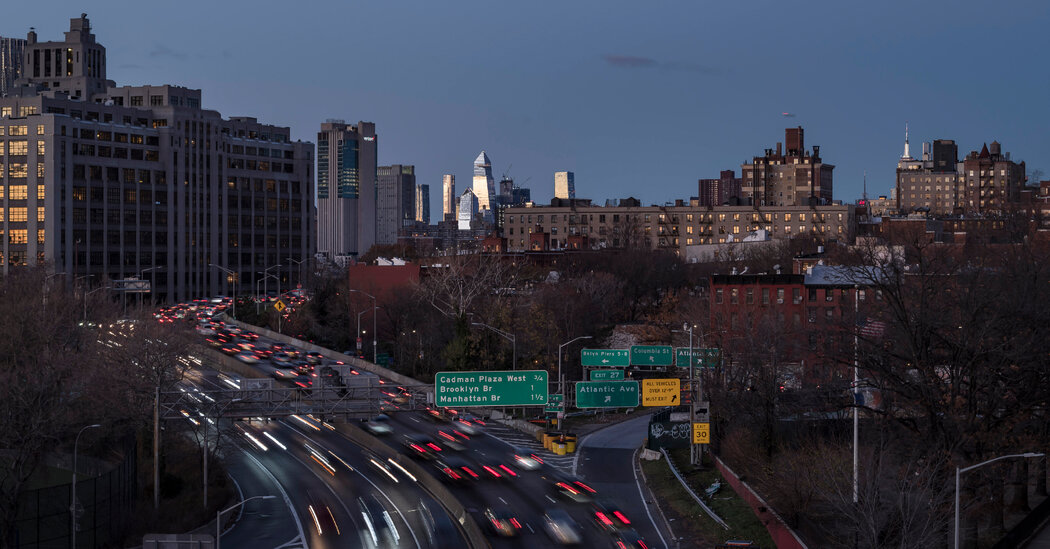
New York City announced plans on Monday to finally rehabilitate a beleaguered section of the Brooklyn-Queens Expressway, a heavily trafficked highway that has been crumbling for years.
The highway, widely known as the B.Q.E., has plagued generations of mayors and transportation departments with its unique, triple-cantilever design that strains to accommodate the amount of traffic that has come to depend on it.
The announcement on Monday detailed a multiphase plan set to take place between 2030 and 2040 to shore up the 70-year-old roadway, including building temporary bypasses alongside it that are no taller than the existing structures in order to limit neighborhood disruption. Parts of the Brooklyn Heights Promenade, a beloved and heavily used walkway, will be closed during construction. The project is expected to cost roughly $4 billion.
The city’s plans pertain to what officials refer to as “B.Q.E. Central” — the 1.5-mile stretch of the highway that is city-owned. The city controls 12 percent of the B.Q.E., all in Brooklyn between Atlantic Avenue and Sands Street, and the state owns the rest, officials said.
“Time is up,” Mike Flynn, the transportation commissioner, said in a statement. “After decades of kicking the can down the road and indecision that failed to yield substantial results, we will act with urgency to rehabilitate the city’s portion of the B.Q.E.”
With Monday’s announcement, Mayor Zohran Mamdani is following through on a promise he made last year, before taking office: that he would find “a permanent solution for the city-owned sections of the B.Q.E. that both meets community needs and preserves this essential transportation corridor.”
The highway, which opened in 1957 and had a 50-year design life, was designed for far less traffic than it now receives. In 2016, the city announced that the triple cantilever section in Brooklyn Heights needed to be completely overhauled. While the highway remains safe to drive on — for now — it requires quick action to keep it that way, officials said.
“This plan allows us to safely fix the B.Q.E. without slowing our city down or wasting decades more on magical thinking,” Mr. Mamdani said in a statement. “The cost of inaction is too high, and the risks to New Yorkers are too important to delay any longer.”
After Mr. Mamdani’s announcement, a group of local elected officials, including State Senator Andrew Gounardes, Assemblywoman Jo Anne Simon, and City Councilman Lincoln Restler, said in a statement that they were “encouraged” by the proposal.
But they described it as “the beginning of a multiyear approval process” and said they wanted the mayor’s office to work with the community to “collaboratively revise this proposal.”
“We are concerned about such an invasive and disruptive construction approach and are worried about the damaging impact of temporary highways in our dense neighborhood,” the lawmakers said.
Smaller steps have been taken along the way, as officials grappled with a long-term solution. Traffic was reduced to two lanes, and a weigh-in-motion program that weighs vehicles on the roadway as they drive has reduced overweight vehicles by 60 percent since 2023. The Transportation Department has also undertaken several rounds of interim repairs.
Another issue is that there are very few options for rerouting traffic, since there are no parallel routes along the highway. Diverted cars and trucks would have to instead clog local streets.
The B.Q.E. cuts through the heart of many dense, busy neighborhoods, which has compounded complications with its aging state and unique design. The triple-cantilever portion in Brooklyn Heights is particularly difficult to rebuild without cutting off access to the promenade above it.
The current plan has a 40-year design life. It involves building a temporary, two-level highway bypass on top of Furman Street next to the existing highway, below the promenade, from Atlantic Avenue to Columbia Heights. Nick Benson, a spokesman for the Department of Transportation, said in an email on Monday that “at least some portion of the promenade will be open at all times during construction.”
“Portions will be closed at various points,” he added. “Work has to be done on the promenade itself, so it’s unavoidable. But, every effort will be made to do it in phases so that there is always some level of access to the promenade.”
Julia Kerson, the deputy mayor for operations, said in a statement that repairing the B.Q.E. was essential for the city’s economic health and civic life.
“Without significant rehabilitation, B.Q.E. Central will continue to weaken, more and more cars and heavy trucks will be forced onto local streets, key freight transportation networks will be disrupted and the cost to the city will continue to rise,” she said.
The highway was designed by Robert Moses, the controversial former parks commissioner who transformed the city through many public works projects.
“When Moses built this thing, it was not going to last forever,” Polly Trottenberg, the former transportation commissioner under Mayor Bill de Blasio, said in an interview. “No one would build anything like it now. It violates so many principles of engineering.”
Lara Birnback, the executive director of the Brooklyn Heights Association, said she was happy the Mamdani administration was interested in taking action to repair the crumbling roadway.
But she said the proposal did not do enough to “move us away from the Robert Moses era, which is about privileging cars and trucks and creating pollution that poisons New Yorkers.”
She called the plan “a hugely disruptive, hugely expensive way to really just repair an infrastructure relic that at the end of the day leaves us with the crummy status quo we have now.”
The state ownership of portions of the highway can be attributed to Mr. Moses and his unique portfolio, Ms. Trottenberg said. At the height of his power, Mr. Moses ran multiple agencies, both city and state, both transportation-related and parks-related. After he left his posts, parts of his projects were left with the state and parts with the city, which is how the city came to own this single, mile-long section of the B.Q.E., she said.
As a result, discussions surrounding any revamp of the roadway have involved three levels of government — city, state and federal, Ms. Trottenberg said. Most interstates around the country, in contrast, would be solely owned by the state in a vast majority of cases.
The current rehabilitation plan, Ms. Trottenberg said, “leaves the door open for what I would describe as when the stars align — you need the city and the state and the federal government together to figure out some of the bigger problems.”
“Let’s be optimistic in the long run,” she said. “The stars will align.”