
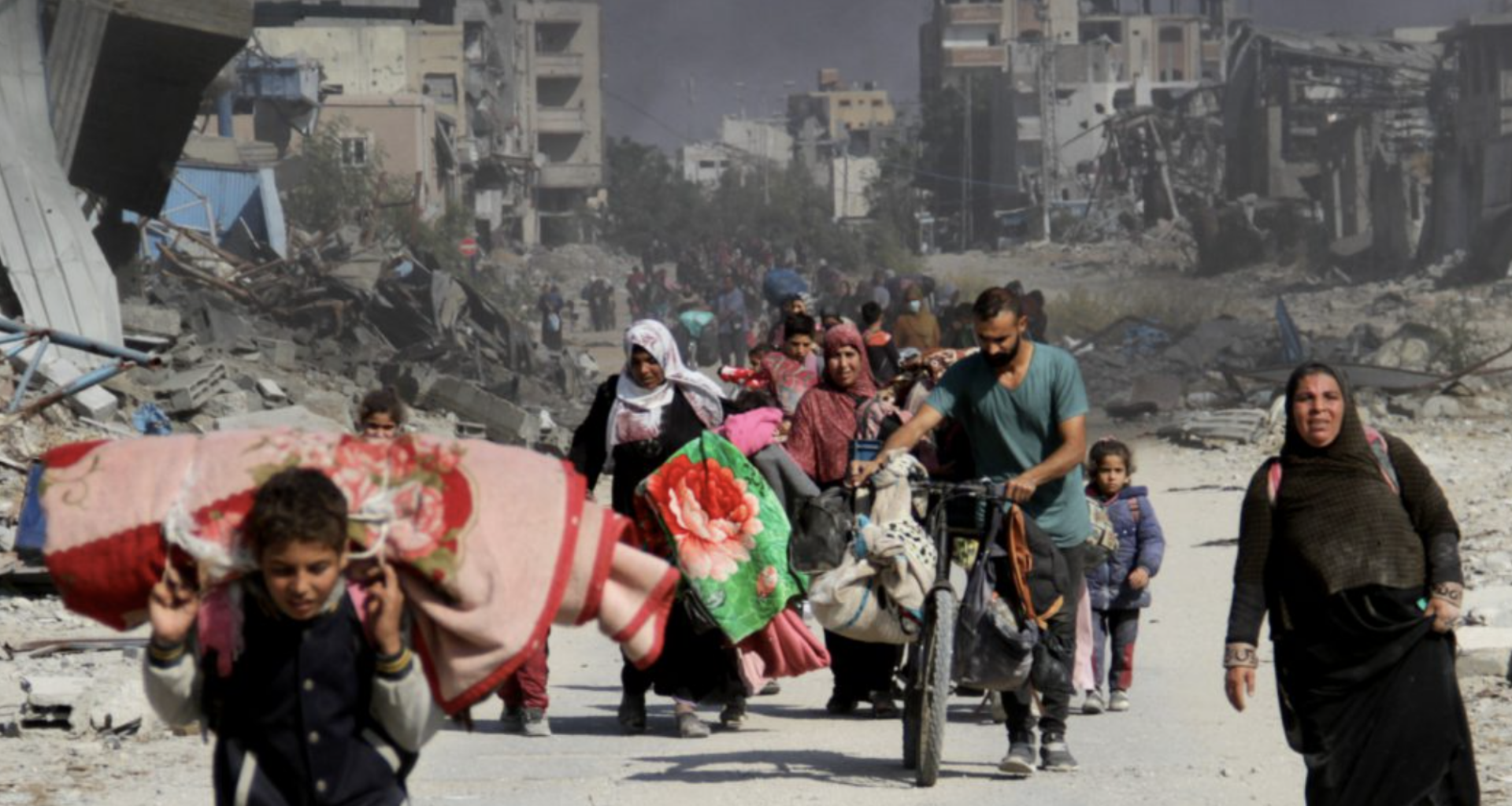
Israel: What Went Wrong (Farr, Straus and Giroux, 2026) by Omer Bartov is a difficult book to read if you have any positive feelings toward Israel. I am writing this review for people who will never read the book, including some of my family members, hoping they will at least think about some of things that he raises. Bartov condemns the savagery of the Hamas attack on Israel in October 2023 as a war crime, but also argues that “resisting oppression and dehumanization, including by force of arms, is not only understandable but also legal under international law, especially when it forms part of a struggle for national self-determination” (21). At the end of this review I include excerpts from three newspaper reviews, two that share my view of Bartov’s positions and one that radically disagrees with him.
Bartov is the Samuel Pisar Professor of Holocaust and Genocide Studies at Brown University. He was born in Israel in 1954, six years after it declared independence. He served as a company commander in the Israel Defense Forces (IDF) during the 1973 Yom Kippur War when he was only nineteen and was severely wounded during a training accident in 1976 while a reservist. During the Yom Kippur War, Bartov was stationed in Gaza, on the West Bank, and in occupied areas of Egypt, and by observing others he first began to understand the impact of occupation on people (8).
Bartov is a graduate of Tel Aviv University and received a Doctor of Philosophy from Oxford University in Great Britain. At the outset of the Israeli assault on Gaza following the brutal October 2023 attack by Hamas, Bartov was reluctant to describe the Israeli action as genocide. However, as early as November 2023, he warned that Israeli military action in Gaza had created a humanitarian crisis that could spiral into genocide. By June 2024 Bartov was convinced that Israeli actions in Gaza had reached the level of genocide. In a July 2025 opinion piece in the New York Times, he argued that the level of death and destruction in Gaza, the forced displacement, of Palestinians, and official Israeli government statements on Gaza and Palestinians met the legal criteria for an accusation of genocide as defined by the 1948 Convention on the Prevention and Punishment of the Crime of Genocide.
In the introduction, Bartov tells readers his goal in writing the book is to explain the “transformation of Zionism, a movement that sought to emancipate European Jewry from oppression and persecution, into a state ideology of ethno-nationalism increasingly focused on the exclusion and violent domination of Palestinians under Israeli rule.” He asks: “How is it possible that a state founded in the immediate aftermath of the Holocaust stands today credibly accused of perpetrating large-scale war crimes, forcible displacement of civilian populations, and crimes against humanity?” (3).
Bartov is a product of the Zionist dream of Jewish emancipation but recognizes that it was achieved at the expense of Palestinians and the creation of a settler colony initially under the aegis of the post-World War I British Mandate (12-13). He argues that to ensure a Jewish majority in the new State of Israel, Jewish forces expelled most of the Palestinian population, known by Palestinians as the Nakba or catastrophe, from the area they controlled during and following the War for Independence (14). In what is certainly a controversial position Bartov describes both the Holocaust in Europe and the Nakba in Palestine as nationalist efforts to eliminate unwanted populations to secure an ethno-nationalist state (15).
Bartov believes that Zionism was transformed as soon as it became the official Israeli state ideology losing it democratic, liberal, and socialist roots (16). The Holocaust, as part of this state ideology, was no longer something of the past, but because of antisemitism and hostility from the Arab world remained an imminent threat to Jewish survival that the Jewish State had to prevent at any cost (17). As part of this state ideology, because the world had not intervened to protect European Jewry from annihilation, Israel had no obligation to accept criticism of its actions from other countries. Bartov argues that American Jewish identification with Israel is often based on an idealized version of the Israeli state supported by intensive propaganda efforts including the claim that it is protecting the Jewish people from another Holocaust and ignores what has been done in Israel in the name of Zionism (81).
This state ideology justifying Israel’s treatment of Palestinians was reenforced by the occupation of the West Bank and Gaza after the Six-Day War in 1967 as Israel governed an area with seven million Palestinians who were denied any civic rights (18). Bartov quotes Martinique author Aimé Césaire that “Colonization works to decivilize the colonizer, to brutalize him in the true sense of the word, to degrade him, to awaken him to buried instincts, to covetousness, violence, race hatred, and moral relativism.” As the colonizer “gets into the habit of seeing the other man as an animal, accustoms himself to treating him like an animal” he transforms himself into an animal capable of the worst atrocities. As a result of colonization, poison is “distilled into the veins” of the country and it “proceeds towards savagery” (18-19). Bartov argues that what Césaire described is the process taking place in Israel since its founding and the initial expulsion of Palestinians, a process intensified by the occupation, and is the reason Israelis have been “indifferent to the massive death toll in Gaza” (20).
Bartov considers the United States complicit in Israel’s genocidal war on Gaza because Israel was only able to sustain the occupation and the war with U.S. funding and weapons and be shielded from international reprisals. He is critical of both Democratic and Republican administrations and believes that if Joseph Biden had refused to support the Israel assault on Gaza in December 2023, genocide could have been averted (28). When Donald Trump became President, the United States continued to provide Israel with financial and military support even when it was clear that Israel under Netanyahu wanted no resolution short of the destruction of Gaza and the removal of the Palestinian people and he was undermining U.S. proposed peace agreements. Prior to the war, Hamas was considered an Israeli “asset” by the Netanyahu government because it could be used as proof that a settlement with Palestinians and creation of an independent Palestinian State was an impossibility (23). After October 2023, the attack by Hamas became a new justification for denying Palestinian statehood, the total destruction of Gaza, and expanded settlements on the West Bank.
While Bartov hopes for an eventual humane resolution of the conflict between Israelis and Palestinians, he fears that it is unlikely. As Israeli actions become more extreme and the Israeli public becomes even more entrenched in its acceptance of its treatment of Palestinians, he
does not believe change in Israel will come from within. Bartov fears a more likely scenario is that Israel will tighten its undemocratic apartheid regime and turn against its own citizens, Jews and non-Jews, who oppose its policies. He argues this would lead to an exodus of liberal, educated, and professional Jews from Israel, increased antisemitism globally, international isolation, and an eventual implosion, similar to the one that led to the collapse of the white minority apartheid government in South Africa (25).
Bartov is very critical of the International Holocaust Remembrance Alliance (IHRA) definition of antisemitism because it essentially equates all criticism of Zionism, settler colonialism, the occupation, and Israeli policy in Gaza and the West Bank with antisemitism. He charges that “The memory of Nazism’s victims is therefore being cynically employed to portray critics of the Jewish state’s mounting breaches of international law as antisemites.” (58). This is especially the case in the United States where the Trump administration, supported by powerful university donors and trustees, are using the IHRA definition as part of an assault on academic freedom on American college campuses. Bartov acknowledges that some of the protests against Israeli actions in Gaza crossed the line into antisemitism, but this was not the main thrust of protests, and he blames Israeli war crimes in the name of protesting Jews for any uptick in actual antisemitism (78). He is also angered by the willingness of the Netanyahu government to work with rightwing regimes that are supposed allies of Israel even though their movements actually harbor antisemitic elements (60-61).
Bartov dedicates a chapter to discussion of the implications of the World War II Holocaust that killed six million European Jews and led to the creation of the State of Israel. In the chapter he addresses a series of questions including whether the Holocaust was unique, the meaning of the slogan “Never Again,” and the role it has played in the history of Israel. Bartov argues that the Nazi mass murder of Jews is only one of a series of genocides in the 20th and 21st centuries starting with German efforts to exterminate the Herero people of southwest Africa and the mass murder of Congolese by Belgium in the first decade of the 20th century and the murder of Armenians in the collapsing Ottoman Empire during World War I. He calls “the claim of historical uniqueness . . . both a truism and a contradiction in terms. It is a truism because no historical event is precisely the same as any other. It is a contradiction in terms because any historical event occurs within a context and can be understood only by tracing its roots, comparing it to related events, and evaluating its relationship to other simultaneous developments.” If Germany had not invaded the Soviet Union, the Holocaust might not have occurred, and if it did, it would have been of a different magnitude (91). The German “Final Solution” had some “unique features,” but unfortunately it was only one of a number of genocides (92).
Bartov reports that in Israel understanding of the Holocaust as a historical event changed in the 1970s and 1980s with the rise to power of the rightwing Likud Party. He believes the focus on the Holocaust as the seminal event in the history of Israel and world Jewry was a political decision made to unify Israeli Jews of different backgrounds following a series of wars with its Arab neighbors. Hence the claims that Israel as a Jewish State would “Never Again” permit the murder of Jews and had the right to use any means necessary to ensure its survival (96). Claiming the uniqueness of the Holocaust gave legitimacy to these arguments. Ironically, as the number of survivors of the Holocaust has sharply declined, claims about Israel’s role in preventing another Holocaust for Jews by eradicating Hamas and suppressing Palestinians has increased. Bartov pointedly argues that these claims have no validity (106).
In a Guardian review, Avi Shlaim, an Israeli and British historian of Iraqi Jewish descent, wrote: “The moral and political degradation of Israel is the subject of this remarkable book. The author, Omer Bartov, has impeccable credentials for writing it: he was born on a kibbutz, he served as an officer in the IDF, and is currently professor of holocaust and genocide studies at Brown University in the US. It is dedicated to his father, Hanoch Bartov, “the last Zionist”, a reference to the liberal brand of Zionism to which the whole family were evidently dedicated. Yet this book is written more in sorrow than in anger. Its goal is not to condemn Zionism but to explain its evolution from a dream to a nightmare.”
Jennifer Szalai, in the New York Times wrote: “Bartov doesn’t go in for rhetorical extravagance; his writing style is clear, sober and deliberate. ‘Israel’ is his attempt to chart what has happened to the country where he was born, and where many of his friends and family — including his eldest son and two young grandchildren — still live.”
In a more negative review, Israel historian Benny Morris argues that “Bartov pushes his arguments and descriptions to extremes not merited by history. … His beef is with the Zionists and Israel; he fails to acknowledge or describe the agency of the other side in all that has transpired in the region since 1882, when the Zionists began to settle in Palestine. For Bartov, absurdly, the Arabs play no role in Zionism’s bad turn. … There is no Palestinian Arab terrorism bedevilling the Zionist enterprise almost since birth; there are no Palestinian pogroms (1920, 1921, 1929, 1936–1939); no Palestinian or other Arab-initiated wars (1948, 1967, 1973); no constant Palestinian rejection of the successive compromises. … At another point, belittling the antisemitism and violence towards Jewish students displayed on the campuses, Bartov simply dismisses the culprits as ‘boisterous.’ … What happened during the IDF counter-offensive in Gaza’s streets — it was a war — was so unlike “genocide” that even a casual reader of genocide literature, say about the Holocaust or the Turkish Muslim massacre of Asia Minor’s Christian communities during 1894–1924, could not avoid noticing the stark differences.”
Omer Bartov, a veteran of the 1973 Yom Kippur war, asks what motivates a soldier to fight? Many American sociologists after World War II argued that “soldiers fight for one another rather than for some bigger ideological goal.” Bartov argues that that did not fit his experience. At least for Israeli soldiers, “we believed we were fighting for a bigger cause, which surpassed our own group of buddies” (8). In The Eastern Front, 1941–1945: German Troops and the Barbarisation of Warfare (Macmillan, 1985) and Hitler’s Army: Soldiers, Nazis, and War in the Third Reich (Oxford University Press, 1991), Bartov argued that as a result of intensive Nazi indoctrination, German troops were complicit in the Holocaust and mass murders in Eastern Europe and the Soviet Union. He argued that growing up young German men had “internalized core elements of Nazi ideology, Especially the view that ‘subhuman’ Slav masses, led by insidious Bolshevik Jews, were threatening Germany and the rest of the civilized world with destruction” and Germany had the right to “decimate of enslave that region’s population (9). As early as 1987, Bartov believed official instructions to the IDF to “break the arms and legs” of rock throwing Palestinian youth was a similar effort at dehumanization of the enemy.