
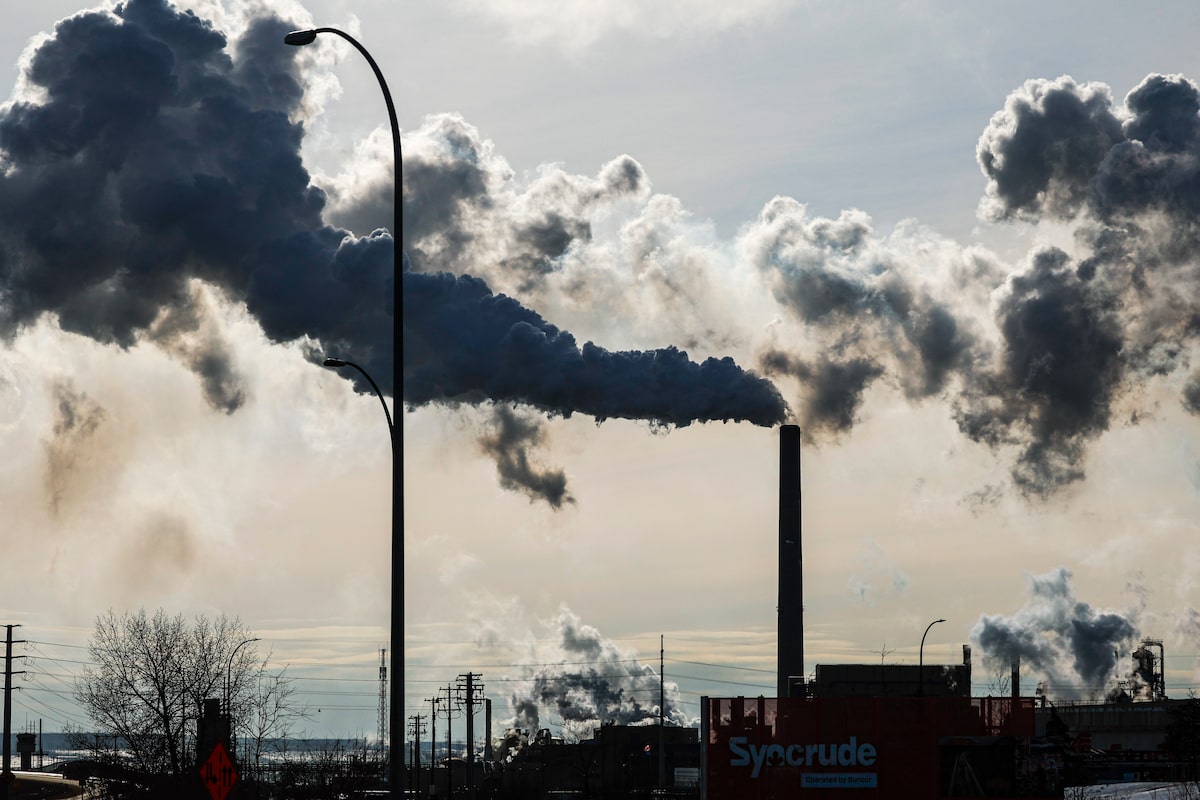
A section of the Syncrude oil sands facility is seen near Fort McMurray, Alta. The province attributed its $2-billion surplus this fiscal year to the war in the Middle East, which pushed up the global price for oil.Jeff McIntosh/The Canadian Press
Alberta has amassed a financial cushion it could deploy to soften the economic pain businesses and residents may feel because of the trade war between Canada and the United States, according to the province’s Finance Minister.
Jason Nixon, during the province’s first-quarter update on Thursday, said Alberta now projects a surplus of $2-billion in fiscal 2026-27, after global turmoil erased the projected $9.4-billion deficit.
Alberta is benefiting from the financial boon, spurred by the war between the U.S. and Iran, as Canada steels itself for a painful trade battle with its closest neighbour, customer and supplier. So far, the U.S. has not placed tariffs on oil imports from Canada, shielding Alberta from the economic fallout. But as the fight escalates, and Canada mulls countertariffs and other measures to pinch Americans, the gush of cash flowing into Alberta could be used to further protect the province’s residents from the financial consequences.
Ottawa suggests trade détente, but Trump escalates tensions with order to rename Lake Ontario
“It creates a situation where we have more opportunities to be able to adjust or step in if needed to be able to help Albertans and Alberta’s economy,” Mr. Nixon told reporters Thursday morning.
The U.S. on Saturday imposed a fresh round of tariffs on roughly $28-billion worth of Canadian goods, after negotiations to stave off President Donald Trump’s levies failed. Prime Minister Mark Carney, with the support of every premier, has vowed to retaliate dollar for dollar, and to support Canadian workers and businesses to the tune of $7.5-billion.
Meanwhile, Mr. Trump on Monday said he would impose a 50-per-cent tariff on Canadian automobiles, car parts and steel starting next year as the two sides dig in.
Premier Danielle Smith previously noted that only about 3 per cent of Alberta’s exports to the U.S. are exposed to current tariffs. The latest round of levies, she said, applies to roughly $1.5-billion worth of Alberta’s trade with the U.S. She said honey makers and furniture companies are among those that will feel the pressure.
Alberta Premier Danielle Smith and Finance Minister Jason Nixon in Edmonton in December, 2025.AMBER BRACKEN/The Canadian Press
Neither she nor Mr. Nixon have proposed a provincial support package.
Mr. Nixon observed Thursday that the war between Iran and the U.S. started two days after Alberta tabled its budget in February; the conflict pushed up oil prices and buoyed the province’s fortunes. The Finance Minister also said he expects Alberta to post a surplus in the most recent fiscal year, ending March 31, rather than the budgeted shortfall of $5.2-billion.
Generations of Alberta politicians have tried to diversify the province’s economy, to ease its reliance on unpredictable global energy markets, without substantial progress. Mr. Nixon reiterated Alberta’s evergreen diversification ambition on Thursday, but also embraced the province’s oil-soaked reality.
“We can’t lose sight of the fact that we’re a resource-producing province,” he said. “We have an oil and gas industry that is doing amazing things for our economy, employs many people in this province and right now is, frankly, the solution to so many different challenges, not only in Alberta but in Canada and across the world.”
Andrew Coyne: How Canada can best respond to threats from the United States
Ms. Smith, however, has batted away any suggestion that Canada’s energy exports should serve as weapons in the trade war against the U.S. Both she and Saskatchewan Premier Scott Moe are adamant that using the natural resources that power their economies as bargaining chips would backfire.
The Alberta Premier, speaking to reporters on Wednesday, said that if Canada applied a 50-per-cent export tariff on the four million barrels of oil it sells to the U.S. daily, the Canadian economy would crater. The U.S., she speculated, would immediately respond with energy-export tariffs between 50 per cent and 100 per cent, driving up prices for diesel and gasoline in Ontario and Quebec.
Further, Ms. Smith said, the refineries on the U.S. Gulf Coast would replace heavy Canadian oil with products from Venezuela.
“We would lose the United States as a customer entirely – and likely forever,” she said.
Jason Kenney, Ms. Smith’s predecessor and a fierce champion of Alberta’s oil patch, said he is baffled by those who insist Canada rule out applying countertariffs to exports such as oil, fertilizer and electricity.
Opinion: An independent Alberta would need to negotiate its trade and treaty relationships
“If they’re going to just keep threatening ever more painful tariffs on Canada, then surrender is not an option,” he said in an interview. “Removing our most potent countermeasures is self-defeating.”
He dismissed the idea that U.S. refineries could replace Canadian crude with oil from Venezuela without years of runway and billions spent increasing production.
Mr. Kenney is not advocating for the immediate use of countermeasures tied to natural resources. But he thinks a restrained retaliation strategy, compared with the aggressive scenario envisioned by Ms. Smith, could prove useful.
Canada, he said as an example, could impose an export levy of $5 a barrel of oil sold to the U.S. The U.S. would still have unfettered access to Canadian energy at a discount to the global price, and Ottawa could use the revenue to support businesses hurt by the trade war, he said.
“To say that if they further ramp up an unprovoked trade war against Canada, while threatening our sovereignty, that we should reduce, partially, a price discount that they get on our most valuable commodity – why would that even be contentious?”