
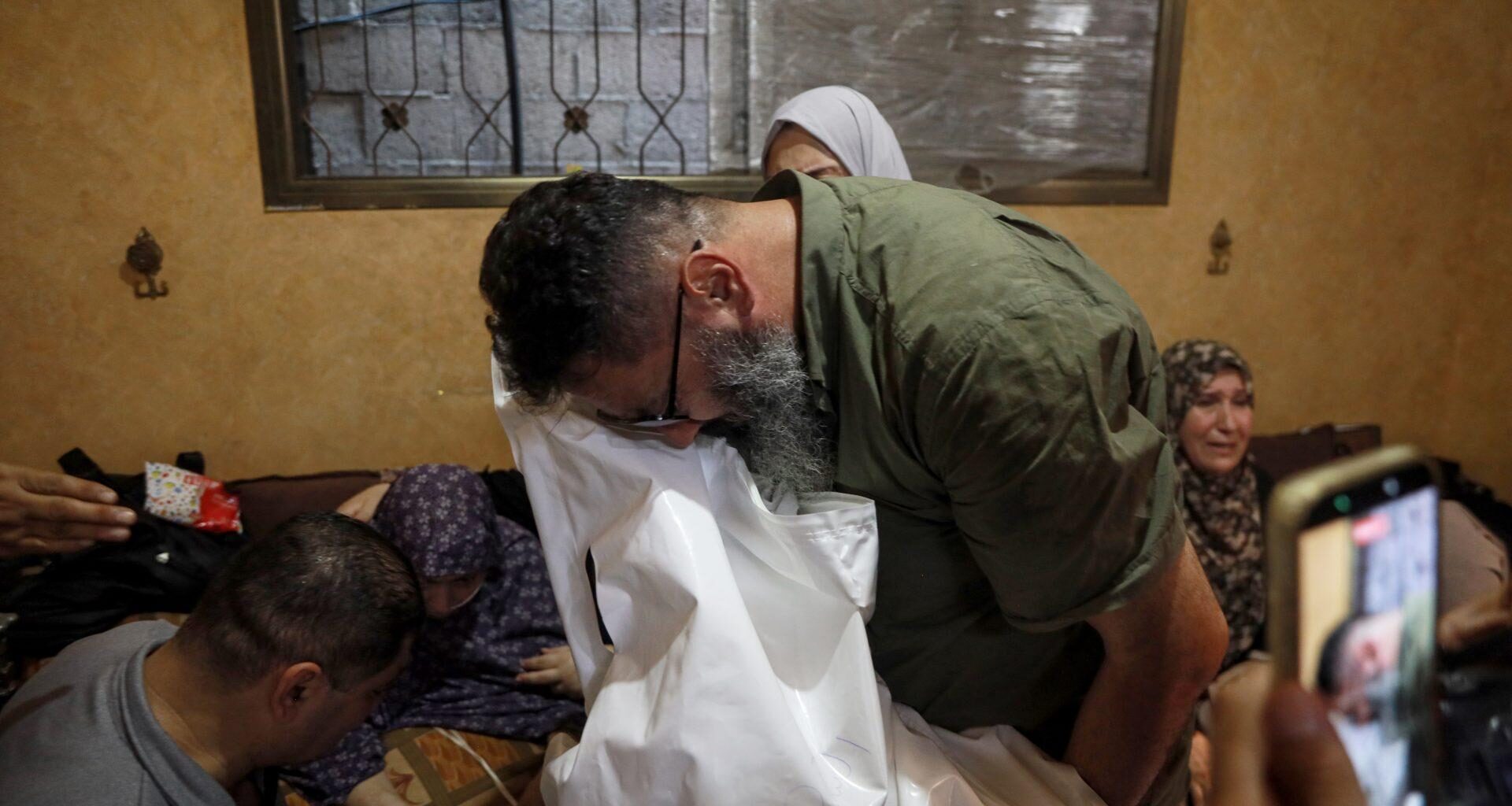
ISTANBUL (AA) — Palestinians marked Thursday the National Day for Recovery of the Bodies of Palestinian and Arab Martyrs as the number of Palestinian bodies held by Israel reaches unprecedented levels, with Israeli estimates putting the figure at around 1,700.
Observed annually on Aug. 27, the day draws attention to the decades-long efforts by Palestinian families to recover the remains of relatives held in Israeli military morgues or buried in military cemeteries known as “graves of numbers.”
The issue has intensified since Israel launched its war on the Gaza Strip in October 2023, with hundreds of Palestinian bodies transferred from Gaza to Israel while thousands of people remain missing.
The Palestinian Cabinet designated Aug. 27 as a national occasion in 2008 to mobilize public and legal efforts to establish the fate of missing Palestinians, recover withheld bodies and return them to their families for burial.
799 bodies identified
The Palestinian National Campaign for the Retrieval of Martyrs’ Bodies and Disclosure of the Fate of the Missing, together with Palestinian prisoners’ institutions, said Israel is holding the bodies of 799 Palestinians whose identities have been documented.
The figure includes 256 bodies buried in “graves of numbers,” 99 belonging to Palestinian prisoners, 81 children under 18 and 10 women.
Recent Israeli reporting indicates that the actual number of bodies held by Israel may be considerably higher.
On Aug. 11, Haaretz, citing two Israeli security sources, reported that Israel was holding around 1,700 Palestinian bodies, most of them from Gaza, for potential use in prisoner or hostage-exchange negotiations.
Buried without names
“Graves of numbers” is the Palestinian term for closed Israeli military cemeteries where Palestinian and Arab bodies are buried without their names being displayed. Instead, graves are identified by numbers corresponding to files containing information about the deceased.
The practice dates in its modern form to the late 1960s and expanded following the 1967 war. The cemeteries are located inside closed military zones and are generally inaccessible to families.
Historically, they have held the remains of Palestinians and other Arabs, including Lebanese nationals.
Bodies as leverage
Israel has increasingly used the detention of Palestinian bodies as a policy tool since 2015. In 2017, Israel’s security Cabinet approved retaining certain bodies for possible use in future negotiations.
Israel’s Supreme Court ruled in September 2019 that military authorities could retain Palestinian bodies under the 1945 Emergency Regulations, including for negotiations aimed at securing the return of Israelis or their remains.
The security Cabinet expanded the circumstances in which Palestinian bodies could be detained in 2020.
International law
International humanitarian law requires respect for the dead and their graves and supports efforts to facilitate the return of human remains to their families.
The International Committee of the Red Cross has documented customary international humanitarian law rules concerning the treatment of the dead.
Article 34 of Additional Protocol I to the Geneva Conventions requires respect for the remains of people who die in connection with armed conflict or occupation and calls for their return to families when circumstances permit.
Gaza war widens the crisis
Israel’s war on Gaza has dramatically increased the number of Palestinian bodies whose whereabouts are disputed or whose remains are being withheld.
The National Campaign to Recover the Bodies said Israel had returned 930 Palestinian bodies to Gaza as of Feb. 4, 2026, along with 66 boxes containing human remains.
The campaign said some of the remains were of Palestinians whose bodies Israeli forces had taken from cemeteries in Gaza and areas surrounding the al-Shifa Medical Complex in Gaza City.
Palestinian teams have struggled to identify many of the remains because of shortages of DNA-testing equipment and supplies. Authorities have therefore relied on traditional identification methods and information provided by relatives of missing Palestinians.
The National Campaign and Palestinian prisoners’ institutions said Wednesday that the thousands of people still missing in Gaza, together with difficulties accessing areas devastated by Israeli attacks, mean the number of withheld bodies could increase as more information emerges and victims are identified.
The crisis also extends within Gaza, where thousands of bodies are believed to remain beneath the rubble of destroyed buildings.
Zaher al-Wahidi, director of the Health Information Unit at Gaza’s Health Ministry, said Aug. 20 that around 7,400 bodies remained trapped under the rubble, with recovery teams unable to reach them.
Since a US-brokered ceasefire took effect Oct. 10, 2025, Israeli attacks have killed 1,303 Palestinians and injured 4,336, according to Gaza’s Health Ministry.
The ministry said the Israeli army has killed more than 73,400 Palestinians and injured more than 174,400 since the start of Israel’s war on Gaza in October 2023.