
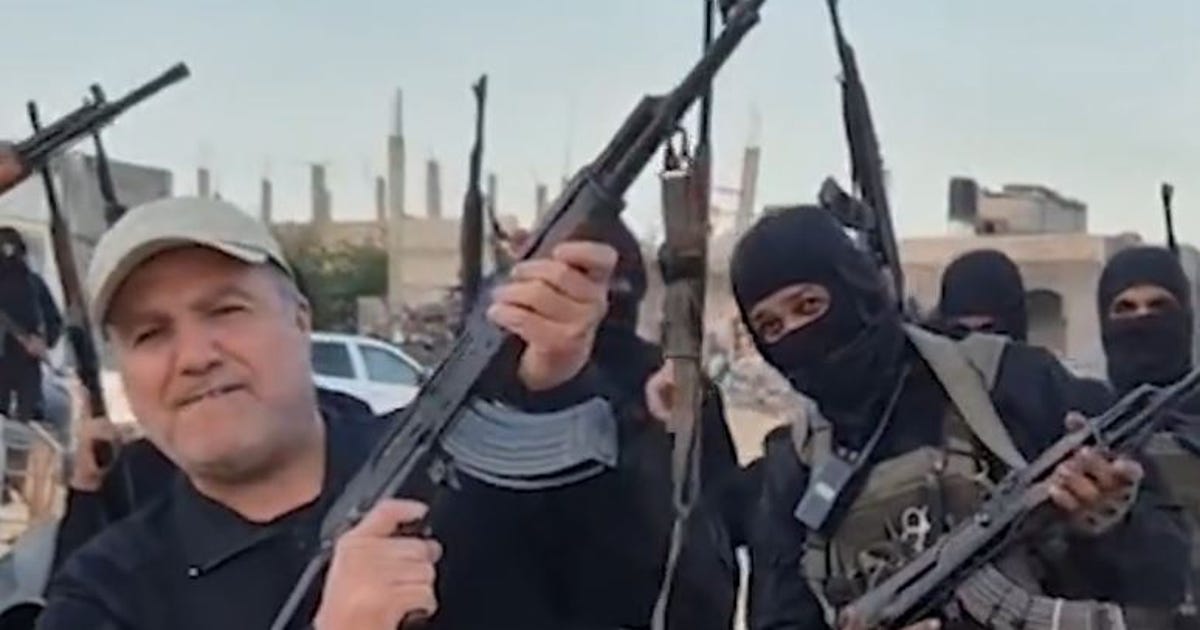
The mission the soldiers were asked to carry out was unusual from the very first moment, even before things escalated and weapons were drawn. It was called a “coordinated activity” in the Khan Yunis area. The coordinators were Israeli soldiers serving in the Gaza Strip and members of an armed Palestinian militia opposed to Hamas.
But the word “coordination” is misleading in this context. The soldiers had no idea what they were walking into. Only in retrospect did they realize they were witnessing an arbitration mechanism following a dispute within one of the militias operating in Gaza.
“One of the clan members with us had apparently accidentally shot another gunman’s wife,” an IDF combat soldier familiar with the incident told Haaretz. “Before our eyes, right there, the price was set, and the other man simply shot him in the legs. Everyone around accepted it as if it were a legitimate verdict. We stood there in complete shock.”
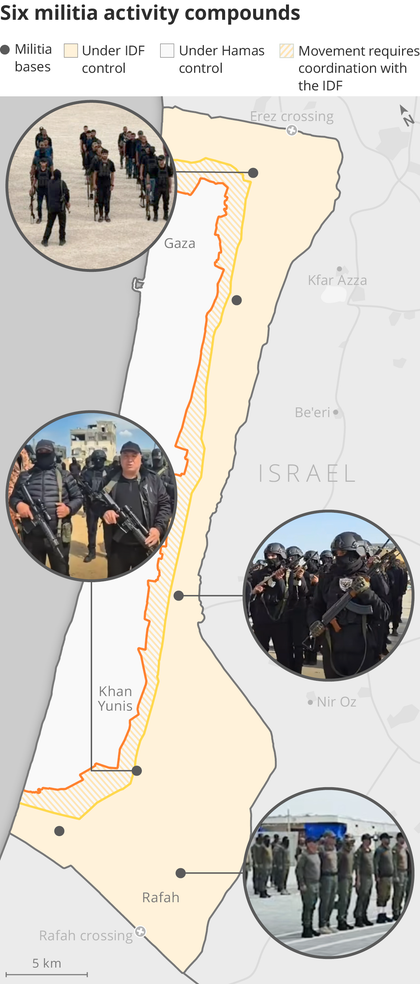
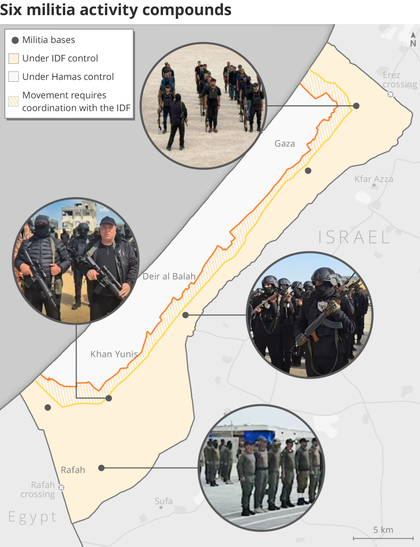 Close Credit: Images taken from Gazan Militias’ Facebook pages.
This incident from earlier this year is just one byproduct of the tightening collaboration between the IDF and Gaza militias. Another manifestation of this blurring of lines is the following phenomenon: Militiamen roam freely around the many IDF outposts established in Gaza, according to witness accounts collected by Haaretz. An officer who served in Gaza said he saw “many militiamen” while visiting some military outposts. The gunmen stage displays of force, film them and upload the footage to their Facebook pages for propaganda and recruitment purposes.
For their part, the IDF and Shin Bet extend their patronage to the militias due to their opposition to Hamas, and they maintain close ties. There’s an interest-based synergy between them. “What’s wrong with that? It’s good,” Prime Minister Benjamin Netanyahu said on the matter last year. Sources in Gaza said the IDF even provided militiamen with artillery and drone support during operations against Hamas in the limited area still under its control.
But the militias are not only operating against Hamas militants but also against Gazans just trying to survive. According to information collected by the UN, some gunmen coordinated with the IDF to expel Gazans from their homes. An Israeli Air Force officer recounted what he saw while tracking militias with a surveillance-and-attack drone alongside a Shin Bet operative.
“We saw them arrive in two or three pickup trucks, very similar to Hamas’ trucks. They just ran and shot at people,” he said. “They entered every structure, looted everything they could get their hands on, came out with piles of stuff – and then burned down the house.”
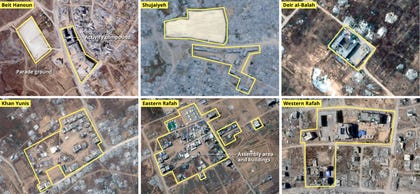
In recent months, Haaretz has tracked the militias that Israel is cultivating. Their activation has previously been reported in local and international media. But mapping based on satellite imagery and on social media videos, together with conversations with Palestinians in Gaza, information collected by the UN, the militias’ own public statements and testimony from IDF soldiers and commanders, reveals the depth and extent of the cooperation. The evidence paints a clear picture: The armed Palestinian militias have become an operational arm of the IDF and Shin Bet inside Gaza.
 Close
Close
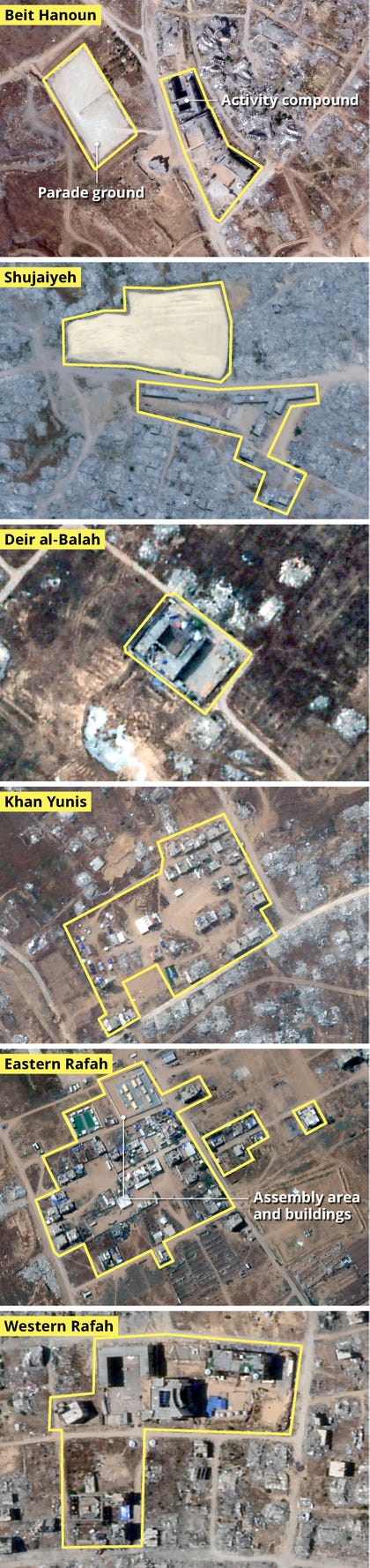
Satellite images of militia compounds in Gaza. Credit: Planet Labs PBC
Satellite images of militia compounds in Gaza. Credit: Planet Labs PBCRelated Articles
This militia project also has policy implications. Israel says that any progress on Trump’s plan to end the war in Gaza depends on Hamas’ disarmament. Hamas, meanwhile, views the militias as a threat and demands that they be disbanded before the terror group moves forward with its own disarmament.
Meanwhile, on the ground, alarm bells are ringing. Shortly after the militia project began, soldiers told Haaretz that the dynamic could lead to atrocities reminiscent of the Sabra and Shatila massacre. The Air Force officer who spoke with Haaretz emphasized: “You see the State of Israel, the IDF and Shin Bet sending armed, trained militias to commit war crimes, and I’m the one who has to protect them during their operations so they don’t get hurt.”
The Gaza militia project already has a history. In the early stages of the war, it was reported that Israel was considering activating clans as an alternative governing body to Hamas. The backdrop was the Israeli government’s opposition to the Palestinian Authority returning to Gaza.
In June 2025, Netanyahu publicly admitted that “on the advice of security officials, we activated clans in Gaza that oppose Hamas.” Netanyahu was responding to claims that the government had armed “criminals affiliated with the Islamic State,” referring to the men of Yasser Abu Shabab, who headed a militia in the Rafah area and frequently spoke with international media. When he was injured, he was reportedly evacuated for treatment in Israel.
Yasser Abu Shabab is dead, but the militia project he came to symbolize continues to evolve and expand – particularly since the October 2025 cease-fire was announced. Gaza was split in two – more than half under IDF control and the rest under Hamas control.
There are now five prominent armed groups in Gaza, with names such as the Popular Forces and the Counter-terrorism Strike Force. Videos they post online sometimes show dozens of armed men, and according to sources in Gaza, some of these groups now number hundreds of members. Each operates in a defined area under IDF control, and Haaretz has identified apparent militia activity in a sixth location. The groups are deployed in Beit Hanoun, Shujaiyeh, Deir al-Balah, Khan Yunis and Rafah.
The proximity of the militia bases to the separation line between the IDF and Hamas – the so-called Yellow Line – allows them to easily launch operations in Hamas-controlled territory. Sources in Gaza, the militias’ own statements and international media reports shed light on their activities, indicating that clashes have raged between militiamen and Hamas fighters in various locations across Gaza in recent months. Militiamen announced that they had killed Hamas militants in Rafah. Deadly clashes were reported in Khan Yunis and around refugee camps in central Gaza. Militiamen boasted of seizing Hamas weapons and threatened to pursue the group’s members.
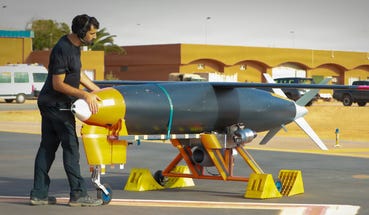
Soldiers told Haaretz that the militias are involved in the IDF’s operational activities. An Air Force officer said the IDF sends militiamen to hard-to-reach areas deep inside Hamas-controlled territory, including to retrieve drones used for smuggling. “They’re told, ‘Bring us the drone and keep whatever is inside.’ Whether it’s weapons or drugs, they take everything.”
A militia commander in the Deir al-Balah area confirmed his cooperation with the IDF in expelling Gazans. “We convey the Israeli side’s messages to people – to leave the place,” he said in a video he posted in May. The UN Office for the Coordination of Humanitarian Affairs (OCHA) stated that same month that it had received reports of militia forces ordering Gazans to evacuate, and that displaced families reported receiving phone calls from people who identified themselves as Israeli forces, ordering them to leave shortly.
In June, the UN cited displaced Gazans who said they had fled “when Israeli forces – supported by armed Palestinians – advanced towards their residential areas while dropping explosive munitions from the air.” It’s unclear exactly where the militias engaged in expelling Gazans, but residents living inside the Yellow Line zone were removed in recent months from where they were living (whether in homes or temporary shelters). Their expulsions coincided with IDF operations to expand the territory under its control while reducing Hamas-controlled territory.
The militias display in various videos armed men in vehicles, combat exercises, armed displays and marches, parades and threats – all designed to challenge Hamas. Hamas sources told Haaretz that they cannot afford to give up “defensive weapons” as long as the militias remain armed and continue to receive support, because they will become targets for the militias.
In late July, U.S. President Donald Trump’s Board of Peace announced an agreement on the implementation of the next phase of the Trump peace plan for Gaza. Articles 8 and 10 of the new deal explicitly link Hamas’ disarmament to the IDF’s withdrawal from the enclave – and to the militias’ disarmament. But Netanyahu officially rejected the plan. Meanwhile, eight Arab and Muslim nations issued a statement condemning Netanyahu’s decision, and Trump’s son-in-law and adviser Jared Kushner arrived in Israel last week to advance diplomatic efforts.
 Haaretz national security
While Trump’s envoys are looking for a breakthrough, the defense establishment and commanders on the ground have no illusions about the allies Israel has chosen. Senior military officials told Haaretz that key militia figures are not political leaders or a legitimate governing alternative to Hamas. Rather, they’re former gang leaders and drug dealers who exploited the chaos and the power vacuum in Gaza for personal gain.
Sources in Gaza noted that some militiamen are former members of the Palestinian Authority security forces. One militia leader, Shawqi Abu Nasira, posted a video in which he stated his position: “I remained in the area and – like everyone else – I was targeted by Hamas. My son and daughter were killed, my house was damaged. It is important that I defend myself, the Palestinian people and my honor.” Abu Nasira confirmed that his men coordinated with Israel on security and military matters, and accused Hamas of promoting Iran’s interests. “I made the decision to liberate the land from Hamas. If people say that makes me a collaborator, then I’m a collaborator.”
“They simply hate Hamas and receive many benefits and power from Israel, and that’s good enough for both sides,” the Air Force officer said. Many within Israel’s defense establishment view the decision to arm the militias and place parts of Gaza under their control as a dangerous gamble. Haaretz asked the IDF what its recommendations were to the political echelon regarding the militia project, how it is working to reduce the risk to soldiers, how it is working to prevent the killing of innocent Gazans, and what the position of the IDF’s legal counsel is on these matters. In response, the IDF referred Haaretz to the Shin Bet, which did not respond.
The militia compounds identified by Haaretz stand out amid the complete destruction around them. By cross-referencing satellite imagery from Planet Labs with videos posted online, Haaretz confirmed militia activity at five compounds. A sixth compound visible in satellite imagery contains the same telltale signs as the other five, like tents and equipment, but no ground activity has yet been documented.
The militias’ bases are located just hundreds of meters from IDF outposts. They have call signs on the army’s radio network, appear on briefing maps, and their gunmen are marked in the IDF’s command-and-control systems.
Satellite imagery and ground footage also reveal infrastructure and fortification work in some of the compounds. Next to the militia base in Shujaiyeh, for example, a large cemetery was leveled and replaced with an extensive training area. At least one militia compound has been fitted with the same concrete barriers used to protect IDF positions. Soldiers told Haaretz that the army had built temporary compounds for the militias, complete with mobile structures.
The evidence from the militia compounds is particularly striking given the stagnation of Gaza’s reconstruction. According to humanitarian agencies, more than 2 million residents are crowded in harsh conditions, with hundreds of thousands living in tents amid the ruins.
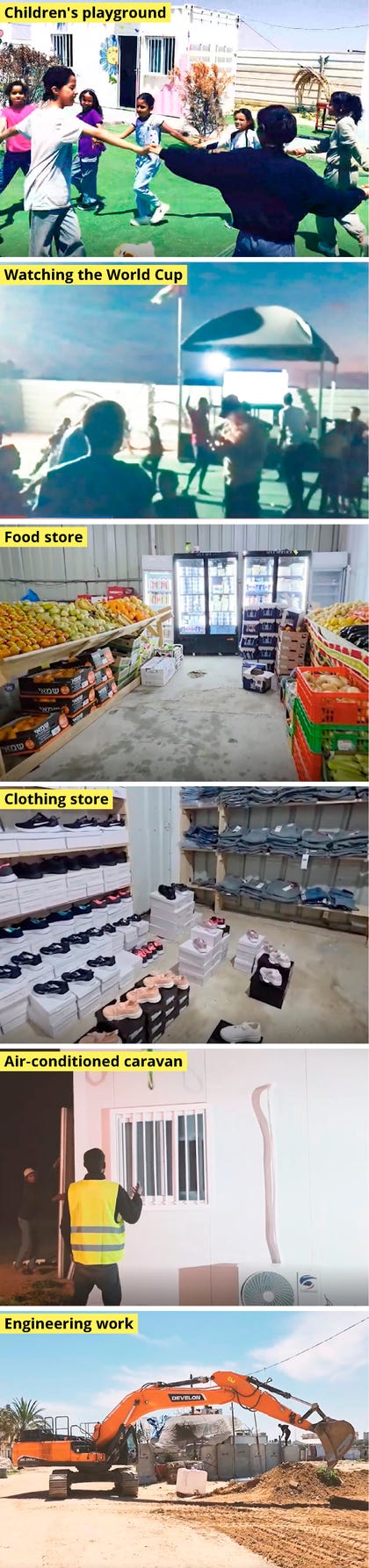
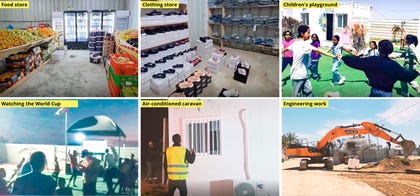
Satellite imagery and videos from the ground show a particularly significant expansion in the Abu Shabab militia compound in eastern Rafah. It showcases heavy engineering machinery at work, the paving of a new training yard and new mobile structures fitted with Tornado air conditioners. It has also shown off a playground with artificial turf, a mosque, a food store with fully stocked shelves and a clothing shop. In Shujaiyeh, another militia filmed its members handing out colorful scooters to children. IDF sources said some of the equipment comes from Israel.
 Close
Close
Activity at the Abu Shabab militia’s compound in eastern Rafah. Credit: The militia’s Facebook pages.
Activity at the Abu Shabab militia’s compound in eastern Rafah. Credit: The militia’s Facebook pages.
These videos are part of a campaign to attract new supporters, despite the fact that the militias operate under IDF patronage and in cooperation with Israel, and lack legitimacy among the local population.
Senior IDF commanders and defense officials said they have no intention of turning the militias into an alternative government to Hamas, acknowledging their limited capabilities. “They don’t have the ability to wrest control from Hamas, and without the IDF’s protection and support, they won’t survive militarily against it,” a senior IDF officer said. Senior commanders describe the militias as a temporary, localized solution.
“Using them is an operational constraint far more than a tactical necessity,” the officer said. “Ultimately, we need a local force that can maintain order in areas under IDF control and carry out work in places where it has a relative advantage over our soldiers.”
The IDF, however, will not have the final say on the militias’ future. That will depend on how much pressure Trump exerts on Israel and whether Netanyahu is willing to move forward on the diplomatic track.