
By Sharon Zhang
This article was originally published by Truthout
Rights groups said it was a likely war crime that helped build evidence for Israel’s practice of using starvation as a weapon in Gaza.
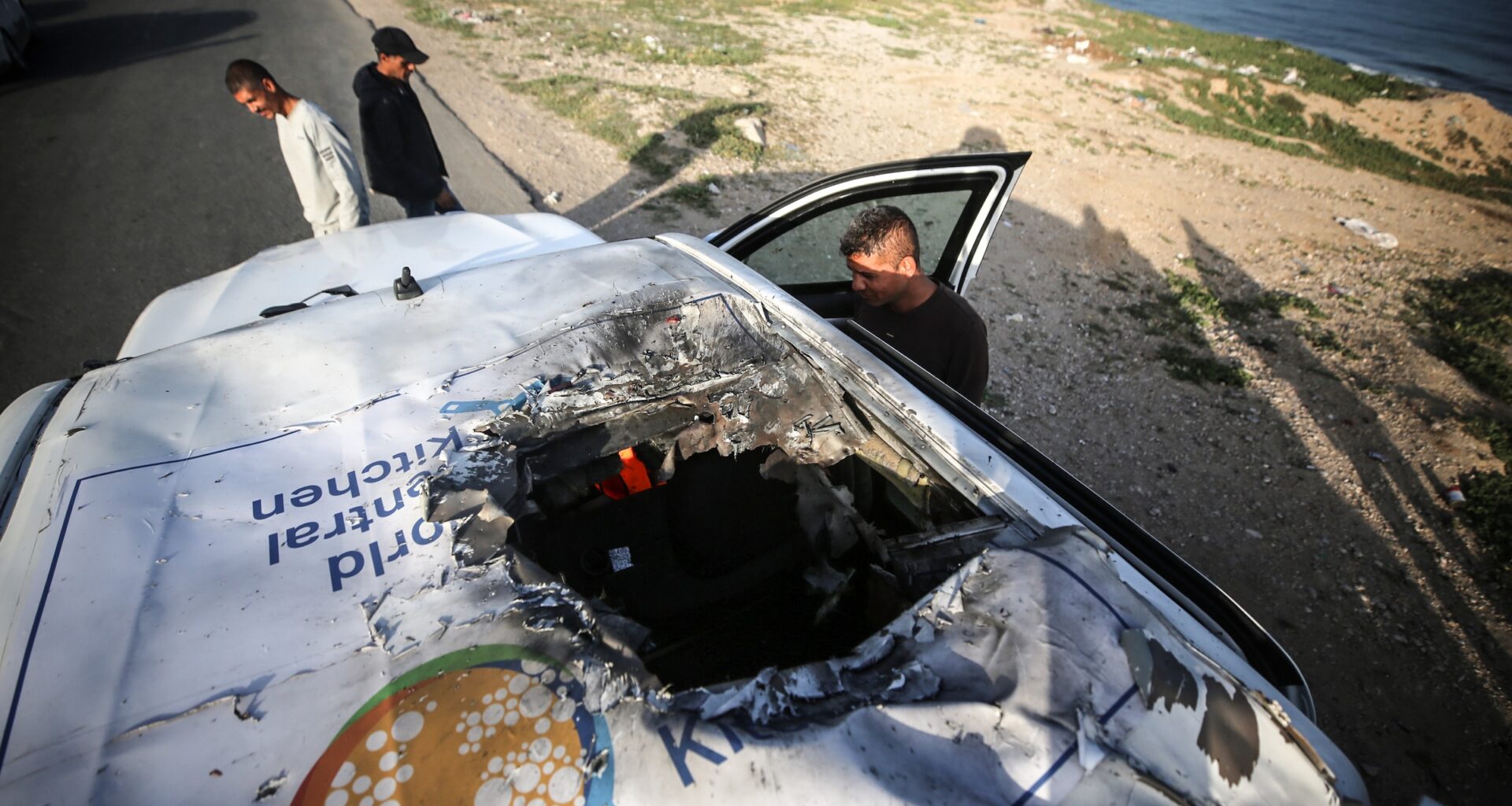
The Israeli commander who ordered the strike on World Central Kitchen (WCK) aid workers in Gaza in 2024 said that he has no regrets for the incident that sparked global outrage and worsened famine conditions in the Strip.
Nochi Mendel, a colonel who was dismissed from his position as the chief of staff of the Nahal infantry brigade, told Australian public broadcaster ABC that he believes that the strike was justified, even though rights groups said it was a likely war crime that helped build evidence for Israel’s practice of using starvation as a weapon in Gaza.
“I’m the commander, and I’m the one who gave the order to carry out the operation,” said Mendel, through a translator. “I’m not sorry for what I did.”
The strike killed seven aid workers: Palestinian driver Saifeddin Issam Ayad Abutaha; British nationals John Chapman, James Henderson, and James Kirby; Canadian-American Jacob Flickinger; Zomi Frankcom, an Australian; and Damian Soból, from Poland. It sparked international condemnation, highlighting Israel’s practice of targeting aid workers. As of April 2026, Israel had killed 560 aid workers in Gaza amid the genocide.
After the strike, the Israeli military said that it was “conducting a thorough review at the highest levels to understand the circumstances of this tragic incident.” Mendel and another commander on the brigade were dismissed for “violation” of procedures.
However, last week, the military announced that it was not doing a criminal probe into the commanders responsible for the incident, sparking renewed outrage.
“At the time of the lethal attacks, the IDF knew that our team in Gaza was unarmed and posing a threat to nobody,” WCK said in response to the decision. “It had full visual clarity on our clearly marked humanitarian vehicles during the extended, multiple airstrikes. It knew our team’s movements, identities and activities in advance.”
Mendel, recounting the incident to ABC, claimed that he didn’t intend to kill the WCK workers, even though he’s not apologetic about the outcome. He said that the attack was justified because he found out after the strike that WCK had links to Hamas — allegations WCK said were “false and outrageous.”
“This is the latest attempt to shift blame away from the IDF’s own actions,” a WCK spokesperson said. “The individual making these slanderous claims has no credibility.”
Indeed, even in his own accounting, Mendel seems to subtly admit that he purposefully killed WCK workers.
Mendel says that he was watching the convoy move through a drone, while he was at a control center in Israel’s Sde Teiman military facility. He said that he saw gunmen moving with the convoy — which the Israeli military later identified as security hired by WCK — which he said were “terrorists,” who were moving alongside aid workers in the vehicles.
He said that, after the convoy stopped at a warehouse and got back on its way, he saw a person with a gun enter a car, which he described as an “armed terrorist.” Mendel says that the people operating from the drone base “definitely confirm that they identified an armed terrorist in the vehicle” — so he ordered the strike.
The gun that Mendel claims he saw the person carrying turned out to be a bag. Having watched the aid workers reload at the warehouse, Mendel would have known that the vehicles in the convoy had aid workers in them. And the vehicle had a clear and large WCK logo adhered to its roof, in clear view of a drone.
Pro-Israel figures have claimed that the strike did not violate international law because Mendel could have believed he was targeting fighters. But international law dictates that militaries must not strike civilians, and that they should refrain from attacking if there is a possibility of civilian casualties.
Mendel says now that “maybe one” or no combatants were killed in the strike. No evidence has shown that the aid workers were involved with Hamas’s militant wing.
Mendel said that his main disappointment is that he was dismissed by the Israeli military after the strike.
“It’s a matter of it being painful because you’re fighting a very complex situation,” he said. “In the end, in a very difficult situation, I’m paying the price.”
The strike ultimately bore dire consequences for Palestinians. It showed that even a highly publicized strike on aid workers would not lead to any material consequences for Israel. The Biden White House papered over the incident despite other countries’ condemnations — allowing Israel to proceed with crossing President Joe Biden’s “red line” of invading Rafah weeks later.
It also accelerated Israel’s blocking of aid into Gaza, as several aid groups announced they were pulling out of their work there as a result of the strike.
This article was originally published by Truthout and is licensed under Creative Commons (CC BY-NC-ND 4.0). Please maintain all links and credits in accordance with our republishing guidelines.