
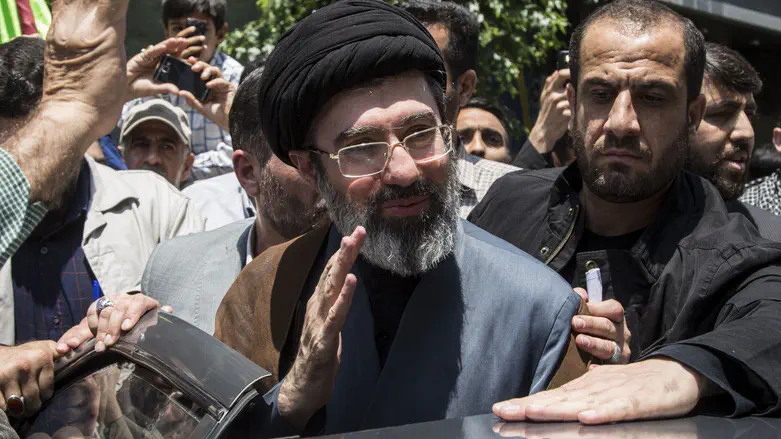
Iranian Supreme Leader Mojtaba Khamenei has called on government officials to protect national unity and avoid statements that could undermine public confidence, according to a written message published Friday on the Telegram channel “News of the Martyr Leader.”
In the message, issued for Government Week, Khamenei declared: “I firmly declare that committing anything that harms social cohesion is forbidden.”
He also instructed officials to refrain from “discouraging statements that weaken national and public motivation” and cautioned against framing political debates through what he described as artificial divisions, including “war or negotiations,” “consensus or extremism” and “compromise or warmongering.”
Khamenei urged Iranian authorities to focus on the country’s “power and strength,” arguing that emphasizing weaknesses could benefit Iran’s adversaries and undermine the morale of its supporters.
The statement also addressed Iran’s economic challenges. Khamenei called for increased attention to inflation, unemployment, prices, investment and domestic production, while supporting efforts to reduce the dollar’s role in the Iranian economy.
His message came four days after the United States announced “Operation Economic Outcast,” an extensive economic campaign intended to isolate Iran and restrict financial resources available to the Iranian regime.
Khamenei has remained out of public view since the 40-day war began on February 28. He has not made a public appearance since his father, Ali Khamenei, was eliminated in joint US-Israeli strikes on Iran, after which Mojtaba Khamenei was elevated to the position of Supreme Leader.
His prolonged absence has fueled speculation over his condition, with reports ranging from serious injuries to claims that he may have died.
In July, Saudi broadcaster Al Hadath cited an Israeli defense source who claimed that Mojtaba Khamenei had left Iran. The source further alleged that messages issued in his name were actually being prepared by Ahmad Vahidi and the leadership of the Islamic Revolutionary Guard Corps, while also claiming that deep internal divisions within the IRGC posed an existential threat to the organization amid growing unrest in Iran.
CNN reported in March that Khamenei had been injured on the first day of the conflict, allegedly suffering a broken foot, trauma near his left eye and facial lacerations.
Earlier this month, a report attributed to Khamenei’s office said Iranian President Masoud Pezeshkian had held a conference with the Supreme Leader. No visual evidence was provided to substantiate the claim.
US President Donald Trump addressed speculation about Khamenei’s condition on Wednesday during an interview with The Glenn Beck Program. Trump said he did not believe the Iranian leader was dead but claimed he had suffered serious injuries.
“I don’t think he’s dead. He was very seriously wounded,” Trump said. “The left side of his body, the arm, the leg, the whole thing, he was very seriously wounded. But I don’t think he’s dead.”
Trump also said Iranian officials continue to act as though they consult Khamenei and seek his approval before making decisions.
“And if he is, they’re putting on a pretty good show because they talk about, you know, going back to talk to him all the time, you know, to get a final blessing on things,” the President said.
(Arutz Sheva-Israel National News’ North American desk is keeping you updated until the start of Shabbat in New York. The time posted automatically on all Israel National News articles, however, is Israeli time.)