
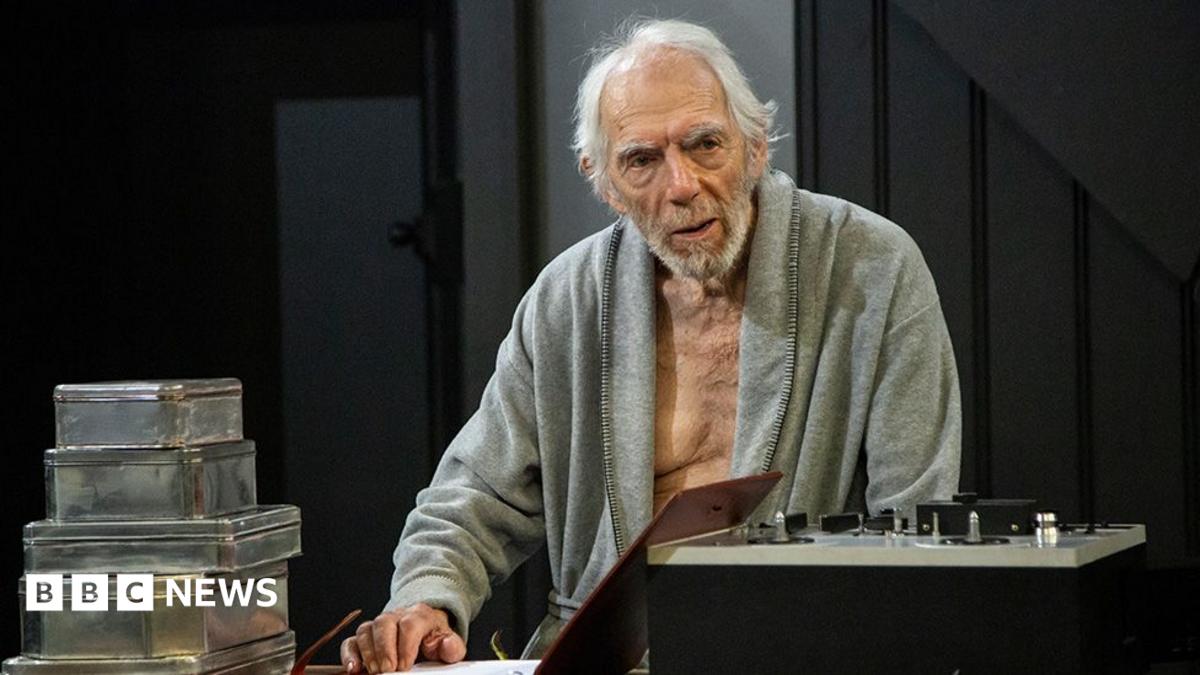
At that point, some actors may have stepped back from the pressure of performing in front of a live audience.
But “out of the blue” a call came in from someone Marinker had worked with closely in the past – Dave Wybrow, the director of the Cockpit Theatre in London.
The idea was to put on Krapp’s Last Tape, an intense one-man play in which an ageing writer listens back to recordings of his younger self, remembering a lifetime of regrets and missed opportunities.
“It’s a dynamite show and a dynamite piece of writing,” says Wybrow, whose mother also lived with memory problems at the end of her life.
Rehearsals have been running since the end of June to give Marinker extra time to practise, and a whole team assembled to make the play happen.
A stage manager will stand next to the set throughout the performances, autocue screens will be dotted around the theatre, and Marinker will be wearing a tiny earpiece so he can be quickly prompted if he forgets his lines.
Wybrow is adamant this is not about “covering up” Marinker’s illness, but showing that collaborative, creative work is still more than possible after a dementia diagnosis.
From day one, Marinker says he did not have any concerns.
“Dave asked would I like to do it, and I was just ‘Yes. Oh yes, yes, yes, yes!'” he says.
“I’ll still get nerves [on the first night] but I know how to deal with them – that’s just the adrenalin.”