
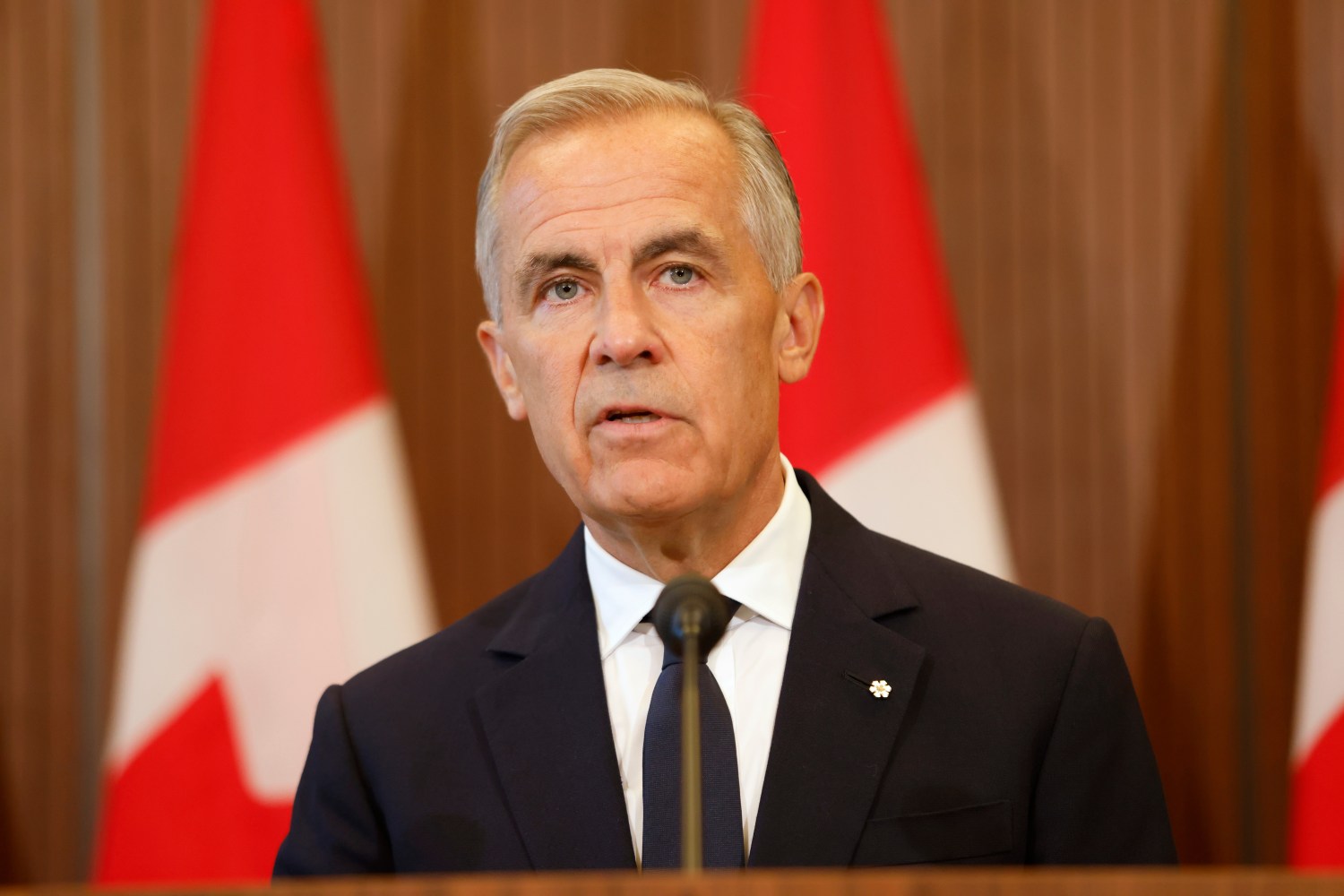
We begin today with Leyland Cecco, Heather Stewart, and Kalyeena Makortoff of The Guardian and their long read on the…somewhat…unlikely rise of Canada’s prime minister Mark Carney into a global leader.
The unlikely transformation of an economist and central banker with no prior electoral experience into a powerful global politician has bucked precedent and expectations. But Carney has settled into the role he warned was necessary for the country, that of a wartime leader standing up to an erratic and vindictive adversary who seems hellbent on subjugating Canada.
After trade negotiations with the US broke down, the two sides traded recriminations and made good on threats to impose new tariffs on each other. In his latest act of petty antagonism, Trump signed an executive orderon Thursday directing the US federal government to rename Lake Ontario as “Lake America”.
But Carney, in walking away from the proposed deal, did what few other leaders have done: dared Trump and the US to test his nation’s resolve.
Economics professor Kent Jones explains the 1930 law behind Trump’s imposition of tariffs on Canada for The Conversation.
“One of the most notable aspects of the collapse in trade negotiations lies in Trump’s unprecedented use of an untested tool in the Tariff Act of 1930, otherwise known as the Smoot-Hawley tariffs. Economists generally agree that the act’s escalating retaliatory tariffs extended the Great Depression by sparking a global trade war. Amplified by foreign retaliation and falling global gross domestic product, U.S. trade fell by two-thirds from 1929-1932.
Smoot-Hawley contains a provision known as Section 338, which provides an additional feature: The president may, on his own authority, impose unilateral tariffs of 50% if a foreign country’s policies “discriminated” against the United States.
But the section was never invoked, as the damage from the other Smoot-Hawley tariffs was already done. That is, until July 2026, when Trump first threatened the 50% tariffs on Canada for its “discriminatory treatment” of U.S. products.”
Sophie Hills of The Christian Science Monitor looks into the reasons that the (recently) reliably Republican Iowa has become a battleground state once again.
“It’s been two decades since Iowa elected a Democrat to the governor’s mansion. But this year, the state is suddenly fielding a host of competitive races. State Rep. Josh Turek, a Democrat, is running within range of Republican U.S. Rep. Ashley Hinson for the state’s open Senate seat. Two U.S. House seats are up for grabs as well, after several cycles in which Iowa’s congressional delegation has been entirely Republican. […]
Democrats have been busy highlighting all the ways in which Mr. Trump’s actions have been bad for Iowans – from tariffs that have squeezed farmers to the Iran war’s impact on the price of gas and fertilizer. […]
Most recently, Mr. Trump announced a deal to lower the cost of imported beef, drawing immediate criticism from Democratic and Republican officials alike. Mr. Sand called it “a blow to Iowa farmers and cattlemen,” and Ms. Hinson called it “a bad idea.” […]
Republicans are also being dragged down by the unpopularity of Governor Reynolds – whose poll numbers are almost as bad as the president’s – and a perception that GOP legislators have failed to deliver on promises, despite holding majorities in the statehouse. At the local level, some Republicans are openly unhappy with the status quo.”
Daniel Nichanian of Bolts takes note of the revolt in (always) reliably Republican Wyoming as it pertains to the state’s elections.
It’s an unusual sight in the Trump-era GOP: In many of Wyoming’s state primaries last week, Republican voters chose candidates who defended the state’s voting systems and election workers, over those who amplified the president’s lies about voter fraud. […]
The results are sure to shake up the balance of power in Wyoming and deflate the far-right’s ambitions to make this state a laboratory of MAGA-style election administration. Marguerite Herman, who lobbied against those proposed restrictions at the legislature on behalf of the League of Women Voters of Wyoming, told Bolts she was delighted to see that many of the officials who championed them won’t be in office come next year.
This ultraconservative bloc had successes, notably a harsh law that took effect last year that requires voters to provide proof of citizenship to register to vote. Wyoming’s governor criticized the legislation and said it threatened to disenfranchise eligible voters, but he still let it become law without his signature.
But many of the far right’s core proposals stumbled, including bills to ban electronic voting machines and ballot drop boxes, a secure voting method that has fueled baseless conspiracy theories about the 2020 election. During his 2022 campaign, Gray hosted screenings of the debunked film “2000 Mules,” which falsely blamed drop boxes for Trump’s loss in the presidential race
Colby Smith of The New York Times analyses the decisions that new Fed Chairman Kevin Warsh willbe faced with.
“But the path ahead for Mr. Warsh is a precarious one. Financial markets now see a quarter-point increase at the central bank’s next meeting on Sept. 15-16 as more likely than not, leaving Mr. Warsh with a tough decision whether to follow through with action.
Another month of benign inflation data will alleviate the pressure on him to raise rates in September. But as the market blowback to his last meeting in July showed, the onus will be on him to explain how doing nothing aligns with his intolerance for elevated inflation. […]
Mr. Warsh on Friday sounded like many of his fellow policymakers at the Fed who had grown impatient about the slow pace of progress on taming inflation after half a decade of it overshooting the target. He not only dismissed data that showed easing price pressures this summer, but also suggested that there was not much restraint on an economy that has been growing at a robust pace. He also made clear that with the labor market stable, the Fed’s focus was chiefly on tackling inflation.”
Finally today, Allegra Kirkland of Talking Points Memo loos at much of the disaster that is HHS Secretary Robert Kennedy Jr.
“We’re coming to the end of a summer of food safety crises. As an Aug. 20 New Republic piece flagged, in just one week, “the FDA has discovered salmonella in granola, salad dressing, jalapenos, and animal food; glass in fruit popsicles; and metal in sourdough,” recalling 12 products — “a rate four times higher than the same week a year ago.” Of course, there were also the bouts of diarrhea lettuce and E. Coli blueberries. All the jarring headlines about foodborne illnesses are perhaps the most visible indicator of how our public health has been endangered by the Trump administration. Turns out imposing sweeping staff and budget cuts on the FDA, CDC and HHS may not have been the best idea. […]
…The HHS secretary has called fluoride “industrial waste” and spread misinformation about its health risks, prompting states including Utah and Florida to ban communities from adding it to public drinking water. ProPublica reported last year that lawmakers in at least 21 states have proposed measures to prohibit or roll back the addition of fluoride to public water systems. The Trump admin entirely dismantled the CDC’s Division of Oral Health, nixing its research for and assistance with fluoridation programs. And TPM fellow Farrell Brenner reported that these RFK-fueled conspiracy theories are also prompting patients to turn down fluoride treatments at the dentist’s office and throw out their kids’ fluoridated toothpaste.
Women in the United States are dying preventable deaths and losing out on essential, basic reproductive healthcare services thanks to state abortion bans and cuts to Medicaid and the VA. Post-Dobbs, the abortion pill mifepristone, which is used in some two-thirds of abortions in the U.S., has been a godsend for women looking to end unwanted or unsafe pregnancies, particularly in states that have restricted access to the procedure.
But RFK Jr. launched a review of the drug’s “safety profile,” even though the FDA itself has said it’s safe and effective when used as indicated (in combination with misoprostol).”
Everyone have the best possible day that you can…and thanks for reading!