
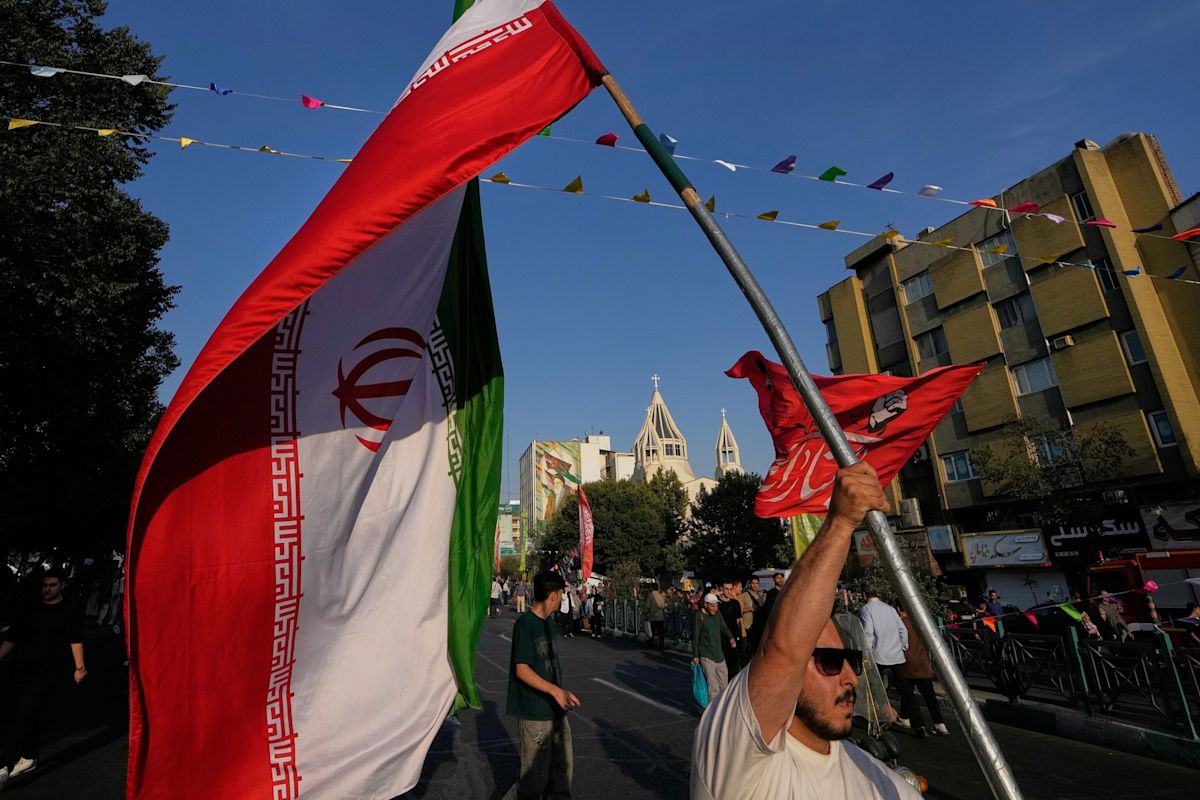
President Donald Trump announced “major combat operations” against Iran on Feb. 28, with massive joint U.S.-Israeli strikes targeting military, government and infrastructure sites.
Delegations from the U.S. and Iran entered negotiations in June aimed at a war-ending deal based on a memorandum of understanding signed by both countries.
The U.S. and Iran have nonetheless continued to exchange strikes, with the strategic Strait of Hormuz as the primary flashpoint.
Treasury Secretary Scott Bessent said Iran is taking the economic sanctions the U.S. threatened “seriously,” and he blamed the recent renewed strikes on the economic pressure from the U.S

Evelyn Hockstein/Reuters – PHOTO: Treasury Secretary Scott Bessent speaks at a news conference, Aug. 24, 2026, at the Treasury Department in Washington.
“They’re taking them very seriously,” Bessent said. “If you look back, what the Iranian political leadership has said over the past 10 days, they’re in shock at the state of their economy, and you know, we are seeing gas lines — could you imagine a country in the world with the third largest amount of energy resources has to import gasolines, and they now have three, four-hour gas lines that go through the night? So I would think that they are lashing out kinetically because they are losing economically.”
Asked whether the sanctions could slow American growth and whether the actions against Iran are creating global economic uncertainty, Bessent said no.
“The U.S. growth is quite strong, and global growth, we will get to the other side of this Iran conflict, and the world will be better for that,” Bessent said. “And in terms of certainty, we have we have the tariff deals with the countries, and we are seeing quite strong global growth. We believe that the countries need to take substantial deregulation, energy security, which the Iran conflict has highlighted.”
-ABC News’ Michelle Stoddart
President Donald Trump told Fox News that the U.S. will respond to Iran’s attacks on American forces in Jordan.
“We’re going to hit them hard,” Trump said, according to Fox News. “There will be a response.”

Manuel Balce Ceneta/AP Photo – PHOTO: President Donald Trump speaks during an event in the Oval Office of the White House, August 27, 2026 in Washington.
Trump said Iran aimed strikes at U.S. forces in Jordan on Sunday night and he said all the missiles except one were intercepted by American air defense systems. That one missile “was identified as not going to hit anything significant, and they allowed it to pass through the airspace,” the president said, according to Fox News.
Trump also said Iranians want to “meet so badly,” though he said he “doesn’t know if you can count on them to make a deal.”
-ABC News’ Michelle Stoddart
Oil prices jumped on Monday morning following U.S. attacks on Iranian rocket launcher positions on Larak Island on Sunday and subsequent Iranian retaliation.
U.S. oil was trading at $86.26, up 3.44%, on Monday morning, while global oil was up 3.4% trading at $91.10.
The average price for a gallon of regular was $4.01, down 4 cents from last week’s average, according to GasBuddy.
-ABC News’ Victor Ordonez
Two Jordanian security sources told ABC News on Monday that some missiles targeting Jordan were not successfully intercepted, but that there were no casualties.
The sources did not specify where the missiles hit.
-ABC News’ Ghazi Balkiz
The United Arab Emirates’ Defense Ministry said on Monday that the nation’s air force “responded to a UAV detected over the country’s territorial waters, approaching from Iran.”
The ministry also issued a statement denying Iranian media reports that the Al Minhad Air Base, located to the south of Dubai, was targeted by missiles.
Iran’s Foreign Ministry confirmed on Monday that Tehran’s forces targeted U.S. bases in Jordan in response to Sunday’s American strikes on Islamic Revolutionary Guard Corps units on Larak Island in the Strait of Hormuz.
The bases targeted in Jordan, the ministry said in a statement published by the semi-official Mehr News Agency, had been used to launch and support attacks on Iran.
The ministry added that Iran’s armed forces “will not hesitate to exercise the inherent right of self-defense.”
-ABC News’ Joe Simonetti
Iranian President Masoud Pezeshkian told reporters early on Monday that Tehran is “not looking for war, but we will give a decisive response to the aggressors,” following U.S. strikes on Islamic Revolutionary Guard Corps forces in the Strait of Hormuz area.
Before leaving Tehran for a visit to Kyrgyzstan, Pezeshkian said Iran “will never sit still in the face of any aggression,” as quoted by the state-run Islamic Republic News Agency.
“Instability and unrest in the region are not in the interest of any country and will challenge everyone,” Pezeshkian added.

-/Iranian Presidential Office/AFP – PHOTO: A handout photo made available by the Iranian presidential office shows Iran’s President Masoud Pezeshkian attending a press conference in the capital Tehran, on Aug. 8, 2026.
-ABC News’ Will Gretsky
U.S. Central Command posted to X late on Sunday describing its strikes on Iranian targets in the Strait of Hormuz area as “limited, precise action” against Islamic Revolutionary Guard Corps “minelaying forces posing an imminent threat.”
“Iran created the threat and the U.S. military eliminated it to protect civilian mariners, commercial shipping, and the free flow of global commerce,” CENTCOM wrote.
-ABC News’ Cindy Smith
Jordanian air defense systems intercepted eight missiles in its airspace early Monday morning, the country’s state media reported.
The Jordanian Armed Forces were able to successfully destroy the missiles before they posed any threat to citizens or property, according to the report.
The attack on Jordan came after the United States struck two Iranian rocket launch sites on Larak Island, a U.S. official said Sunday. Iran’s Islamic Revolutionary Guard Corps said at the time that the attack “will be responded to.”
United States forces on Sunday struck two Iranian rocket launch sites on Larak Island, according to a U.S. official.
IRGC forces were observed to be preparing rockets armed with sea mines for launch into the Strait of Hormuz, according to the official.
Larak Island is a small Iranian island in the Persian Gulf at the eastern end of the Strait of Hormuz.
This attack comes after U.S. Central Command and Trump last week said that the Strait had been cleared of mines.
The official said U.S. forces are monitoring the area closely and remain prepared to protect the free flow of commerce through this essential waterway.
Iran’s Islamic Revolutionary Guard Corps said the U.S. military’s Sunday night attack “will be responded to” and “will lead to punishment of the aggressor,” according to a statement published by Iran’s official news agency IRNA.
-ABC News’ Steven Beynon