
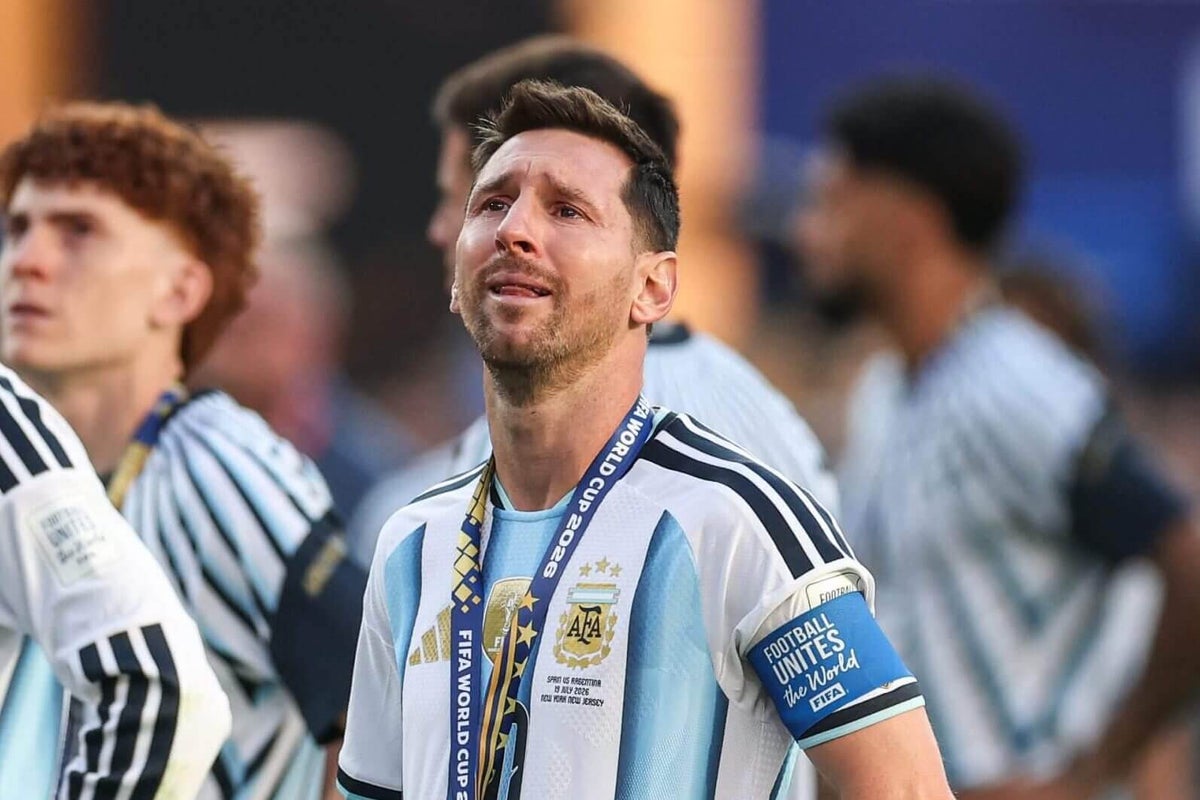
Argentina captain Lionel Messi has confirmed his retirement from international football.
The 39-year-old’s last appearance for Argentina was the World Cup final defeat by Spain. It was Messi’s sixth appearance at a World Cup and one in which he became only the second player (after Brazil’s Cafu) to appear in three men’s World Cup finals, having won the previous edition in 2022 and been a runner-up to Germany in 2014.
Writing on Instagram on Monday, Messi said the decision “hurts deep in my soul”, but added that he “realises the time has come.”
Earlier this month, the Inter Miami star spoke of his doubts over continuing his playing career “for much longer” following the death of his father, Jorge, who died aged 68 on August 8.
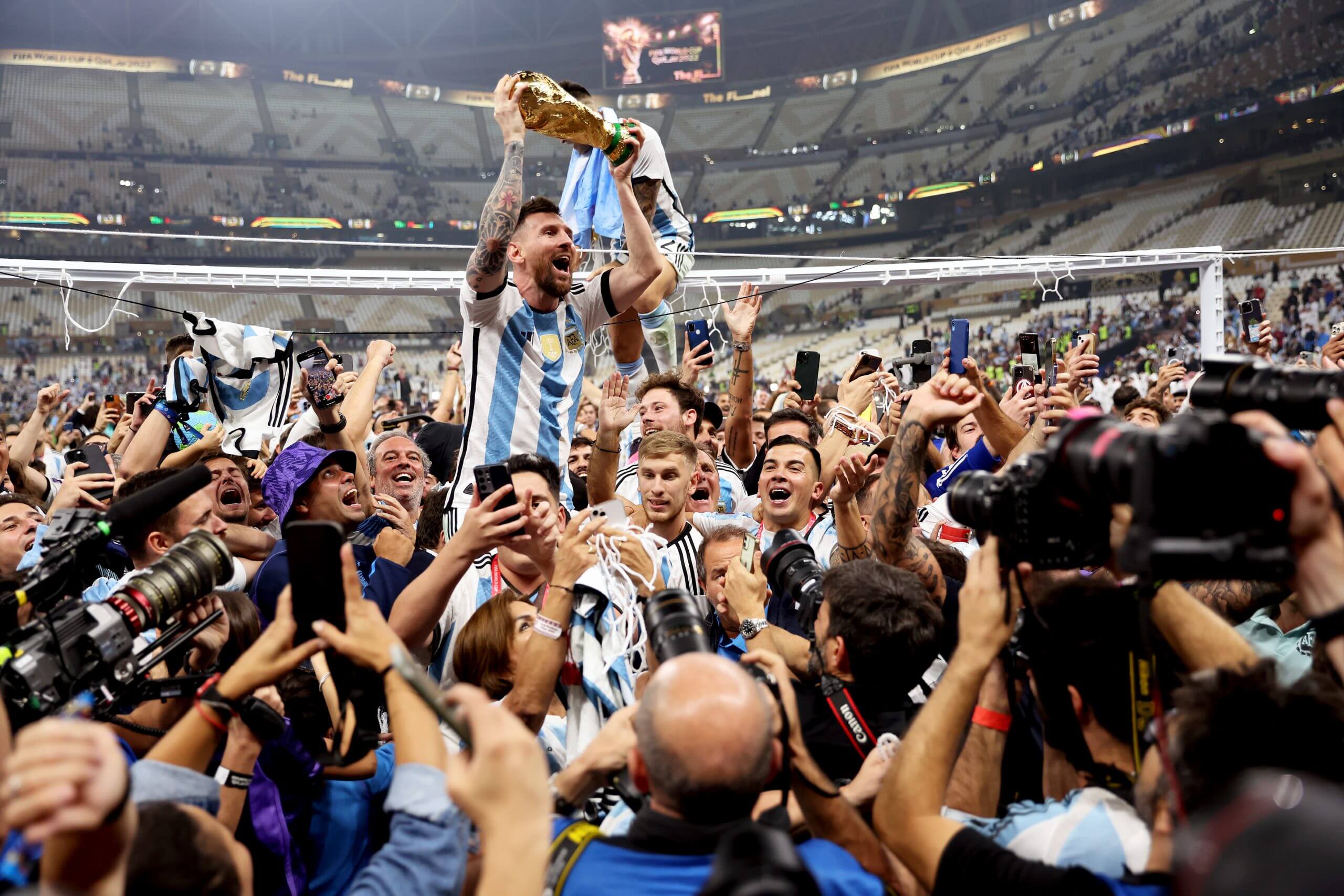
Messi won the World Cup with Argentina in 2022. (Clive Brunskill / Getty Images)
Argentina’s next major tournament will be the Copa America in 2028, when Messi will be aged 41. The next World Cup, which will have one match in Argentina (as well as one each in Paraguay and Uruguay) before being primarily hosted in Spain, Portugal and Morocco, would see Messi turn 43 midway through.
Argentina and Messi were nullified by Spain in July’s final, as the South American champions registered only two shots in 120 minutes — one from Messi, which was blocked — before Ferran Torres scored the 106th-minute winner.
“The pain is immense and it’s going to take a long time for this wound to heal,” Messi wrote on Instagram the day after the final. “But I’ll also hold on to all the good memories … It’s hard to appreciate what we achieved today, but this squad reached two consecutive World Cup finals.”
The Argentina captain ended the tournament in North America with eight goals and four assists, finishing second in the Golden Boot race behind France’s Kylian Mbappe, and with the Silver Ball award — finishing behind Golden Ball award-winner Rodri.
Messi became the all-time leading goalscorer in World Cup history during this summer’s edition, surpassing Germany’s Miroslav Klose (16) when he scored the opener in the 2-0 group-stage win against Austria. However, that record was short-lived after Mbappe’s double in the third-place play-off against England saw the France captain move to 22 total World Cup goals.
Messi is widely recognised as one of the best players of all time, and is his country’s all-time record appearance holder (207) and goalscorer (125).
The 2026 World Cup was Messi’s sixth, the joint-most editions played in by any player at the men’s tournament alongside Cristiano Ronaldo. The 2010 World Cup in South Africa is the only one in which he failed to score.
Messi has captained Argentina since 2011 and won the World Cup in 2022 for the first time. He is a two-time winner of the World Cup Golden Ball, presented with the award for the tournament’s best player in 2014 and 2022.
Messi played a crucial role in leading Argentina to their first World Cup title since 1986 in 2022, when he scored seven goals en route to his nation lifting the trophy in Qatar. It added the major trophy which had eluded him during his international career, having twice won the Copa America, in 2021 and 2024, and led to him winning his eighth Ballon d’Or — the most of any player in history.
While the forward brings an end to his international career, he is contracted for another two years with MLS club Inter Miami. Speaking in 2024, Messi said he would not retire until “I can no longer perform, or no longer enjoy the game, or not able to help my team-mates.”
Lionel Messi’s statement in full
“Now that some time has passed since the final, having thought it over carefully, I want to tell you all that I am retiring from the national team.
“It was a decision that hurt — and still hurts — deep in my soul, but I realise that the time has come. I swear to you that I always gave my all – not just in recent years when we won everything, but before that too – and I always fought hard and gave my all for this shirt, to bring you joy and make you feel proud to be Argentine through football.
“There’s not much time left and chapters are coming to a close; this is one that hurts me deeply. I love, have loved and will always love being part of the national team. I’ve given my all; I’ve nothing left to give, and besides, there are some brilliant young players coming through who deserve their place.
“Thank you for all the love over these 20 years. I’m going to miss hearing you all from the pitch so much. Now I’ll be just one of you, always cheering you on and supporting you from the sidelines (through thick and thin – especially the tough times).
“Thank you to my family for always being there, for accompanying me on this beautiful yet difficult journey. Thank you to every single coach, team-mate and official I’ve had the privilege of sharing this journey with. I take with me unforgettable memories and moments.
“I leave with the peace of mind and pride of having given you, together with my team-mates, moments we could only have dreamed of. It was incredible to have experienced it all with you. I love you all!
“Thank you, God, for making me Argentine.
“Come on, Argentina!
“*I wrote these words on 21 July, two days after the final. Today, after what happened with my dad, I’m even more convinced than before.”
An emotional, but expected, goodbye
Analysis by senior football writer Oliver Kay
The announcement is not a surprise. It was expected in the days — possibly even the hours — after last month’s World Cup final. Messi says he wrote his statement two days later, on July 21, so the timing of the announcement reflects a period of further contemplation along with the time to grieve the death of his father, Jorge.
It has been, as he said in today’s statement, “a beautiful but difficult journey” for Messi with the Argentina team. It will go down as international career of two distinct halves: the first half featuring defeats in three consecutive finals (two Copa America and one World Cup), struggling to replicate his irresistible Barcelona form, which led him briefly to retire from the Argentina team in 2016; the second full of highlights as, having been coaxed back to the national team, he led them to victory at Copa America in 2021 and 2024, either of side of his crowning glory at the 2022 World Cup.
He wanted the perfect ending at this summer’s World Cup, during which he turned 39. His brilliance and heroics took them all the way to the final, but they were beaten by a superior Spain team. The sight of him at the final whistle, struggling to hold back the tears as Argentina’s supporters chanted his name, added to the feeling that this was his final appearance on the international stage.
Messi will continue playing in Major League Soccer for Inter Miami, but after 207 appearances and 125 goals for Argentina, his time on the biggest stages is over.
The legacy he leaves behind is enormous. Had he stuck to his initial decision to retire from international football in 2016, a lack of success with Argentina would have been held against him even as he maintained his extraordinary form at club level. But what he went on to achieve in the later years of his Argentina career only enhanced his claims to be recognised as the greatest of all time. There was no happy ending in 2026, but that would perhaps have been too much for even Messi to ask.
Messi’s Argentina career by numbers
Analysis by Will Jeanes
Messi’s astonishing international career was of course about so much more than just statistics — both on and off the field — but, nevertheless, with him finally now stepping away from the Argentina team for good after 21 years, it is worth detailing just how extraordinary his numbers really were.
He played for Argentina 207 times and scored 125 goals, with Ronaldo of Portugal (233 games and 146 goals) the only man ahead of him on either metric.
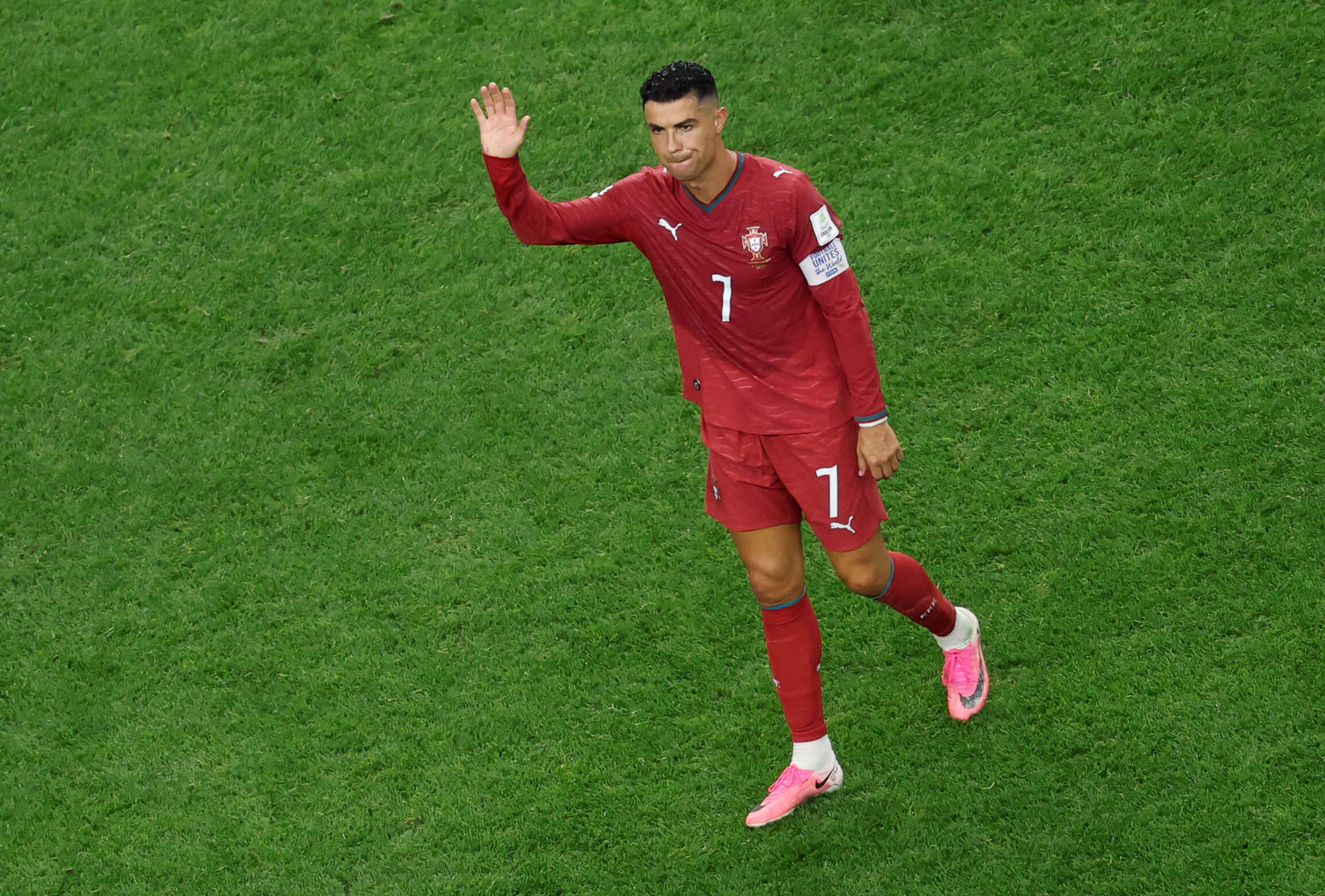
Ronaldo is the only man to score more international goals than Messi. (Stacy Revere / Getty Images)
A remarkable 21 of those goals came at the World Cup and 14 at Copa America, meaning Messi scored more goals for Argentina at major tournaments than Diego Maradona scored in total for the South American nation (35 to 34).
Fifteen of his goals at the World Cup came after turning 35 years old, with only Mbappe (22) and Klose (16) bettering that figure among all players at any age in the competition’s 96-year history.
Overall, he played at six World Cups and seven editions of Copa America, winning the former once (in 2022) and the latter twice (in 2021 and 2024).
His debut came in a friendly in August 2005, when he was sent off against Hungary after less than two minutes (one of two red cards he received for Argentina) and over the course of his time with Argentina he had 187 different team-mates, with one born in 1972 (Roberto Abbondanzieri) and another born in 2007 (Franco Mastantuono).