
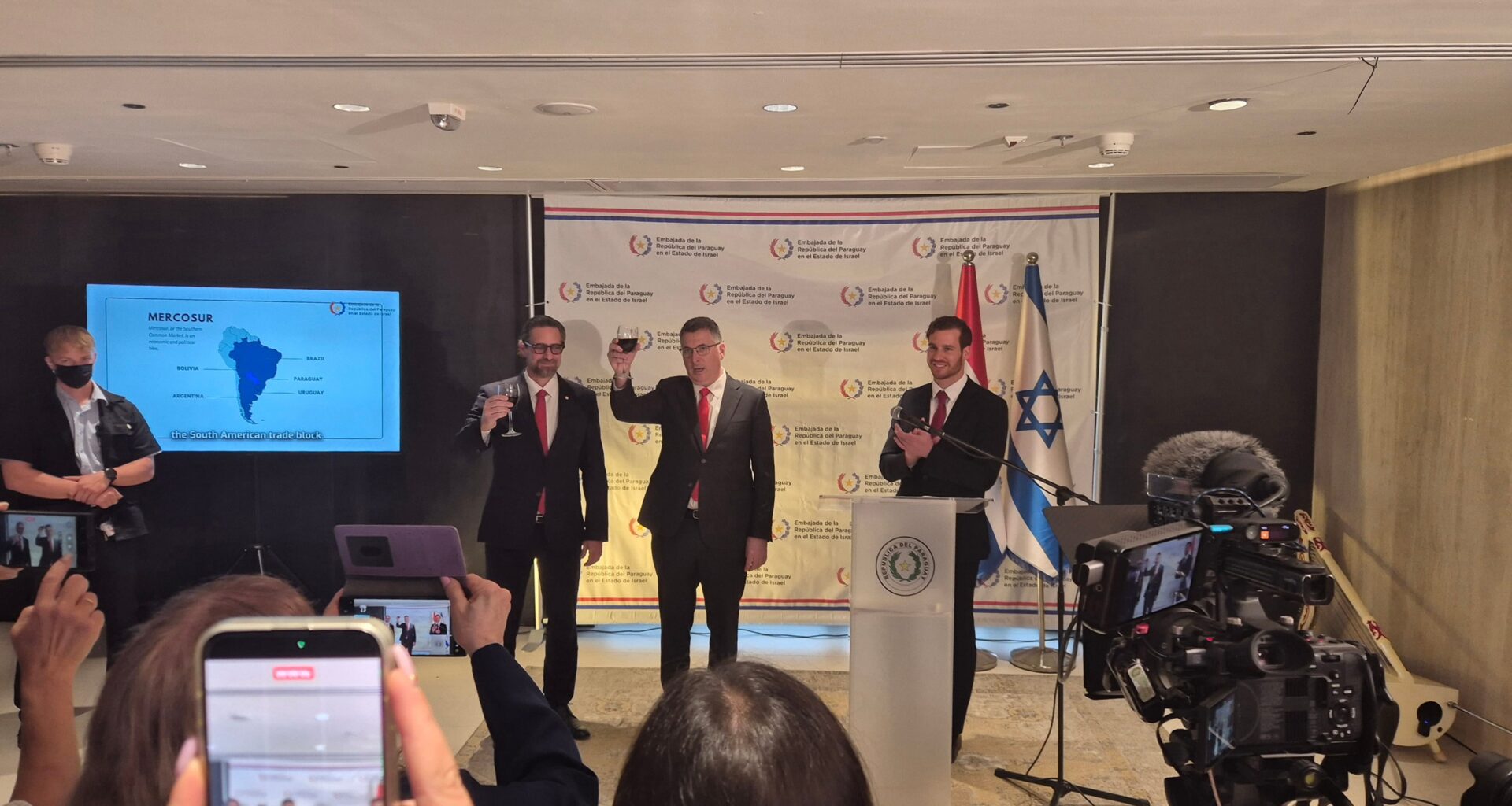
Alejandro Rubin Cymerman said his next personal priority is getting Israeli backpackers to include Paraguay in their itineraries. He said Israeli visitors “can show their passports without shame, without fear of being Israeli.”
The WhatsApp videos come from Israeli friends who have spotted Paraguay’s flag beside beef for sale. “Ambassador, there’s Paraguayan beef here,” they tell Alejandro Rubin Cymerman, Paraguay’s ambassador to Israel. He had visited supermarkets, suppliers, and buyers to ask them to display the flag. Now, those messages give him a satisfaction that trade figures alone cannot provide.
“Israel needs its supporters to be here,” Rubin told The Media Line in a Spanish-language interview at Paraguay’s embassy in Jerusalem. He arrived in January 2024 with instructions to move the mission to the city during the war. With that move accomplished, his work now includes building commercial and institutional ties that can withstand changes in government, ranging from beef sales to water management and education.
Rubin put Paraguayan beef exports to Israel at $220 million in 2025 and forecast roughly $300 million for the current year. That compares with $88 million in 2023, when, he said, exports practically stopped after October 2023. He credited the private sector with much of the subsequent growth. “We only played a small part,” he said, while describing his effort to make the meat’s Paraguayan origin more visible to shoppers.
The country itself had been unfamiliar to many Israelis he encountered when he arrived, Rubin recalled. Some asked where Paraguay was, a response he found painful given its longstanding support for Israel, dating back to the 1947 UN partition vote.
Today I go out, say ‘Paraguay,’ and people say, ‘Thank you’
He believes President Santiago Peña’s public support and the embassy’s relocation helped change that. “Today I go out, say ‘Paraguay,’ and people say, ‘Thank you,’” he said. Rubin described Israel, the United States, and Taiwan as the three pillars of Peña’s foreign policy.
Paraguay’s embassy policy has changed with its presidents before. The country moved its mission to Jerusalem in 2018, then returned it to Tel Aviv later that year under a new president. Israel responded by closing its embassy in Asunción. Israel reopened its mission in September 2024, and Peña inaugurated Paraguay’s embassy in Jerusalem that December. Rubin called the earlier reversal the relationship’s worst moment, while stressing that Paraguay never closed its embassy in Israel.
Asked how the relationship could withstand another political transition, Rubin said both governments and their foreign ministries were working to make cooperation useful to their populations. He suggested domestic Paraguayan considerations may have contributed to the 2018 decision. The task now, he said, was to establish “the strongest possible ties” beneath the embassy’s move to Jerusalem, with benefits for both countries.
Paraguay and Israel have signed at least five memorandums of understanding, according to Rubin, covering areas such as water, innovation, defense, and technology. Their implementation has been uneven. “Sometimes signing agreements is easier than carrying them out,” he said. Water cooperation is furthest along: Israeli technical experts have visited Paraguay to examine its water system, an assessment is being prepared, and another delegation is planned.
Sometimes signing agreements is easier than carrying them out
Paraguay’s abundant water does not make that work unnecessary, Rubin argued. The country sits above one of the world’s largest aquifers, he noted, but poor management could create future problems, including declining water quality. “You might say we have no water problem. But we do have a water management problem,” he told The Media Line. Israel’s experience managing scarce water supplies, in his view, offers practical lessons for a country with very different resources.
War disrupted the exchanges needed to move projects forward. Rubin said bringing visitors to Israel had been particularly difficult for almost six months. Embassy staff continued working from bunkers, hearing explosions, and feeling the building shake. “We went through very difficult times,” he said. Visits are resuming, according to the ambassador, after interruptions that slowed cooperation across several fields.
On cybersecurity, he did not confirm that a separate memorandum expected in 2026 had been signed. He described a process of review and exchanges between the responsible ministries. Under the security agreement signed in 2025, he said, delegations must be formed, with an Israeli delegation due to make the first visit. Arranging travel by defense officials has been difficult while Israel emerges from wartime conditions, he said.
Rubin distinguished those formal arrangements from existing intelligence and security cooperation, which he said had continued. “That doesn’t require a memorandum of understanding between the institutions,” he said. “They understand each other.” He did not describe specific operations or intelligence exchanges but maintained that cooperation between the two countries remained active despite the obstacles to official visits.
Education presents a different problem of measurement. Asked about cooperation with the Feuerstein Institute, an Israeli research center focused on cognitive development, Rubin said the work requires time and cannot be judged as quickly as commercial sales. He did not offer figures for educational outcomes. “It’s not the same as selling beef,” he said. “Beef is easier. But this is where we’re investing in long-term relationships.”
Agriculture also gives the two countries a reason to work together beyond the sale of meat. Paraguay knows how to produce food, Rubin said, but needs to increase output from each square meter of land. He sees Israeli technology as a way to improve productivity, and said private companies were seeking each other out. He also promoted Paraguay as a base for Israeli businesses entering the Mercosur regional trading bloc, citing its economic stability and tax environment.
Paraguay needs a strong Argentina. It needs a strong Latin America.
Rubin welcomed what he described as a rightward political shift in parts of Latin America, associating it with renewed ties to the United States and Israel. He said Paraguay maintains good relations with its neighbors and benefits when they prosper, while arguing that its economy has become less dependent on their fortunes. “Paraguay needs a strong Argentina. It needs a strong Latin America,” he said.
His next personal priority is getting Israeli backpackers to include Paraguay in their itineraries. He described an affordable country with good food and abundant nature but acknowledged that it still needs to win a place in their travel plans. He also offered a reassurance to prospective Israeli visitors: They “can show their passports without shame, without fear of being Israeli.”