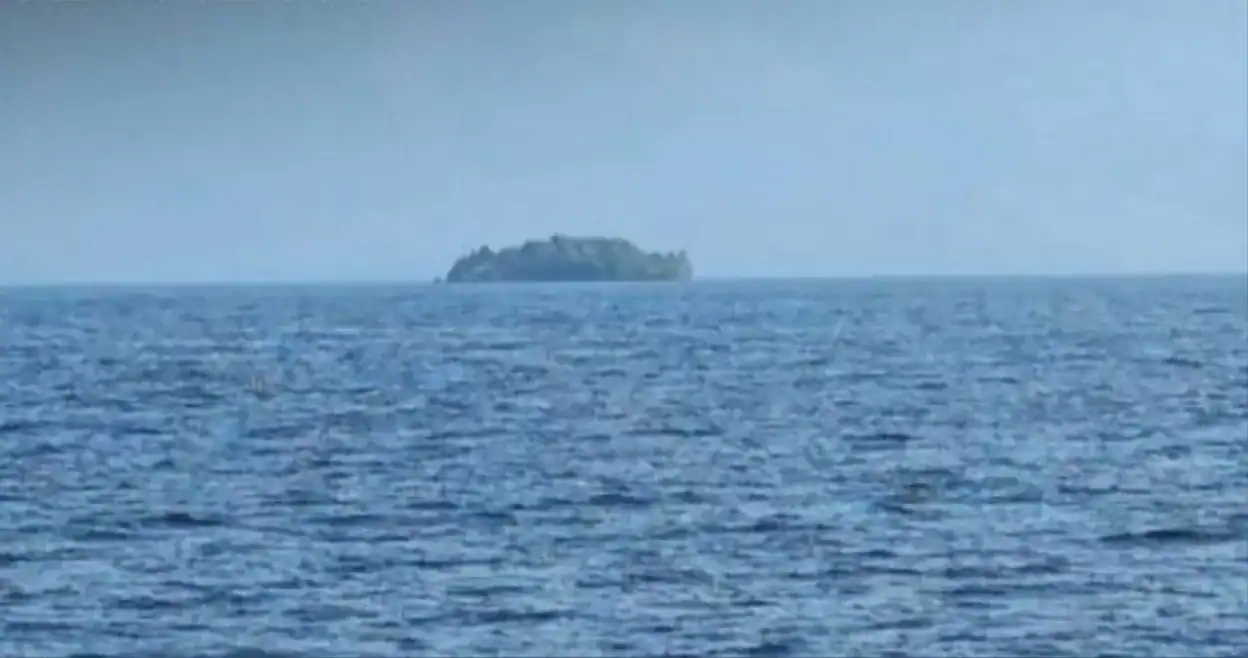
 Still from footage of the reported new island at Williston. Credit: Facebook.
For a while, the simplest explanation was that the reported sighting of a new island did not exist. Surely, it must be some AI hoax.
Earlier this summer, boaters on British Columbia’s enormous Williston Reservoir began reporting something truly bizarre: a forested island, complete with mature trees, drifting through open water. It seemed to have appeared from nowhere. There was no obvious place it had broken away from, and almost no one else had seen it.
Even officials at B.C. Hydro, the provincial utility that operates the reservoir and the W.A.C. Bennett Dam, were initially unsure what to make of the reports.
Bob Gammer, a spokesperson for the utility, initially wondered whether the images circulating online might be fake, a reasonable suspicion in an era of increasingly convincing AI-generated pictures. “It’s certainly something we’ve not heard of before,” Gammer told CBC News. “And with not very many people reporting it, it was difficult to locate.”
Then satellites found it.
An image taken from Earth’s orbit on July 21 showed an unmistakable patch of trees floating west of Finlay Bay, roughly 100 kilometers from the W.A.C. Bennett Dam. The thing was enormous for a supposedly new island appearing out of thin air: about 140 meters long and 70 meters wide, covering nearly 9,800 square meters — close to the size of two NFL football fields.
And then, just as strangely as it had appeared, it disappeared.
 Satellite images from July 21 and August 5 show the location and estimated size of the floating island in Canada’s Williston Reservoir before it disappeared from view. Credit: B.C. Hydro
By Aug. 5, fresh satellite images showed no sign of the floating forest. B.C. Hydro could not say where it had gone. It may have drifted into a hidden cove, blended back into the shoreline or moved somewhere else across a reservoir so vast that even a two-football-field-sized island can apparently get lost.
×
Thank you! One more thing…
Please check your inbox and confirm your subscription.
The episode sounds almost supernatural. But scientists have seen it happen before. Floating mats of peat, roots, driftwood and vegetation can grow large enough to support shrubs and even mature trees. Under the right conditions, rising water can rip them free and winds can send them wandering across lakes and reservoirs.
Williston’s mystery, then, is not whether an island like it can form. It is how this particular one formed, what set it loose — and where, exactly, it is now.
Somewhere on one of the world’s largest reservoirs, nearly 10,000 square meters of forest may still be on the move.
How does an entire forest start floating?
Williston is not an ordinary lake. Created after the W.A.C. Bennett Dam impounded the Peace River in 1968, it covers roughly 1,760 square kilometers and ranks as the world’s seventh-largest reservoir by volume. Its scale is one factor explaining why a small island can go unnoticed. Monitoring every bay and inlet continuously is not practical.
This year also provided unusually favorable conditions for putting a piece of shoreline into motion.
A heavy mountain snowpack followed by steady summer rain brought the reservoir to full capacity for the first time in 14 years. Water rose into places that had long been dry, and B.C. Hydro opened the Bennett Dam spillways in June and July.
Gammer’s working explanation is that driftwood had accumulated for years in a sheltered section of shoreline. As the wood decayed, plants took root in the mass. Roots, soil, decomposing vegetation and timber gradually became bound together. When the reservoir rose high enough, the structure may have lifted or torn free.
“We haven’t had a full reservoir in 14 years,” Gammer told CBC News. “We can’t pinpoint the origin of this floating island [but that’s] one explanation that seems reasonable.”
No one has sampled the island, so its exact construction remains unknown. But there are good scientific precedents for something like it.
Researchers studying natural floating peatlands have found that vegetation can grow on thick mats of organic matter that remain buoyant. Decomposition can produce gases inside peat, helping lift the material, while dense networks of roots and rhizomes hold the mat together. Some floating peatlands eventually support shrubs and trees, according to research published in Scientific Reports.
Once freed, the trees themselves can help move the island. Their trunks and crowns catch the wind like sails.
“It doesn’t mean it’s gone to the bottom of the reservoir,” Gammer said. “It may have returned to a more sheltered area along the shoreline.”
Floating islands can become surprisingly mobile
 High water levels in northern British Columbia’s Williston Reservoir forced B.C. Hydro to open the W.A.C. Bennett Dam spillways in June and July. Credit: Matt Preprost/CBC
This isn’t Wisconsin’s first rodeo with new floating islands.
When the Chippewa Flowage was created in 1923, flooded peat bogs rose toward the surface. Some later developed grasses, shrubs and mature trees. Today, movable bogs there can range from patches the size of a parking space to several acres. The famous “Forty Acre Bog” occasionally drifts far enough that boats have to help move it away from structures. According to local accounts, high water and strong winds can suddenly send formations that have sat still for decades traveling across the reservoir.
Researchers have seen more consequential versions in Africa. A 2023 study of floating islands around Lake Victoria and the White Nile dams found that rainfall, changing water levels and wind all helped govern when large vegetation masses formed and where they traveled. The islands can obstruct transportation, fisheries and irrigation and even interfere with hydropower facilities, so studying how they form can be of great interest to authorities.
One especially dramatic example came in Uganda in 2020, when floating vegetation reached the Nalubaale hydropower dam and contributed to a nationwide electricity blackout.
B.C. Hydro says it does not expect the Williston island to affect its energy generation operations. But floating material is hardly a new concern there.
The utility’s 2026 Williston Reservoir management report describes an ongoing program that uses annual aerial surveys to identify woody debris and removes material partly to reduce navigation hazards. That program has operated since 2009.
The mystery now is where it went
The satellite trail went cold on Aug. 5. The eyewitness trail did not.
On Aug. 12, a resident filmed what appeared to be the same floating forest much farther east, near the reservoir’s Peace Reach. The video eventually reached Rocky Avery, the local resident who had helped publicize the original sightings.
Then came another report. Avery said the island was spotted again on Sunday, Aug. 30.
Neither sighting appears to have been independently confirmed by B.C. Hydro, and the island’s present location remains unknown. But if the reports involve the same mass seen by satellite in July, they offer a much less mysterious explanation for its apparent disappearance: it never disappeared at all. It simply moved.
That is surprisingly easy to do on Williston. The reservoir covers roughly 1,760 square kilometers, with long arms, bays and convoluted shorelines. A floating mass pushed against the shore could become difficult to distinguish from the forest behind it. Once the wind changed, it could break away again and resume its journey.
And the giant floating forest may not be alone. In comments on Avery’s Facebook updates, Dawson Creek resident Patrick Tutin described encountering unusually large amounts of floating material elsewhere on the reservoir.
“The last time I was out, there was a ton of debris and a couple root balls that looked like islands,” Tutin wrote, according to Gizmodo. Of the much larger floating forest, he added: “This is something else, this is unreal!”
For boaters, those smaller pieces may pose the more immediate threat. B.C. Hydro warns visitors to Williston Reservoir that floating and submerged debris can occur throughout the lake, and whole trees can become difficult to spot when the water turns choppy.
Avery offered his own warning.
“Some are full-size trees and it’ll do a lot of damage to your boat,” he told CBC News. “So you got to be super careful.”
As for the two-football-field-sized forest, B.C. Hydro is still watching for it.