
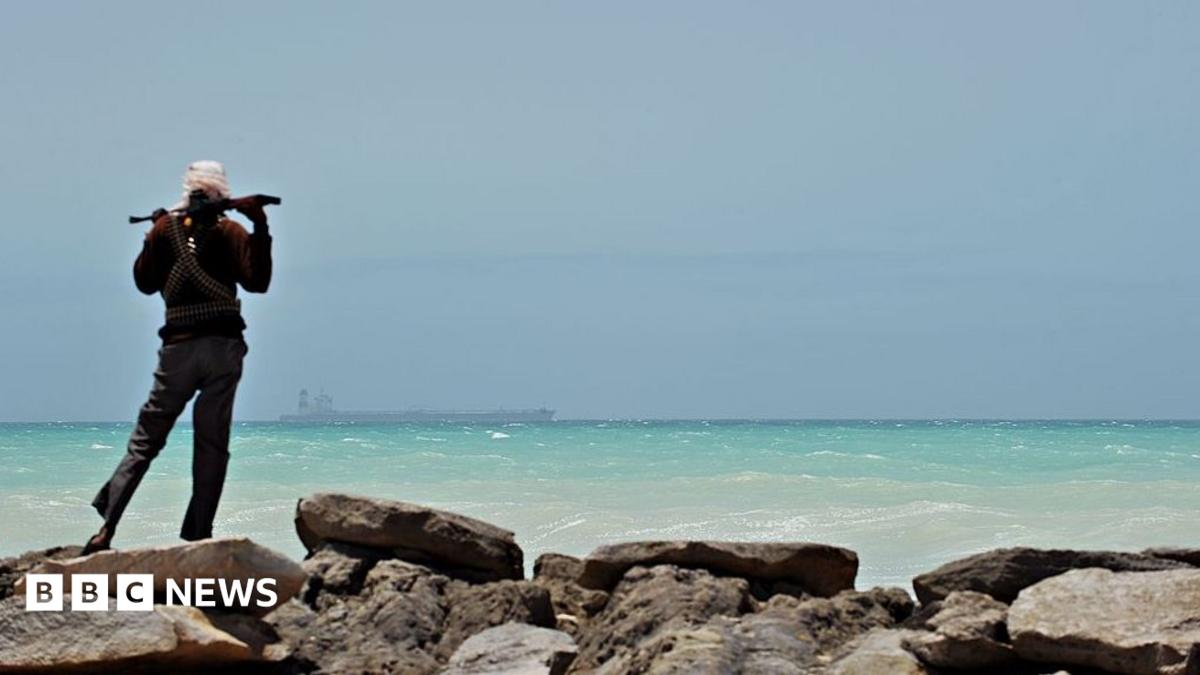
The security sources say eventually six international warships arrived in the seas close to the Lutuf – two from Turkey and one each from Spain, Denmark, the US and India, something the BBC was not able to independently verify.
“There is military equipment on the [hijacked] ship meant for Turkey’s operations in Somalia,” the Somali government official said, speaking on condition of anonymity, adding that the cargo included satellite equipment for a space station that Ankara is building north of the capital.
He alleged that Turkey had carried out the second drone strike that killed nine armed men on 23 August.
“The men who were killed were criminals and I don’t have sympathy for them,” he said, “but taking it to that level is escalating the situation even more.”
Turkey’s defence ministry stated that its forces are providing “necessary support” to Somali authorities regarding the incident involving a hijacked vessel in Somali territorial waters, within the framework of their security agreement. But it stopped short of addressing the accusations that Turkey had carried out deadly drone strikes.
Publicly the government in Mogadishu said only that it was aware of the operations against pirate groups and would take measures to address them.
Puntland authorities were more outspoken.
Speaking to the BBC’s Somali Service, Deputy Minister of Security Abdirahman Yusuf said his administration had evidence that Turkey was responsible for the attacks, citing information about Turkish activity around the vessel and along the Puntland coast.
The BBC has not independently verified his allegations.
The security ministry also issued a statement expressing opposition to “bombings by international warships targeting civilians” that “undermined co-operation… in combatting piracy”, and demanded an immediate explanation for why they were carried out.
Rival accounts have since emerged of how the Lutuf was reportedly later released.
Somalia’s government said its troops carried out a joint operation with Turkey, freeing the ship and killing 14 pirates. Puntland authorities denied that claim, declaring that the pirates were actually paid a hefty ransom, something they called a “serious mistake” that could encourage further hijackings and undermine anti-piracy efforts.
Neither Turkey nor the ship’s owners have commented.
Puntland is wary of Turkey’s close military relationship with the Somali government, and the incidents risk further complicating a long-standing political dispute between the semi-autonomous region and Mogadishu that hinders a co-ordinated effort to fight piracy, analysts say.
There is not yet a full-blown resurgence. But without an end to the US-Iran war, or increased international efforts at deterrence, Somali piracy stands to continue raising the threat level in a crucial maritime space that is already dangerously squeezed.
Additional reporting by Mohamed Gabobe in Mogadishu and the BBC Somali Service
Update 31 August 2026: This story has been amended to reflect the fact that the MV Lutuf was released