
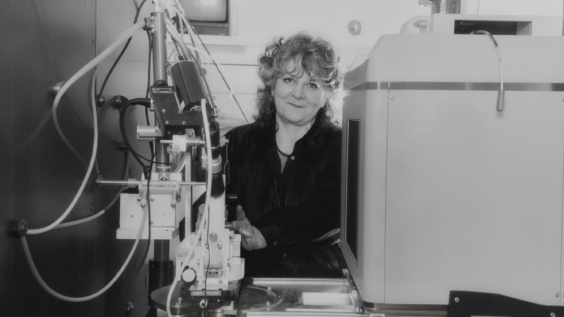
Ada Yonath became the first Israeli woman to win a Nobel Prize, but the discovery that brought her that distinction had implications far beyond the award itself: Her pioneering research into the structure of the ribosome helped advance the development of antibiotics and efforts to combat drug-resistant bacteria.
Yonath died Monday at 87. Born Ada Lifshitz in Jerusalem’s Geulah neighborhood in 1939, she moved with her family to Tel Aviv and began teaching math at age 12 to earn tuition for Tichon Hadash high school.
Yonath returned to Jerusalem to study at Hebrew University, earning a bachelor’s degree in chemistry and a master’s in biochemistry. She received her PhD in X-ray crystallography from the Weizmann Institute of Science in 1968 before completing postdoctoral work at Carnegie Mellon University and the Massachusetts Institute of Technology.
After returning to Israel, Yonath established the country’s first protein crystallography laboratory and pioneered the production of ribosome crystals. She later held senior positions at Weizmann, including serving for many years as director of the Mazer Center for Structural Biology.
Her work revealed the structure and function of ribosomes, the cellular machinery responsible for producing proteins. In 2009, that research made her the first Israeli woman to receive the Nobel Prize in Chemistry.
The Weizmann Institute said her discoveries helped “pave the way for the development of more advanced antibiotics and the fight against antibiotic-resistant bacteria – one of the most pressing medical challenges of the 21st century.”
Yonath also belonged to the US National Academy of Sciences, the American Academy of Arts and Sciences, the Israel Academy of Sciences and several other international academies.
President Isaac Herzog remembered Yonath as “among the leading researchers in Israeli scientific history,” describing her as a “globally pathbreaking woman” whose curiosity, determination and devotion pushed beyond the existing boundaries of scientific knowledge.