

Manchester City have reached an agreement with Chelsea to sign midfielder Enzo Fernandez for £125million ($169m).
The package for Fernandez equals the existing British transfer record set by Liverpool’s purchase of Alexander Isak from Newcastle United last summer, a move that was also completed late in the transfer window.
Fernandez has been given permission by Chelsea to undergo a medical ahead of the proposed move.
City had offered £104m plus add-ons but Chelsea asked any fee be fixed and then specified on Monday a price of £135m, at which point City indicated they were walking away, before a compromise was found at £125m.
Fernandez’s impending exit brings to an end what has been a drawn-out saga surrounding the 25-year-old and his future at Chelsea.
The west London club had indicated on August 14 that they expected Fernandez to stay for the 2026-27 season after their self-imposed deadline passed without City making a bid.
Chelsea valued Fernandez at £120m and insisted at the time that if they did not receive an offer of that figure inside the outlined timeframe, he would not leave the club this summer.
Chelsea said that their terms were communicated to City and Fernandez’s camp, and said his representatives had been made aware of their valuation since May.
However, The Athletic reported on Monday that City had turned their focus to Fernandez after their pursuit of Liverpool forward Cody Gakpo ended with the Merseyside club rejecting a bid of up to £80m.
Fernandez was booed by supporters at Stamford Bridge during the club’s final pre-season friendly against Real Sociedad and again in the opening Premier League game at Fulham. He ended the match by going down the tunnel without joining his team-mates in front of the away support at full-time and did not feature in either of the following games, against Luton Town in the Carabao Cup or Brighton & Hove Albion in the league on Sunday.

Fernandez has made 170 appearances for Chelsea, scoring 31 goals and providing 30 assists. (Shaun Botterill/Getty Images)
Fernandez joined Chelsea from Benfica for a then British transfer record of £106.8m in January 2023 and has a contract with the club until 2032.
He cast doubt over his Chelsea future on multiple occasions during the latter stages of the 2025-26 campaign, culminating in former head coach Liam Rosenior dropping him for two games in April.
Fernandez’s agent, former Argentina international Javier Pastore, told The Athletic that the punishment was “completely unfair”. The player later apologised and returned to the squad.
The Athletic reported in April that City were considering Fernandez as a midfield option this summer. The club have already signed England midfielder Elliot Anderson from Nottingham Forest for £116m and Ayyoub Bouaddi from Lille for an initial €95m.
This comes after Rodri joined Barcelona and Tijjani Reijnders left for Saudi Arabian side Al Qadsiah, while Tottenham Hotspur have signed Savio and Omar Marmoush.
Fernandez played under new City manager Enzo Maresca for 18 months at Chelsea.
Real Madrid, meanwhile, publicly denied reports linking them with a move for the 2022 World Cup winner earlier this summer.
Fernandez has made 170 appearances for Chelsea, scoring 31 goals and providing 30 assists.
Will Chelsea miss Fernandez?
Analysis from Chelsea correspondent Liam Twomey
The transfer saga of the summer is finally over. Chelsea certainly won’t miss Enzo Fernandez the distraction, but how much will they miss Enzo Fernandez the player?
Chelsea need some of the things that Fernandez can provide in central midfield — namely, his ability to dictate play and progress the ball into the final third at a high level — but those things have not really been the bulk of the value he has provided in his three-and-a-half years at Stamford Bridge.
Fernandez excelled under Maresca as a box-crashing, goalscoring midfielder operating from a more advanced position in the left pocket, scoring 15 goals last season. Chelsea filled that spot at great expense in July with the £117m signing of Morgan Rogers, who has made a very impressive start to life in Xabi Alonso’s team.
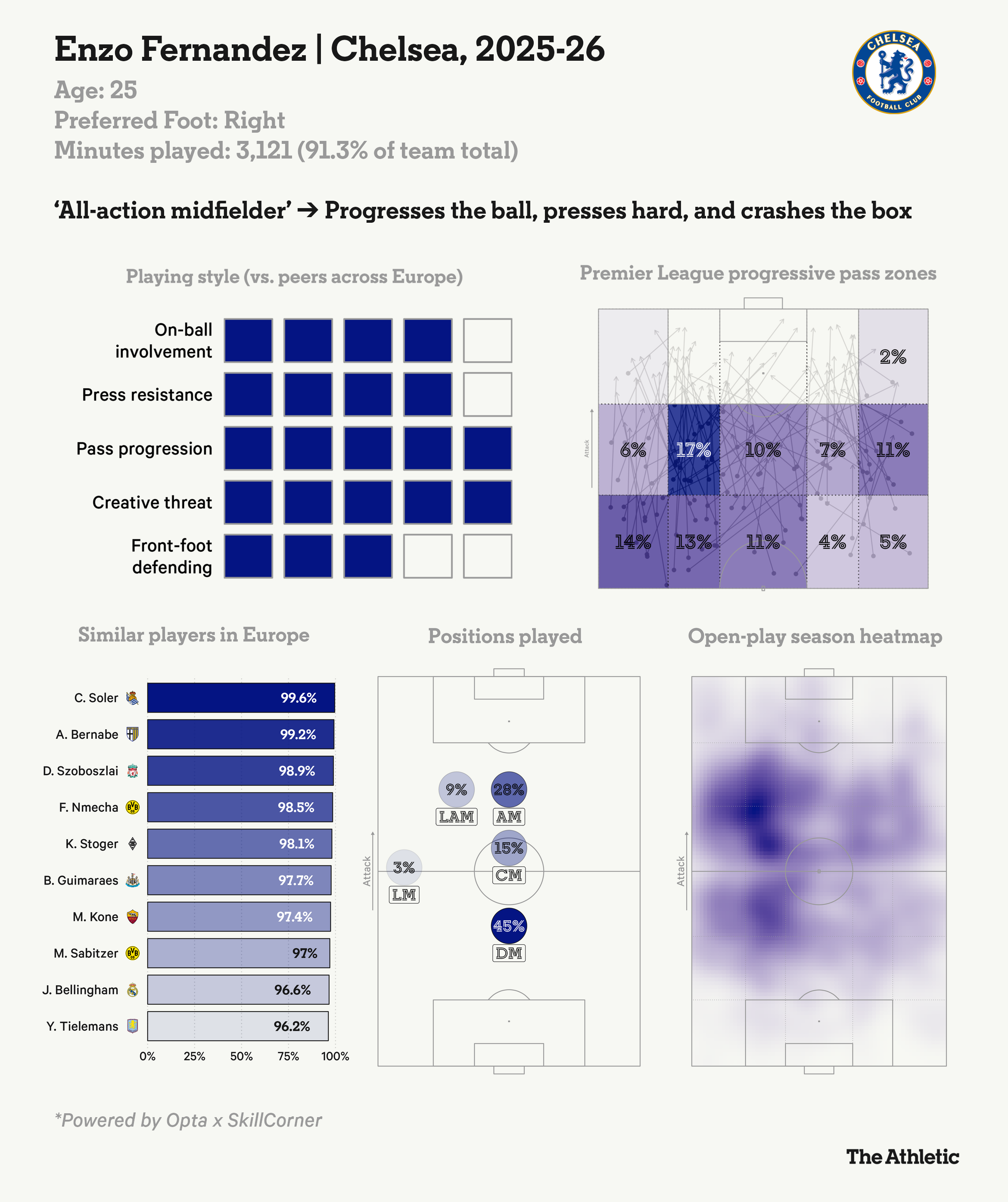
Had he stayed, Fernandez would have been required to play in Alonso’s midfield double pivot, where he and Moises Caicedo have rarely looked good enough without the ball to be a dominant Premier League pairing. Defensive solidity already looks to be Alonso’s biggest challenge as he builds his Chelsea team, and the Argentine would not help in that endeavour.
Then there are Fernandez’s less tangible qualities. For most of his Chelsea career, he served as de facto vice-captain behind Reece James, regularly wearing the armband on the pitch. His personality and dressing room presence merited that status, but his body language towards teammates at times raised eyebrows and his enduring loyalty to Maresca was a problem.
Chelsea needed a cultural reset and a midfield revamp under Alonso, and Fernandez’s sale substantially advances the progress of both.
Analysis from Football Finance Writer Chris Weatherspoon
Chelsea paid Benfica €120million to bring Fernandez to west London in January 2023, at which time he signed an eight-and-a-half-year contract. His new club exercised an option to extend his deal by a further year soon after.
Clubs spread fees across the life of player contracts, and Chelsea signing players up to such lengthy terms was widely seen as a way of spending big without torpedoing their immediate finances, and remaining compliant with profitability and sustainability rules (PSR).
Lengthier amortisation terms mean players hold higher book values for longer; if Fernandez was to be sold in this year’s summer window, Chelsea would have needed to recoup a sizeable fee in order to turn a profit on him.
The figures are inexact, given the lack of verified detail around the costs of signing players, but we can estimate.
We know, for example, that Fernandez cost Chelsea £106million three years ago, and that the Premier League applies a four per cent levy on all incoming transfers. Guess at some agent fees to go on top, and you arrive at a total acquisition cost of £121m.
Chelsea were amortising that region of fee over eight and a half years for a short time, but their triggering of a one-year option in spring 2023 spread the cost yet further. In essence, based on The Athletic’s estimates, Fernandez currently costs them £12.8million in annual amortisation fees. It is worth remembering that all of this relates to how the transfer is accounted for, and that is separate from the cash terms of the deal.
By extension, at just three years into a now nine-and-a-half-year deal, Fernandez’s accounting value remains high. According to our estimate, on the day this summer’s transfer window opened, Fernandez would have still carried a net book value of £77.6million. Any fee received below that, or below £75m by the window’s end, would have seen Chelsea recognise a loss.
Chelsea need to continue to be good sellers, not least when the terms of their settlement agreement with UEFA limit them to €5m in adjusted losses this season and require them to break even (again, adjusted) in 2026-27.
Selling Fernandez would naturally result in wage savings and remove those £12.8million annual amortisation costs. At a club where player sales are so important, only managing a slim profit or, god forbid, an accounting loss on a star’s departure, would hardly have helped their financial situation.