
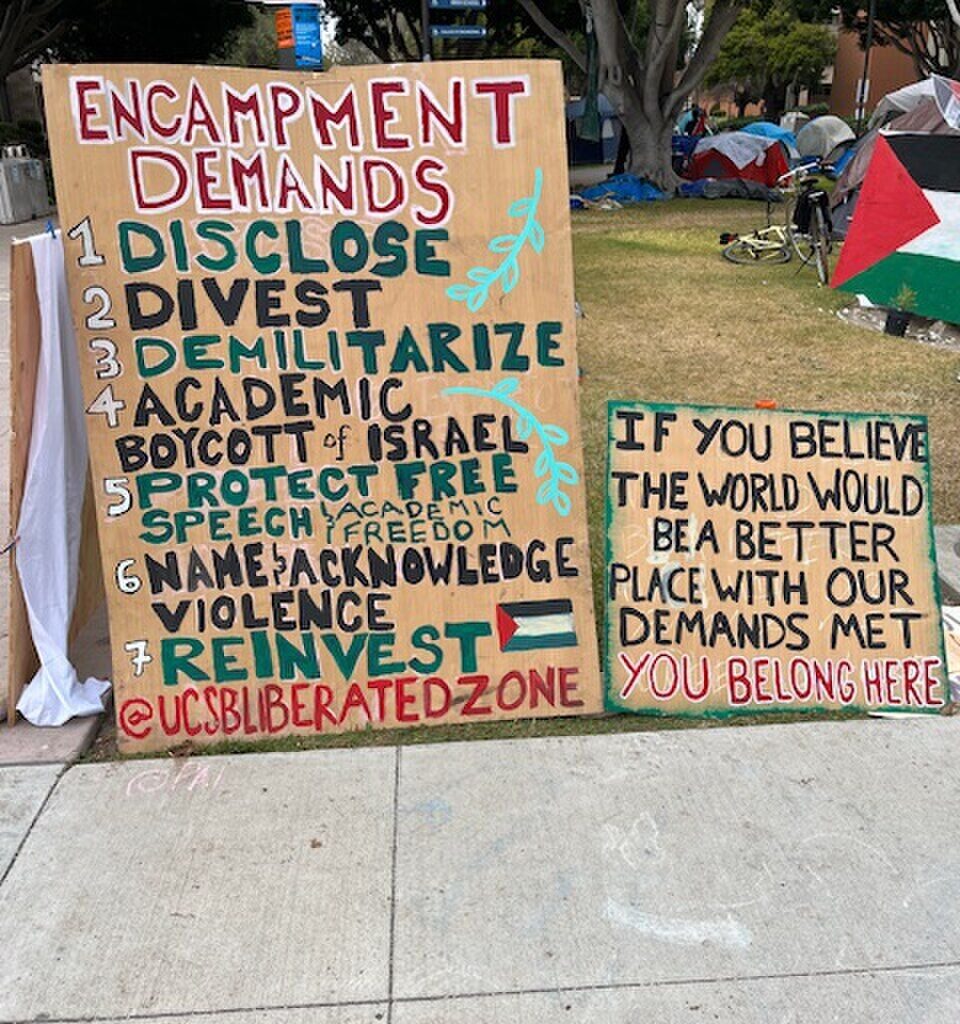
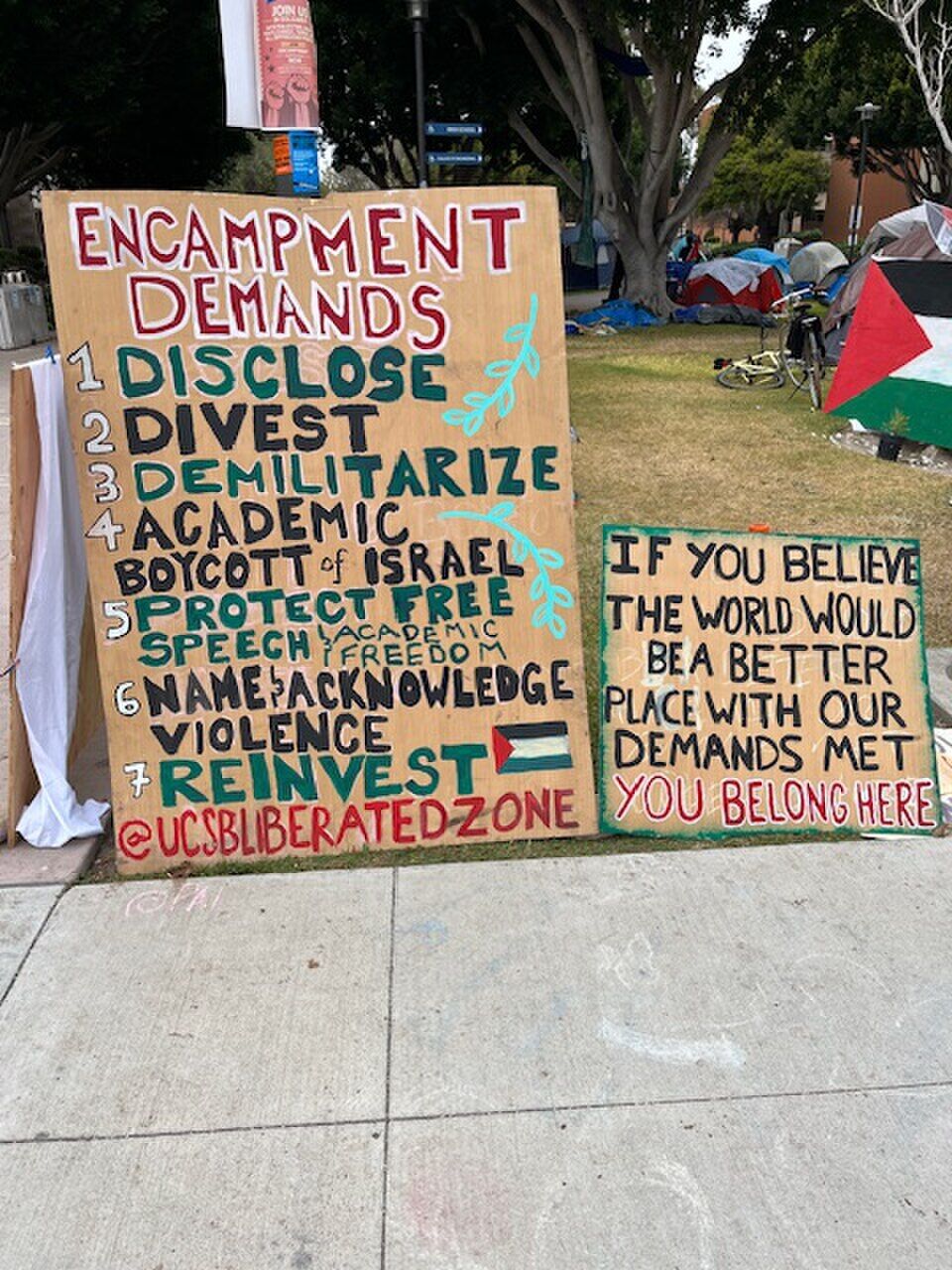
 A pro-Palestine encampment at The University of California, Santa Barbara following the Oct. 7 attacks and subsequent war. (Marcywinograd/WikiCommons)
According to one publication, it’s not just U.S. universities that have an anti-Israel problem — it’s Israeli and Judaic studies programs at those universities, as well.
The Olam, a publication headed by publisher Ronn Torossian, an American public relations executive with right-wing and pro-Israel ties, published a study this month that claims data collected over the last five years show that among 1,014 faculty in Jewish studies, Israel studies, Hebrew or Holocaust studies, 39.5% have “documented anti-Israel public signals.”
The study also analyzed 2,499 faculty and institutional records from Judaic and Israeli studies programs in American universities, of which 51.9% “carry documented anti-Israel public signals.”
The study defines anti-Israel public signals as actions like describing Israel as an apartheid state or one rooted in settler colonialism, describing Israeli operations in Gaza as a genocide, calling for the end of U.S. aid to Israel, signing certain public statements or letters and supporting certain organizations, among others.
It distinguishes the following, among other positions, as not being explicitly anti-Israel: supporting Palestinian human rights within the framework of Israel’s continued existence, supporting a two-state solution, criticizing specific Israeli policies or specific IDF operations, criticizing Prime Minister Netanyahu and calling for accountability in regard to Palestinian civilian casualties.
James Loeffler, the Felix Posen professor in modern Jewish history and director of the Leonard and Helen R. Stulman Jewish Studies Program at Johns Hopkins University in Baltimore, said Torossian is not necessarily a source that should be trusted based on his background.
“I would strongly urge the media and the Jewish community to take into account the fact that Mr. Torossian is a public relations activist and the founder of Betar USA, an organization that has been at the forefront of controversy for its extreme ideological positions and political agitation,” Loeffler said.
Michael Brenner, professor of history and Abensohn Chair in Israel Studies at American University, said he has seen the full spectrum of responses from colleagues across the university’s disciplines, but that he hasn’t seen anti-Israel sentiment within his own.
“At American University, we do not have any negative experience within Jewish and Israel Studies. As director of America’s oldest center for Israel studies, I have encountered the whole range of behavior after Oct. 7 among colleagues in other fields, including expressions of solidarity by non-Jewish colleagues who I hardly knew before all the way to behavior of boycott and hostility by others,” Brenner said.
Loeffler said he considers the study to be “a piece of political provocation, not a rigorous empirical study of bias,” citing the fact it does not disclose its data or specific sources. Loeffler added that the study does not differentiate between scholars in the field of Jewish studies and those from “adjacent departments,” according to the study, which Loeffler called “an imprecise category.”
“It does not address internal contradictions in its own definitions, and it includes information before and after Oct. 7, ignoring the fact that some professors have changed their political positions to become more defensive of Israel, not less,” he said.
Robert Eisen, George Washington University’s director of Judaic studies, said that reactions to Israel in the school among faculty and students were inflamed after Oct. 7, and that much of what he hears from students is regarding to classes focused on the Middle East.
“It was always somewhat of a problem. Students would complain to me about the content of courses being tilted against Israel. But usually, the complaints, which is interesting as I think about it, were about courses that were on the Middle East that seemed biased against Israel,” Eisen said.
The Olam study found 14 endowed chairs who hold “positions funded by donors who [intend] to strengthen Jewish scholarship” are signatories of statements like the 2023 Jewish Studies Ceasefire Letter and the 2025 “Not in Our Name” letter, which Olam labels as anti-Israel.
Rabbi Bruce Aft, adjunct professor in Judaism and Holocaust studies at George Mason University, said what he has seen at his university is reassuring for the future of Israel supporters and Jews at American universities.
“What’s happened is that the president of the university, like so many presidents, was under the gun, and the Jewish community significantly supported him,” Aft said. “Under his leadership, there’s now a Jewish studies minor, and we’re working toward trying to develop a Jewish studies major at some point. There is an initiative that is being launched to try to raise money for another Jewish studies chair or another professorship … it’s just been amazing the change that’s occurred in my view.”
Loeffler added that right now is a difficult time to work in Jewish studies, as both sides of the political aisle have their qualms with what he and his peers teach and how they teach it.
“The reality for Jewish Studies faculty is that we are now challenged from both the Right and the Left. Far Right critics like Mr. Torossian attempt to demonize scholars of Jewish Studies and Israel as traitorous ideologues. Far Left critics accuse Jewish Studies programs of acting as agents of the Israeli government. Both offer distortions and caricatures of the work we do trying to help students — both Jewish and non-Jewish — understand the complex reality of Jewish history, Zionism, and Israel.”
Ultimately, Loeffler said what college is for — and what college students want — is to think critically. He said what any student, parent and educator should do is engage thoughtfully with the data and conclusions presented to them, whether they come from a pro-Israel or anti-Israel perspective.
“Today’s college students seek open intellectual environments where they can engage complex, hard questions without hostility or dogma. They do not want to be spoon-fed propaganda — for or against Israel; they want to pursue the truth and acquire critical analysis skills,” he said.
Brenner also said there are levels to anti-Israel and pro-Israel activism, and that strong Jewish and Israel studies departments are necessary to combat stringent anti-Israel work.
“In a campus climate in which activism and misinformation are growing, Israel and Jewish Studies can serve as an important source of information, as crucial support for students, and as bridge builders in a divided world,” he said. “Thus readers need to understand that weakening Israel and Jewish studies on campus would be handing a victory to the real anti-Israel activists, which to the most part are not the people depicted in this study.”
aguckes@midatlanticmedia.com