
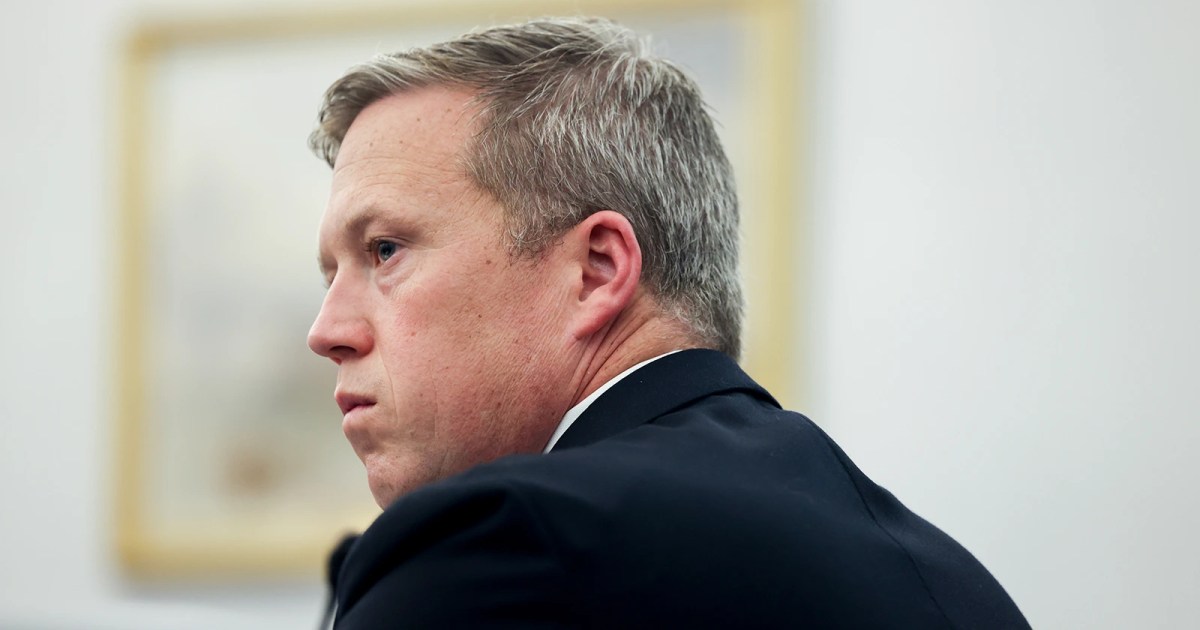
Dan Driscoll, an Iraq War veteran and the youngest-ever Army secretary, personally delivered his resignation to President Donald Trump on Monday, thus becoming one of the first significant “Washington casualties” of the Iran war.
Driscoll was highly respected by the Army’s uniformed leadership. He established strong working relationships with senior officers, and he was one of the few Trump Cabinet officials who showed himself to be willing to work with congressional leaders from both parties. But in his 18 months in the role, he repeatedly clashed with Defense Secretary Pete Hegseth, and leaked reports indicate he, along with a number of senior officers, had cautioned against extending the Iran conflict.
He repeatedly clashed with Defense Secretary Pete Hegseth, and leaked reports indicate he, along with a number of senior officers, had cautioned against extending the Iran conflict.
Driscoll’s departure was not entirely unexpected. Rumors of a possible resignation had been circulating for months, but his resignation comes at a particularly consequential moment. The war with Iran that Hegesth strongly advocated for looks more and more like a strategic disaster, and Driscoll’s departure is more evidence that the defense secretary is seeking to surround himself with loyalists.
Their disagreements focused largely on Hegseth’s removal of numerous officers across all services from general officer promotion lists, more than half of whom were African American or women. Many were Army, but Hegseth also dismissed four senior Army generals, including Gen. Randy George, the Army chief of staff; the vice chief of staff; and three other senior Army generals. The loss of so much senior military experience represents a significant blow to the Army.
As much as Hegseth may have clashed with Driscoll, he couldn’t fire a presidential appointee. Instead, Hegseth surrounded the Army scretary with officers loyal to Hegseth. The defense secretary made Gen. Christopher LaNeve, his former military aide, the vice chief of staff after firing his predecessor. He then fired George and made LaNeve the acting Army CSA. He later forced Gen. Chris Donahue into early retirement. Donahue was the senior American ground force commander in Europe and heavily involved in providing U.S. support to Ukraine. He was widely regarded as a “rising star,” a strong advocate for Army modernization and a potential future chief of staff.
Play

Driscoll and George had raised serious concerns about the Army’s long-term readiness and transformation based on lessons emerging from the Ukraine war. Their concerns were reflected in the Army Transformative Initiative, which called for greater integration of artificial intelligence into decision-making, modification of existing equipment, deployment of drone formations and closing the widening gap in counter-drone capabilities.
Trump frequently referred to Driscoll as his “drone guy” because of his advocacy for the military to rapidly embrace emerging battlefield technologies. Many of these initiatives, however, were rebuffed by Hegseth.
For example, Ukraine reportedly presented the Pentagon with a major counter-drone proposal in August 2025. Ukrainian officials are said to have specifically warned that Iran was upgrading its drone capabilities, but Trump, perhaps under Hegseth’s influence, said, “We don’t need their help in drone defense.” Hegseth also supported the recent decision to dismantle the Army’s experimental drone warfare battalion in Europe.
Trump frequently referred to Driscoll as his “drone guy” because of his advocacy for the military to rapidly embrace emerging battlefield technologies.
Driscoll reportedly told Trump during their final Oval Office meeting that the Army could not transform effectively while losing so many senior experienced leaders — and that Hegseth had fired many of the uniformed leaders with whom he and George had been working on a reform agenda.
More articles

Jeff McCausland
Jeff McCausland, a retired Army colonel, is a visiting professor at Dickinson College. A former dean of the U.S. Army War College, he commanded a battalion in combat and was later a member of the National Security Council. He is the author of “Battle Tested! Gettysburg Leadership Lessons.”