
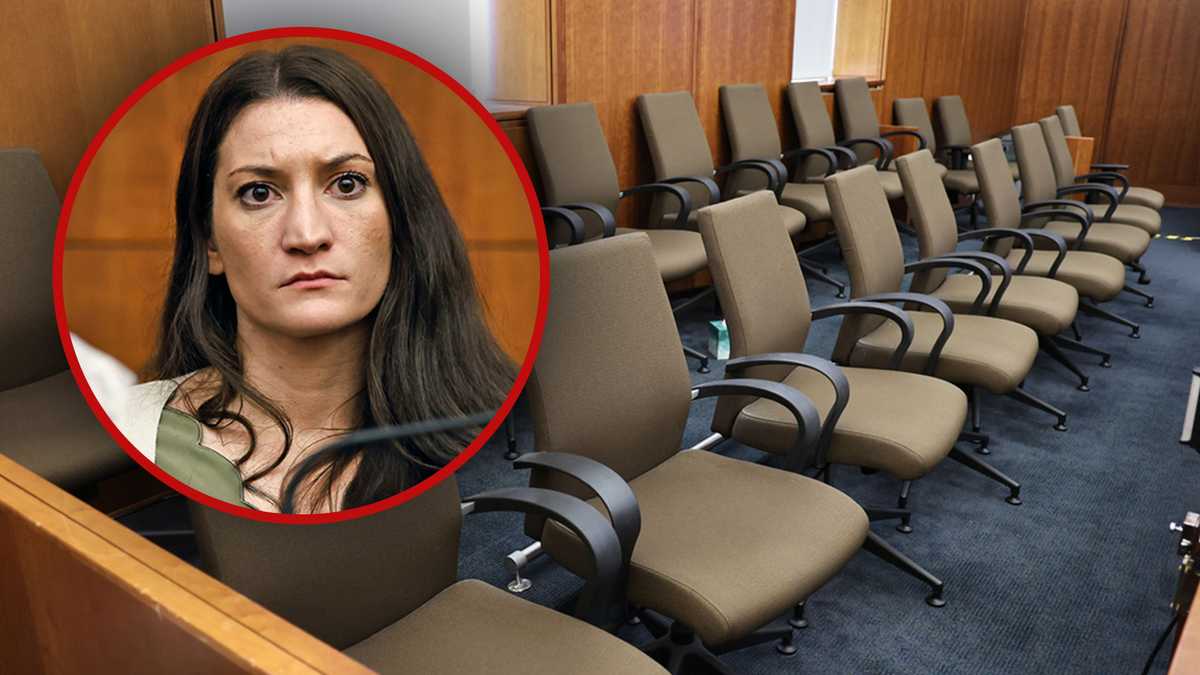
What is the Tuey-Rodriguez instruction, aka ‘dynamite charge,’ given in Lindsay Clancy’s trial?
 PLYMOUTH, Mass. —
After the jury in the murder trial of Lindsay Clancy twice reported that they were unable to reach consensus in their deliberations, the judge decided to issue the Tuey-Rodriguez instruction in hopes that the push would tip them toward making a decision.
As retired Massachusetts judge Jim Barretto explained on NewsCenter 5, those instructions are also sometimes known as the “dynamite charge.”
“It alerts the jury to, among other things, the seriousness of the obligation and unique qualifications to decide this case,” Barretto said.
A jury of nine women and three men is deciding if Lindsay Clancy, 36, is guilty of killing 5-year-old Cora, 3-year-old Dawson and 8-month-old Callan or if she is not criminally responsible due to her mental health.
Jurors first reported that they were deadlocked on Tuesday morning and the judge asked them to keep working. After about five hours of work on Wednesday, the group sent another note reporting they were still stuck.
“There likely has been passionate discussion in that jury room, and somebody, or perhaps even more than just one person, is locked in, so to speak, and cannot be moved,” Barretto said.
Judge William Sullivan presented the jurors with the Tuey-Rodriguez instruction, which urges them to keep working and suggests there is no reason to believe a different jury would have an easier time reaching agreement.
If the deadlock continues, retired judge Jim Barretto said the jury can be sent back one more time, if Sullivan believes it would make a difference.
“So if they come back deadlocked yet again, he’ll have a decision to make. Does he give it again?” Barretto said.
After that, if a deadlock continues, the judge would need to declare a mistrial.
“We’re nearing the end. We’re nearing the end,” Barretto said.
The District Attorney would then have the chance to decide if they want to pursue a second trial.
Clancy’s defense argued that she was not criminally responsible for the killings because she was suffering from postpartum psychosis. It is the burden of the prosecution to overcome the lack of criminal responsibility defense, also known as the insanity defense.
Tuey-Rodriguez in the Karen Read trial
Karen Read was tried twice in consecutive years on a charge of second-degree murder. Her first trial ended with a hung jury, which told the judge several times that it was unable to reach a unanimous verdict.
After repeatedly sending them back to try again, Judge Beverly Cannone ultimately gave the jurors guidance known as the Tuey-Rodriguez instructions. Cannone told the jurors they were the best hope for reaching a verdict and encouraged them to look at the arguments from the other side.
When Read’s first jury returned again to say they were still deadlocked, Cannone was forced to declare a hung jury.
Read was ultimately tried again and found not guilty of second-degree murder but convicted on a lesser charge of drunken driving.
What happens if a mistrial is declared?
In the event of a hung jury, as we saw in Read’s first trial, the jury is dismissed and the judge would be forced to declare a mistrial.
As with Read’s case, it would be up to the prosecution to decide whether to bring the case to trial a second time.
Read’s legal team attempted to fight a second trial, but the courts found that double jeopardy protection did not apply because no verdict was recorded in the case.
Transcript of Judge Sullivan’s instruction to the jury
Our Constitution and laws provide that in a criminal case, the principal way for deciding questions of fact is by the verdict of a jury.
In most cases, perhaps, strictly speaking, in all cases, absolute certainty cannot be attained. Nor is it expected. The verdict to which a juror agrees must be their own, the result of their own convictions, and not a mere acquiescence to the conclusions of their fellow jurors. Yet, in order to bring 12 minds to a unanimous result, you must examine the questions submitted to you with candor and with proper regard and deference and respect to the opinions of each other.
You should consider that it is desirable that the case be decided, and that you have been selected in the same manner and from the same source from which any future jury would be. There is no reason to suppose that the case will ever be submitted to 12 persons more intelligent, more impartial, or more competent to decide that more or clear evidence will be produced.
And with this in mind, it’s your duty to decide the case. If you can do it quite generously in order to make a decision more attainable, the law imposes the burden of proof on one party or the other in all cases. In the present case, a criminal case, the burden of proof is on the Commonwealth to establish every element of the crime charged beyond reasonable doubt.
If you were left in doubt of any element of the crime, the defendant is entitled to the benefit of the doubt and must be acquitted. However, in conferring together, you ought to pay proper respect to each other’s opinions, and listen with an open mind to each other’s arguments. Thus, where there is disagreement, jurors for acquittal should consider whether a doubt in their own minds is a reasonable one if it makes no impression on the minds of others who are equally honest, equally intelligent, and who have heard the same evidence with the same attention, with an equal desire to arrive at the truth, and who have taken the same oath as jurors.
On the other hand, jurors for a conviction ought seriously to ask themselves whether they may not reasonably doubt the correctness of a judgment that is not concurred in by other members of the jury, and whether they should distrust the weight or adequacy of the evidence that fails to convince the minds of fellow jurors.
With that, I now ask you to return to your deliberations with these thoughts in mind. Thank you.
This content is imported from infogram. You may be able to find the same content in another format, or you may be able to find more information, at their web site.
Background of the Clancy case:Lindsay Clancy, 36, faces three murder charges in the 2023 deaths of her children, Cora, Dawson and Callan.She also jumped from a second-floor window, leaving her partially paralyzed.In a civil case, Lindsay Clancy alleges a “catastrophic failure” of multiple medical providers in diagnosing and treating her psychiatric condition.Her trial began July 20. Although her legal team offered to stipulate to the deaths of the children, she has pleaded not guilty.She is being held at Tewksbury State Hospital.
This case involves issues of mental health. If you or someone you know needs help, you can talk with the Suicide & Crisis Lifeline by calling or sending a text message to 988, or you can chat online here.