
Donald Trump has claimed his commerce secretary, Howard Lutnick, erroneously stated that no Americans had been killed in the war with Iran because he was thinking about a previous US operation, in Venezuela.
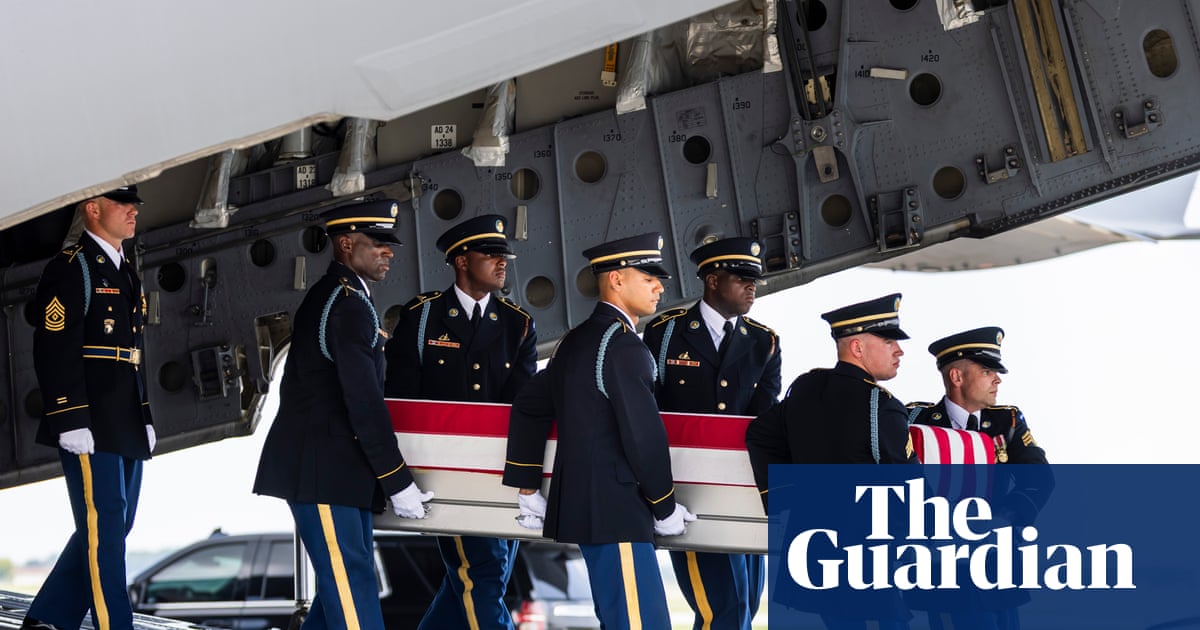
The claim, at odds with the Pentagon’s count of 18 US service members dead in the US-Israel war on Iran, sparked a swift backlash as Trump struggles to end the conflict after six months.
In a post on his Truth Social platform on Thursday, the US president wrote: “Sec. Lutnick had Venezuela on his mind when he said nobody was killed. 18 people were killed in Iran!”
The rebuke came a day after Lutnick appeared on CNBC’s Squawk Box and framed the Trump administration’s approach to Iran as primarily economic. Describing the strategy as an “economic choke-out”, he erroneously told the network there had not been American deaths in the conflict, adding that he was optimistic bond markets would respond well to the approach.
Lutnick this morning acknowledged the mistake, posting on X that he had misspoken and also claiming he had been thinking of the US operation in Venezuela, where US forces captured Nicolás Maduro in January with minimal US casualties. The Pentagon said seven US troops were injured and none were killed in that operation, while Venezuelan officials put their overall death toll at 47, and Cuba said 32 of its military and police personnel were killed.
Trump’s post landed as Iranian authorities detailed heavy casualties from the latest US strikes. Iran’s health ministry said Tuesday night’s strikes killed 18 people and wounded 108, while the country’s Red Crescent identified that four people were killed and 67 wounded when a US strike hit a wedding ceremony near the coast of the strait of Hormuz, which also killed a child. Reuters said it was able to verify the location of the damaged building using satellite imagery.
A US Central Command spokesperson, Capt Tim Hawkins, said the US military does not target civilians and that the reports, which originated with Iranian state media, were being reviewed.
The strikes were part of a broader operation that Central Command said hit Iranian air defense systems, radar installations, maritime assets, mine-laying equipment and communications sites near the strait of Hormuz, a strategic waterway through which a large share of the world’s oil passes.
The Pentagon’s capacity to independently verify such claims has been sharply reduced. Its Civilian Protection Center of Excellence has been cut from 40 staff to nine since the start of last year, according to the Pentagon’s own inspector general, while the department has also stopped developing a database meant to track civilian harm from US operations.
The episode has exposed a wider tension in how the White House is presenting the conflict.
Officials have sought to characterize the campaign (estimated to have cost at least $37.5bn as of July) against Iran in economic terms even as it continues to produce US military deaths, mounting Iranian civilian casualties and rising oil prices.
Polling from UMass-Amherst in late August found that 54% of Americans disapprove of the war initiated by the US and Israel, and one in six Trump voters would go back and change their vote in 2024.
The current round of fighting began after the US struck rocket launchers on Larak Island that officials said were being prepared to mine the strait, prompting Iranian missile and drone attacks on US and allied positions in Jordan, Bahrain, Kuwait and Iraq. Jordanian authorities said 13 ballistic missiles were fired at the country, of which 10 were intercepted.
Trump described Iran’s retaliation as a “love tap”, but warned that further strikes remained an option. “It was a very heavy attack last night, and we’re prepared to do another one anytime we want,” he said earlier this week.