
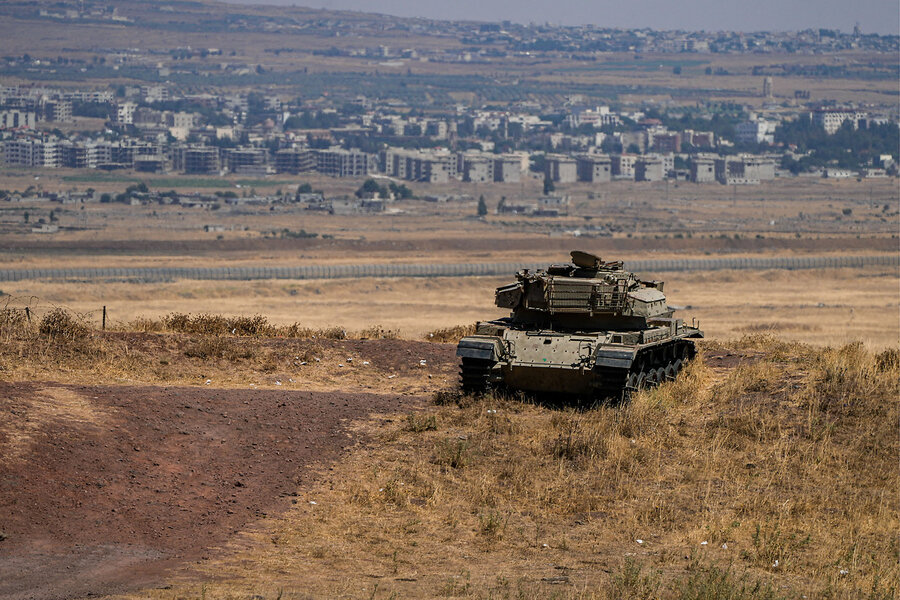
Listen to recriminations coming from the governments in Ankara and Jerusalem, and one could get the impression that Turkish and Israeli forces are on the verge of military conflict.
Yet while analysts caution that the growing regional rivalry between the two and collision of strategic interests – especially in Syria – are real, and that the risk of an unintended clash exists, they say neither country wants a war.
An Israeli strike on a Syrian military air base on Aug. 18, which Israel said was intended to prevent Turkey from establishing a military presence there, brought the risk of a clash into sharp focus. U.S. Ambassador to Turkey Tom Barrack said the next day that the strike carried a “real risk of rapid escalation into a direct military confrontation” between Israel and Turkey, as well as Syria.
Why We Wrote This
Could the growing regional rivalry between Turkey and Israel lead to a military clash? A recent Israeli strike on an air base in northern Syria illustrated the two countries’ conflicting strategic interests, but analysts say neither wants war.
Analysts say the tensions reflect a broader strategic rivalry that has emerged as the war in Gaza has reshaped the region, former Syrian President Bashar al-Assad was deposed, and Iran, Mr. Assad’s benefactor, was weakened.
NATO member Turkey wants a stable, unified Syria in which it can expand its influence and contain Kurdish armed groups it sees as hostile. Israel, meanwhile, is determined to maintain its freedom to operate in Syrian airspace and prevent a powerful Turkish military presence on its northern frontier.
“There is no love lost between the current Turkish and Israeli governments, and relations have deteriorated dramatically since the start of the Gaza war,” says Aslı Aydıntaşbaş, director of The Turkey Project at the Brookings Institution. “Turkey increasingly regards itself as a guarantor of Palestinian rights, and what happened in Gaza has deeply offended Turkish sensibilities across the political spectrum.”

Turkish Foreign Ministry/Reuters
Turkish Foreign Minister Hakan Fidan (at right) meets with his Syrian counterpart, Asaad al-Shaibani, in Ankara, Turkey, Aug. 6, 2026.
The Israeli strike on the Abu al-Duhur air base in northern Syria “was a direct warning to Ankara that Israel intends to draw limits around Turkey’s military presence in Syria,” Ms. Aydıntaşbaş says by email. “Israel doesn’t seem to want Turkey to expand its bases or repair Syria’s existing military facilities.” This is part of Israel’s policy to do all it can to keep its neighbors weak, she adds.
Turkey’s concerns “are almost the mirror image of that,” she says. “Turkey wants a stable, territorially intact Syria capable of controlling its borders, integrating or containing Kurdish armed groups, and allowing refugees [who fled during Syria’s civil war] to return,” she says.
“Ankara believes [the] Israeli government,” using its relationship with minority groups such as the Druze, “is keen to keep Syria divided and decentralized” to keep it weak.
Yet according to Professor Miri Shefer-Mossensohn, head of the Program in Ottoman and Turkish Studies at Tel Aviv University, Israel’s security concerns in Syria are not focused on Syria’s own armed forces.
“Although Syria is formally an enemy of Israel, its military power is close to almost nothing,” she says. “There is no threat from Syria towards Israel. However, Turkey might be a threat.”
Israel is also watching Turkey’s growing involvement in Palestinian affairs, Professor Shefer-Mossensohn says, fearing that Ankara is seeking to surround Israel in the way Iran did through its regional proxies. Turkey has an official presence on U.S. President Donald Trump’s Board of Peace for Gaza, which is in charge of reconstruction and has diplomatic, cultural, and humanitarian ties with Palestinian institutions in East Jerusalem, she explains.

Syria’s Abu al-Duhur air base is shown following the Israeli attack in northwestern Syria, Aug. 18, 2026. An American envoy said the attack carried a “real risk of rapid escalation.”
The Israeli-Turkish tensions are striking given how close the two countries once were.
Israel and Turkey have had a stormy relationship of love and hate over the years, explains Alon Liel, an international relations scholar and a former chargé d’affaires at the Israeli Embassy in Ankara.
Diplomatic relations that were founded in March 1949 “were never broken,” he says. “For over 77 years,” he notes, “the ups and downs were all inside the framework of diplomatic relations.”
Between 1992 and 2002, Turkey was one of Israel’s greatest friends, with trade, culture, tourism, and military cooperation booming, Mr. Liel says. Relations deteriorated after Recep Tayyip Erdoğan – who rose through the ranks in an Islamist party, and was elected prime minister in 2002 – and collapsed further after the war in Gaza began in October 2023. Turkey banned all trade with Israel in May 2024, sharply reducing economic ties and tourism.
The narrative about Turkey is now different, he says.
“The Israeli leadership is building [now President] Erdoğan or Turkey as the new Iran, creating the feeling inside Israel that the Turkish presence inside Syria is at least as dangerous as the Iranian presence,” says Mr. Liel.
The tensions between the two countries today could “really bring about a military clash between the Turkish and Israeli armies,” he says.
Meanwhile, the run-up to Israel’s Oct. 27 election could be a particularly sensitive time.
“[Prime Minister Benjamin] Netanyahu has an incentive to project military strength – especially since the Iran war is going nowhere and is seen as unfinished business by the Israeli government,” says Ms. Aydıntaşbaş.

Prime Minister Benjamin Netanyahu votes in his Likud party primary elections ahead of Israel’s general election in October, in Jerusalem, Aug. 17, 2026. The political season has exacerbated tensions with Turkey.
Ambassador Barrack has also suggested that some of the rhetoric between Mr. Netanyahu and President Erdoğan could be driven by domestic political calculations.
Still, neither country appears to want a direct confrontation. And outside powers have an interest in preventing one.
“The U.S. and maybe other NATO members who do not want to see a NATO member in clash with Israel, will help the two sides to relax the tension between them. But effort is needed,” says Gallia Lindenstrauss, a senior research fellow at The Institute for National Security Studies who specializes in Turkish foreign policy.
Progress on the Palestinian issue could also help ease tensions, she says.
“The Palestinian issue is a very detrimental element in the Turkish attitude towards Israel. So, any move to what Turkey perceives as the right direction will have a trickling effect also on the bilateral relationship.”
For now, however, the fundamental dispute over Syria remains unresolved, says Ms. Aydıntaşbaş.
“The greatest danger is miscalculation rather than a deliberate decision to open another front,” she says. “If an Israeli strike were to kill Turkish soldiers, or if Turkish air defenses were to target an Israeli aircraft, both governments would face intense domestic pressure to respond.”