
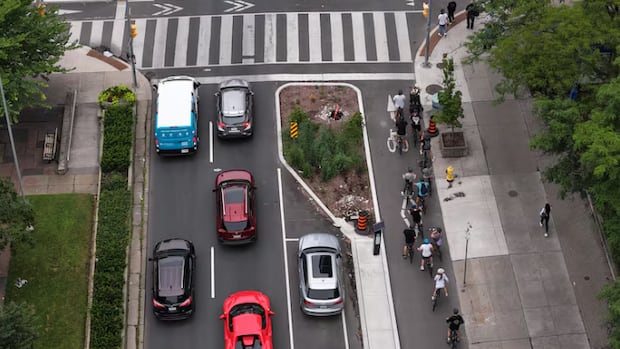
With bike lane removal and reconfiguration plans along some of the city’s busiest roads now underway, questions persist over what the endeavour will look like and how much it’s going to cost taxpayers.
Ontario’s transportation ministry announced Tuesday that it is going ahead with bike lane removal and reconfiguration on some of Toronto’s busiest roads.
The provincial government will begin “restoring motor vehicle lanes” previously removed to make bike lanes on Bloor Street, Yonge Street, University Avenue, Queen’s Park, Queen’s Park Crescent and Avenue Road, it said in a news release.
The release also said the province issued a request for proposals to “study and provide design options” that could retain or reconfigure bike lanes.
Margaret Parkhill, an engineer with consulting firm Arup who’s worked with the city on bike lane projects, including Bloor Street W. and Yonge Street, said removing or reconfiguring the lanes would “not be a simple task.”
“Whether you’re adding or removing lanes, the cost is likely to be about the same,” she said, noting that in addition to actual road reconstruction, signage, traffic signals and parking infrastructure would also have to change.
CBC News reached out to both the city and the province on bike lane costs.
In an emailed response Wednesday, Charlotte Carron, spokesperson for Ontario’s transportation ministry, said Minister Prabmeet Sarkaria made comments about the bike lanes during a news conference Tuesday and those comments still “stand.”
Sarkaria’s comments did not specifically address costs or identify which level of government would foot the bill.
City pegged removal at $48M, province rejected figure
Kate Lear, spokesperson for the city, said $27 million was spent on installing bike lanes along a 13-kilometre stretch of Bloor Street, a 3.2-kilometre stretch of Yonge Street and around a 3.6-kilometre stretch of University Avenue and Queen’s Park, in an email Thursday.
In a previous report presented to council in 2024, the city estimated that removal of the full 19-kilometre stretch of bike lanes identified by the Ford government would cost $48 million. The province rejected that estimate at the time.
While there is currently no official price tag on the undertaking, it also remains unclear who would pay for the costs.
City road maintenance typically falls under the municipality’s purview, while roads like highways are a provincial responsibility, according to Jeff Casello, professor of transportation planning and engineering at the University of Waterloo.
“The question is, will the province pay this bill or will they push that responsibility down onto the city to remove bike lanes?” he said.
WATCH | What to know about the province’s bike lane removal, reconfiguration plans:
Ford government to begin Toronto bike lane removal. Here’s what you need to know
The Ford government is going ahead with bike lane removals, the province announced Tuesday. CBC’s Lane Harrison breaks down what you need to know.
Myer Siemiatycki, professor emeritus of politics at Toronto Metropolitan University, said the Ford government’s move will come with a “hefty price tag.”
“This [is coming] from a premier who claims to honour and cherish nothing more than the tax dollars of hard-working Ontarians,” he said.
“It does seem like a wasteful use of public funds.”
During Tuesday’s news conference, Sarkaria said removing or reconfiguring the bike lanes would help alleviate costs associated with gridlock.
“Gridlock costs our economy almost $56 billion a year. Getting these bike lanes out of the way [and] restoring vehicle lanes will allow us to get people moving quicker and faster in one of the busiest cities in the world,” he said.
Removal, reconfiguration varies in difficulty: expert
Casello said the process of removing or reconfiguring bike lanes is common contractor work, but it varies in difficulty.
The easiest changes would be to painted-on bike lanes, he said. Crews would just have to scrape the paint off and possibly put a new coat of asphalt on top.
It gets more complicated when the bike lane has a curb because removing it would damage the pavement around it, so it would likely be a “full reconstruction” of the lane that’s being removed, said Casello.
“The most complicated system is if you’re actually changing the curb, so you are actually changing the width of the roadway,” he said.
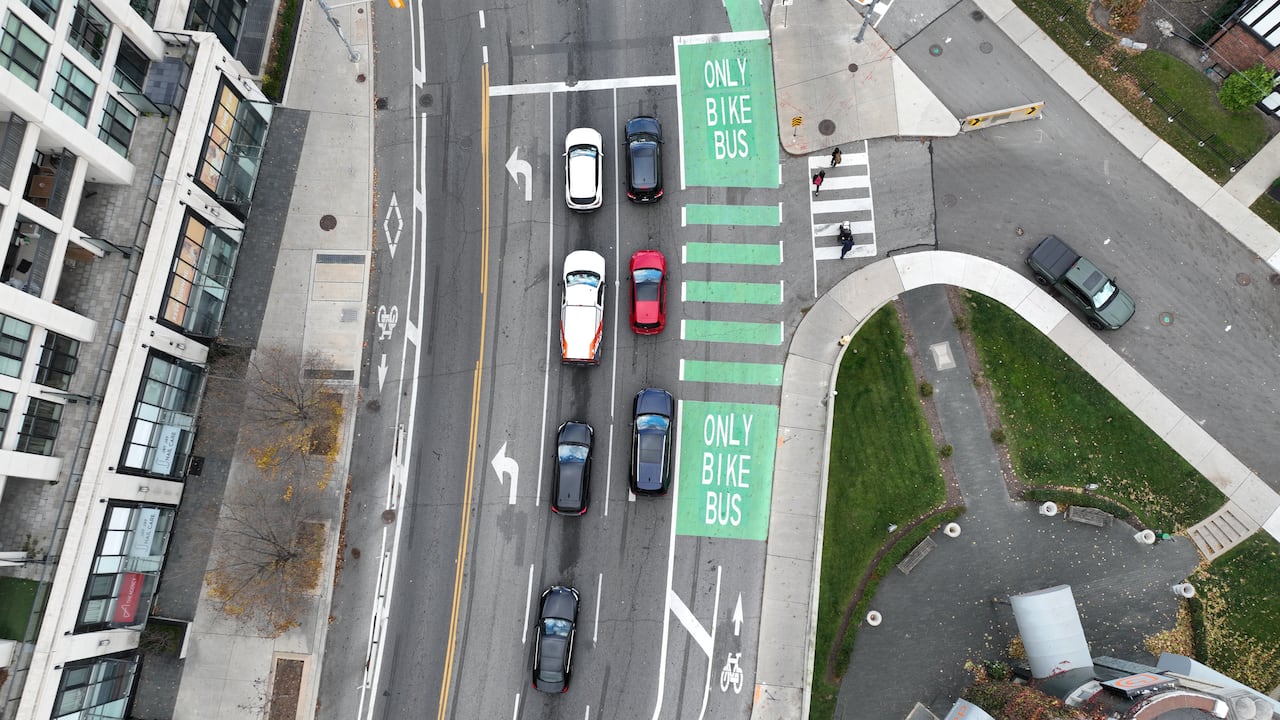 The Bloor Street W. bike lanes near Jane Street and the Humber River. Casello said bike lane removal can vary by difficulty, depending on whether the lane is simply painted on or if there are physical barriers separating it from the road. (Patrick Morrell/CBC)
Parkhill said intersections like Bloor Street and St. George Street could see placements change for everything from fire hydrants to streetlights and rainwater catch basins.
“I’m personally really curious to see which, if any, engineering consulting firms actually respond to the request for proposals to do this work, and provide a design that does remove the bike lanes,” she said.
Casello said before construction begins, the province should calculate travel times in the bike lane corridors it aims to remove or reconfigure, and then calculate the same travel times post-construction.
“They ought to be able to demonstrate to the public … that there is substantive benefit, that their travel time has improved in those quarters,” he said.
WATCH | Ontario passes legislation to allow for bike lane removal: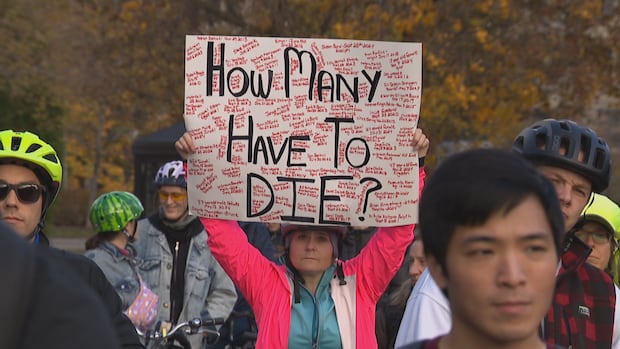
Ford government passes controversial Bill 212. Here’s what it entails
The Ontario government has passed Bill 212, a controversial piece of legislation that allows the removal of bike lanes on three major cycling routes in Toronto. The bill also lets Highway 413 construction begin before Indigenous consultation. CBC’s Lane Harrison has the details. City, province at odds over bike lanes for years
The city and province have been engaged in a tug-of-war of sorts over bike lanes along Bloor Street, Yonge Street and University Avenue for years after the province passed Bill 212 in 2024. That legislation gave it sweeping control over municipal bike lanes.
Cycle Toronto, a local cycling advocacy group, launched a court challenge, and city council deliberated numerous motions regarding the province’s plans to remove the bike lanes it had spent millions to install. In August, Ontario’s court of appeal ruled that Ford’s government can rip out 19 kilometres of protected bike lanes in Toronto.
The chain of events culminated Tuesday when the province announced its bike lane removal and reconfiguration plans, including “immediately” restoring motor vehicle lanes on a 600-metre stretch of the Bloor Street W. bike lanes, east of Clissold Road in the city’s west end.