

Listen to this article
Estimated 4 minutes
The audio version of this article is generated by AI-based technology. Mispronunciations can occur. We are working with our partners to continually review and improve the results.
Canadians will have to prepare for a future that’s 5 C hotter, according to a new report summarizing the latest science on climate change.
The second edition of Canada’s Changing Climate Report, a synthesis of the science on the impact of a warming planet on Canadians, confirms with greater confidence that burning fossil fuels, or what the report calls “human activities,” are responsible for climate change.
On Thursday, the federal government released a summary of the report’s findings.
The report is forward-looking, assessing what Canada would look like under different scenarios depending on whether countries fulfil their climate commitments.
“We do still have some agency,” said Nathan Gillett, one of the report’s authors and a research scientist with Environment and Climate Change Canada. “Where emissions go from here will affect how temperatures evolve through the century and whether we can stabilize temperature or whether it just keeps increasing.”
The report finds that if global governments keep pursuing their current climate policies, Canada will still see intensified warming, which “corresponds to a future climate for Canada that is far from benign,” the report states.
Glaciers could ‘largely disappear’
Under such a scenario, Canada is projected to warm through this century with an estimated temperature increase of 5 C. In Nunavut, warming in winter could exceed 10 C.
Glaciers in western Canada are projected to lose more than 75 per cent of their ice, it finds, and there’s a more than 60 per cent likelihood that the central Arctic Ocean will be ice-free most Septembers.
“Iconic landscapes are changing across Canada as snow and ice disappear,” the report states. “Glaciers in western Canada will largely disappear by the end of this century.”
WATCH | Glacier collapse that led to flooding at Nepal-China border: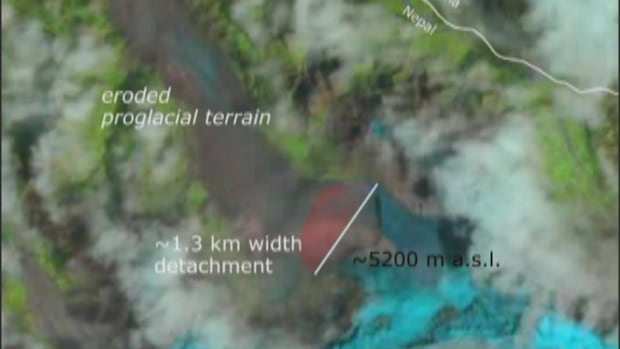
Satellite images show glacier collapse that triggered flooding at Nepal-China border
Jakob Steiner, a geoscientist at the University of Graz in Australia, says images obtained from satellites show that ‘the lower part of a tongue of a glacier completely sheered off across a width of 1,300 metres’ and dropped off a cliff onto a lake 2,000 metres below. Steiner said climate change played a role, and the area was known to be at a high risk for a collapse.
Beyond considerable warming in the North, the report paints a difficult future in southern Canada, where most of the country lives.
Summer droughts are projected to become longer, more intense, and more frequent in central and southern Canada, the report states.
Canadians should also brace for an increase in the frequency and intensity of flash flooding and atmospheric rivers.
“Multiple lines of evidence support the finding that the length of the fire season has increased in most parts of Canada and is projected to continue to lengthen as global temperature rises,” the report states.
Things would look even worse for Canada if countries abandoned their climate policies, with average temperatures projected to increase 6.9 C this century.
If the world, however, dramatically reduces greenhouse gases and achieves net-zero around 2075, Canada’s climate is projected to stabilize and average warming would increase by 3.5 C.
Report is ‘physics, not fate’
Despite the grim picture the report paints, 5 C of warming is not locked in, and there’s still time for Canada to avoid a hotter future, independent policy research organization the Canadian Climate Institute says.
“This report describes physics, not fate,” the group said in a statement.
Cutting emissions in Canada and around the globe, the institute says, will determine “whether Canadians have to live with the consequences of more than 5 C of warming or 3.5 C.”
The institute says each degree of warming that’s avoided will save lives and prevent homes, communities and livelihoods from being destroyed. It will also save the Canadian economy billions of dollars, the statement says.
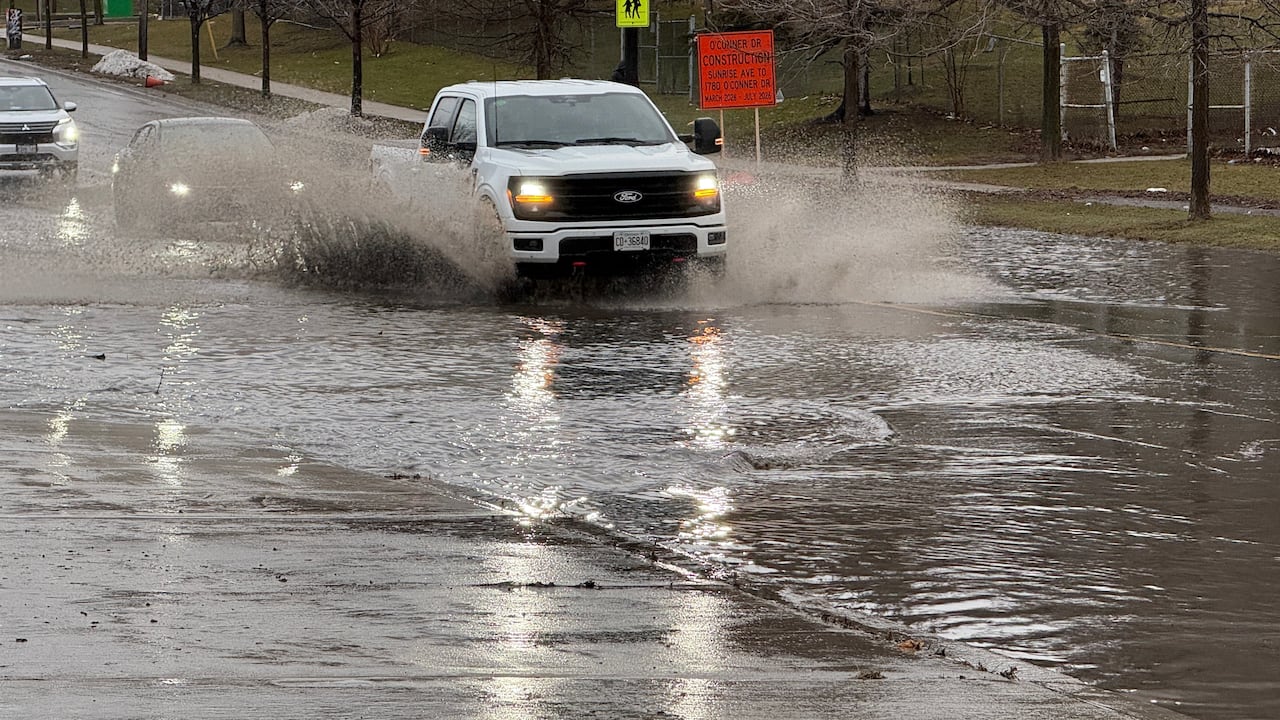 A truck drives through a flooded road in Toronto on Wednesday after heavy rains led to flash floods throughout the city. (Paul Smith/CBC)
In a statement responding to the federal report, a climate advocacy group called for greater action to reduce emissions, linking Toronto’s flash flooding on Wednesday to climate change.
“As the climate breakdown accelerates, more than 65,000 Torontonians lost power in yesterday’s severe storm, often for many hours,” said Toronto city Coun. Dianne Saxe, writing for Climate Caucus, a network of municipal leaders from across the country. “There was also extensive disruption to traffic and to transit, and expensive flood and wind damage to homes.”
“Our communities cannot afford the frequent human and economic blows that oil and gas use are causing.”
Responding to the report, a statement from Canada’s environment minister said Canada remains committed to reducing its emissions and achieving net-zero by 2050.
“Our government is moving with urgency to fight climate change, while working together to build the energy security, industrial capacity, and strategic autonomy that will define this century for Canada,” said Chris Zhou, the director of communications for the environment and climate change minister.