
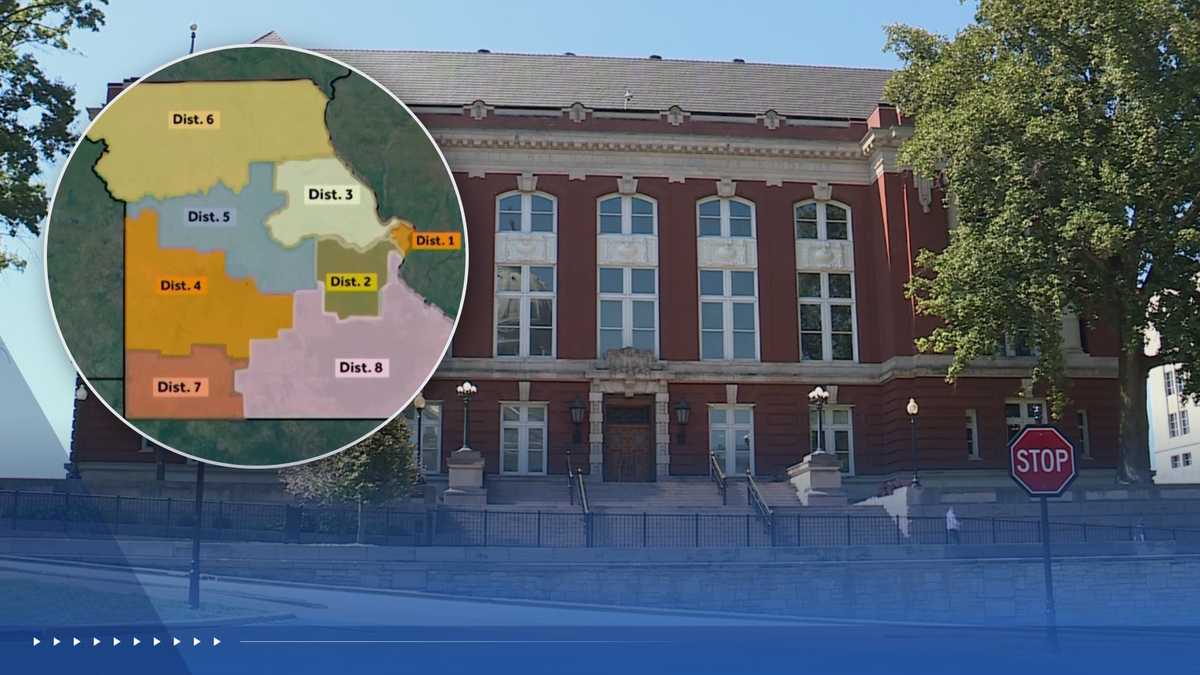
Missouri Supreme Court makes ruling on redistricting referendum: Map must go on ballot
State Supreme Court reverses circuit court decision


The Missouri Supreme Court has made a decision on the validity of a referendum related to the redrawn congressional map.
The state’s highest court unanimously ruled in favor of map opponents, determining that the map must go on the ballot for a public vote.
“The referendum petition was legal, sufficient and timely, and the secretary incorrectly concluded otherwise,” the ruling says. “HB 1 did not go into effect and will not go into effect unless and until approved by the voters.”
The Missouri Supreme Court said that the congressional redistricting established in 2022 “remains in full force and effect for the November 2026 general election.”
On Aug. 4, 2026, Secretary of State Denny Hoskins declared an attempted referendum insufficient despite necessary signatures.
Hoskins said it wasn’t about the signatures, and that the petition could have “500 million signatures,” but the challenge itself would still be unconstitutional.
That determination brought about the latest case in the state Supreme Court and ultimately led to Thursday’s ruling.
“This is what democracy looks like, the people of Missouri demanded a voice, and the court just confirmed what we’ve been saying all along. People, not politicians, will have the final say,” said Richard von Glahn, executive director of People Not Politicians Missouri, in a news release. “This victory reaches beyond Missouri. In a year, when map-drawing has become a national weapon, courts across the country are watching what happens here. A Missouri win for the referendum is a signal that the people still hold power.”
It’s the latest ruling in a long legal battle over the constitutionality and applicability of a new congressional map.
The new map has been at the center of political controversy since its inception and subsequent approval by Missouri Gov. Mike Kehoe on Sept. 28, 2025.
Various lawsuits over the congressional map have traveled through the state’s court system. Opponents tried to push back against the map, arguing it was not compact and that the timing of its issuance, mid-decade, made it unconstitutional.
But the Missouri Supreme Court shot down both those claims, determining the map was constitutional.
Immediate next steps
The court ordered Hoskins to issue a certificate of sufficiency regarding the referendum and to place the referendum petition on the November 2026 ballot. The court also ordered Hoskins to “take any and all additions steps necessary” to put the referendum petition on the ballot before Sept. 8.
“The secretary and all of those acting in concert with him are restrained and enjoined from implementing, using or mandating the use of the congressional redistricting in HB 1 for the November 2026 general election or at any other time thereafter unless and until HB 1 is approved by the voters at the November 2026 general election and takes effect 30 days thereafter,” the ruling says.
Missouri Attorney General Catherine Hanaway told KMBC she is seeking an emergency stay from the U.S. Supreme Court to permit the state to use a new congressional map.
“Yes, it did come as a shock. I’ll be totally honest,” Hanaway said when asked about the ruling.
Hanaway said no in the country has ever ordered different maps to be used between a primary and a general election.
When asked if her office would accept the old congressional map if the Supreme Court does not grant the emergency stay, Hanaway said they would.
“Well, after we’ve exhausted all our appeals, of course that’s what we have to do. But I suspect strongly that there will be new lawsuits filed by those who won primaries in the new districts, who think that not only are their voters being disenfranchised, but they’re seeing free speech, right?”
Ruling could significantly alter Kansas City-area Congressional race
Democratic Rep. Emanuel Cleaver, whose district was altered by the map, described the court’s decision as a victory for Missouri residents and a rejection of the legislature’s attempt to shift his district from Democratic to Republican control.
“In terms of reaction, a sigh of relief? It is a relief, but I think that more than a relief, it is sending signals to people all over the state of Missouri that the voice of people still rings loud and solidly in the ears of the Supreme Court,” Cleaver said.
Republican State Sen. Rick Brattin, Cleaver’s opponent, criticized the ruling, calling it unconstitutional and disrespectful to voters.
“Now, we’ll have almost 25,000 people that voted for me now are going to go to the ballot in just a few weeks and vote for a new candidate, a new person to represent them that’s in the third congressional. And in the fourth, you’ll have almost 40,000 people that are going to the ballots. Who am I voting for? I just voted for Rick Brattin. Who am I voting for?” Brattin said.
Brattin also stated that he plans to take legal action in response to the ruling.
Cleaver has won at least 60 percent of the vote in the past two elections with the current district.
Had the 2025 map been upheld, he would be running in a district with more registered Republicans.