
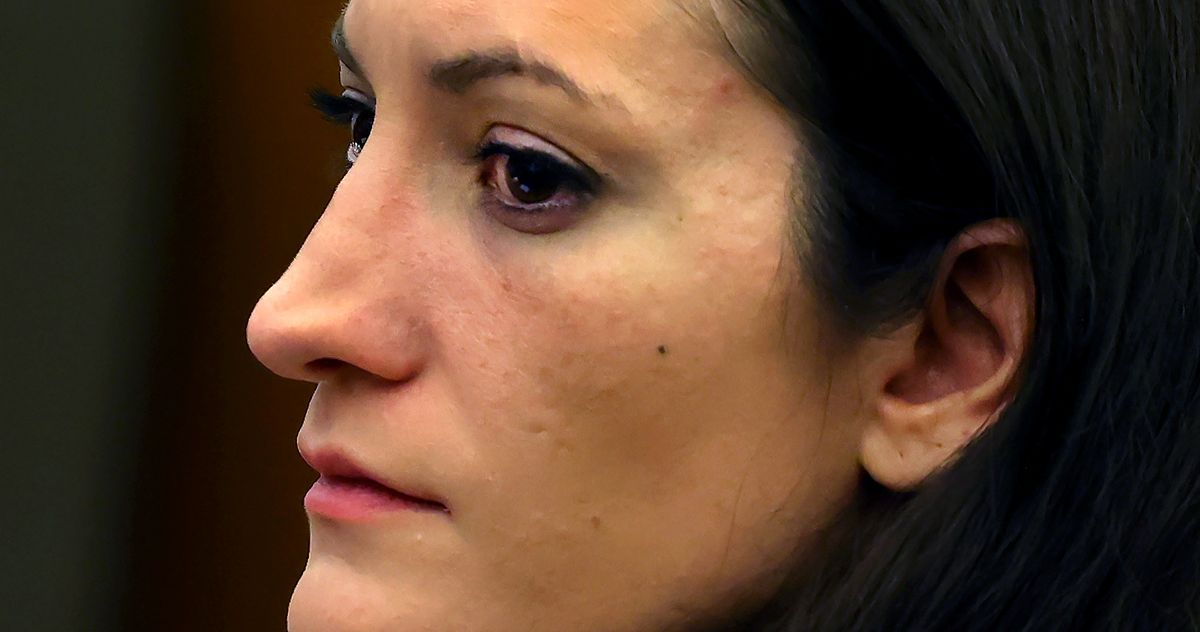
Photo: John Tlumacki/The Boston Globe via Getty Images
There are so many details of the Lindsay Clancy trial, which has now ended in a mistrial, that haunt me. Her texts to her mother, telling her she can’t sleep and she’s scared to be alone. Her emails to her doctors chronicling her increasing desperation. That earlier that day in January 2023 she took her daughter to the pediatrician for a stomach ache and, hours later, strangled her three children in the basement before jumping out a second-floor window. But there’s one detail in particular I can’t stop thinking about. After her son Dawson was born in 2019, she was “elated with increased energy,” according to Clancy’s lawsuit against her doctors. When Callan was born in May of 2022, she threw herself into exercise. One week after giving birth, she was waking up at 4 a.m., running three miles, spinning on the Peloton, and doing aerobics. She started posting videos of herself working out on Facebook and promoting a “beach body” MLM scheme. Five weeks after giving birth, she ran a five-mile race.
This is also how my postpartum psychosis started. After bringing my daughter home from the hospital in October 2020, I was completely euphoric. I couldn’t believe how beautiful she was. While she slept, I dressed her up in different outfits and took hundreds of photos, sending them to everyone I knew. I wasn’t tired; I had way too many things to do. At 5 a.m., I drafted a master plan for a new parenting website I was going to launch. I immediately emailed my boss to let her know I was going to need a new job title. I started buying a new wardrobe for my inevitable promotion.
When I recounted all this to my husband, he was alarmed. Soon many of the people close to me had noticed I wasn’t acting like myself. I was offended. I liked the new me. I felt as if all my best qualities had been turned up, and I was suddenly hilarious and charming and full of good ideas. Multiple people brought up the possibility that I was manic, but I was desperate for that not to be true. Most of the time, I was chatty and giddy; my usual shyness had melted away. But if I sensed someone had slighted me, my mood would turn on a dime. I started keeping a list of whom I could trust and whom I couldn’t, crossing people off in real time.
I was incredibly lucky that my husband and closest friends recognized right away that I needed help. But it quickly became clear just how few medical professionals are trained to identify postpartum psychosis. Despite having read several books on pregnancy and childbirth, I had barely heard of it. Postpartum psychosis is not recognized as a distinct disorder in the DSM, and it’s often misdiagnosed. I was lucid enough to convince more than one doctor I was just sleep deprived. My own OB didn’t catch it. After I spent an hour talking nonstop to a therapist about how I needed couples counseling because I’d just had a baby and my husband kept telling me I was manic, she told me she’d see me next week.
When my husband finally took me to the ER, I was livid. I thought he was overreacting; I didn’t understand why I needed to be in a hospital. The next few days were the darkest of my life. Much of it I can’t remember clearly. I know I was loopy but also full of aggressive energy. They wouldn’t let me have my phone or laptop, so I scribbled frantically on a yellow legal pad, trying to keep track of my racing thoughts. I called everyone I could think of from the hospital landline, desperately explaining the injustice of my situation. I was being held against my will, and they wouldn’t tell me when I would be able to see my baby. When a psychiatrist came by intermittently to check on me, I was openly hostile. I could tell he thought I was just another crazy woman.
I spent most of my time at the hospital campaigning for them to let me go home. They kept giving me Ativan, so occasionally I’d pass out for a few hours and wake up groggy and disoriented. They started me on antipsychotics and recommended I be admitted to a partial-hospitalization program for perinatal mood disorders at Women & Infants hospital in Rhode Island.
It’s hard to overstate how much better my experience was once I got to Women & Infants. The psychologist who evaluated me was a warm middle-aged woman, and I immediately trusted that she knew what she was talking about. She patiently explained that what I was experiencing was almost certainly postpartum psychosis — a rare but serious mental illness that affects around one or two women out of a thousand after giving birth. It’s most common among women with bipolar disorder, but it can also occur in women with no prior psychiatric history. She gave me a tour and told me I was welcome to bring my baby with me: The group-therapy room was full of gliders and baby bouncers, and there was a nursery where I could drop my daughter off when I needed a break. It felt like the first time a doctor had recognized that I was going through all of this while also being a mom.
It broke my heart to learn that Clancy tried to go to the same program and was turned away. Earlier this year, Clancy filed a civil lawsuit against the doctors who oversaw her mental-health treatment, arguing that they failed to properly diagnose and treat her symptoms despite her repeated efforts to get help. During her intake appointment at Women & Infants in December 2022, she said she felt “numb and crazy depressed” and like her life was “becoming a disaster.” “It takes all the effort in the world just to breathe,” she said. Her attorneys say she scored a 23 on the Edinburgh Postnatal Depression Scale, indicating severe depression. Yet according to the suit, the doctor evaluating her concluded she did not have postpartum depression or bipolar disorder. Instead, she recommended that Clancy stop taking Seroquel, an antipsychotic, and sent her home.
Clancy’s story is full of moments like this, where she was so close to getting the treatment that she needed. In the months before the killings, Clancy was “begging for help,” her mother-in-law told the court. She was prescribed more than a dozen different medications, many of which, she told doctors, made her symptoms worse. Clancy met with the psychiatrist Jennifer Tufts for months, during which her insomnia and depression got only more severe. Clancy had a telehealth appointment with Tufts the day before she strangled her children; Tufts told the jury there was no indication she was a danger to anyone. Rebecca Jollotta, a psychiatric nurse practitioner who also treated Clancy, said she brought up the possibility of a bipolar diagnosis, but her husband shut it down. “I recall Patrick saying, ‘My wife is not bipolar,’” Jollotta told the court. Both Patrick and Clancy’s mother testified that she confided in them that she was having thoughts of harming the children. Twice she called a suicide hotline but was told her situation wasn’t an emergency because she didn’t have a plan. In early January 2023, Clancy admitted herself to McLean Hospital due to suicidal ideation and was diagnosed with severe depression. Yet when she was discharged a few days later, her doctor told the court that she “did not have any concerns about her safety or a risk for anybody else.”
Prosecutors argued that, throughout all this, Clancy lied about her symptoms while she carefully plotted her children’s murder. They said she didn’t really want to get better — she didn’t take all of her medication as prescribed, and she checked herself out of McLean so that she could attend her daughter’s birthday party. Many people watching the trial seem to be under the impression that if Clancy had truly loved her children, she wouldn’t have been depressed. Others are unable to comprehend why someone in the midst of severe mental illness wouldn’t act rationally. Some point out that among multiple doctors, her husband working from home, a part-time nanny, and parents who came to help out, Clancy had far more support than most mothers. What else could she possibly need?
All I can say is that if I had been in charge of my own care while in the throes of postpartum psychosis, I would not have gotten better. It took my husband pushing back against multiple doctors to convince them what I was experiencing was an emergency. It took a hospital stay that was more traumatic than the illness itself. Above all, it took finding the right therapists and the right medication. I’m grateful that I ultimately landed at one of the best treatment centers in the country for postpartum psychosis and one of the few where mothers are not separated from their babies. Even then, it was only after months of therapy and cycling through multiple medications, many with terrible side effects, that I started to feel remotely normal again. I didn’t have thoughts of harming myself or my baby while I was manic. But seeing the speed with which my brain betrayed me left me with little doubt that that was where my illness was headed.
Clancy’s early postpartum mania, her lawyers argue, was a red flag that just about everyone in her life missed. It’s not hard for me to see how that could happen. When my second daughter was born in 2023, I knew I needed to get on the right medication and prioritize sleeping through the night. At the hospital, I asked to see a psychiatrist. She was reluctant to prescribe me lithium — the only medication that had worked to stabilize me before — because I wasn’t “running around naked.” Most of the hospital staff I encountered after giving birth seemed more concerned with why I wasn’t breastfeeding than the fact that I had a history of postpartum psychosis. Before I left the hospital, I attended a class for new parents where they went over safe sleep guidelines and the warning signs for postpartum depression. No one mentioned that a mother having too much energy could also be cause for concern.
Examining Clancy after the killings, the forensic psychologist Paul Zeizel diagnosed her with bipolar disorder with postpartum psychosis. He told the court that, before she killed the children, she was paranoid that other people could hear her thoughts and worried that her children would be taken away from her. He also said that she had “no appreciation for the wrongfulness of her act.” Another doctor testified that at the time of the killings, Clancy was in a dreamlike state with no control over her body. “It was almost like she was a puppet and someone else was pulling the strings.” A hospital chaplain who saw Clancy afterward told the court that as they prayed together, Clancy told her, “I am so glad my children are safe.”
For the past three years, Clancy has been held at Tewksbury Hospital, where Zeizel testified she is on constant suicide watch. Her suicide attempt left her with a severe spinal-cord injury; she will be in a wheelchair for the rest of her life. Now as the jury remained deadlocked after almost a week and the judge has declared a mistrial, Clancy may face this all again in a matter of months before knowing her ultimate fate. It’s hard not to imagine how her life would be different had she gotten the help that I did. Dawson would have celebrated his 7th birthday this month.
Related