
The gap between what is being inflicted on Palestinians and the appropriate reaction on the part of the international community has always been vast. But now it yawns so wide that it swallows reality itself. As arms export licences for Israel from states such as Germany surge, talk of harsher measures and sanctions on the part of other European countries remains talk. People continue to be killed in Gaza, Palestinian families remain besieged in the West Bank, and the Israeli political right has been removing all doubt that these violations are intentional, by telling the world of its hopes and plans.
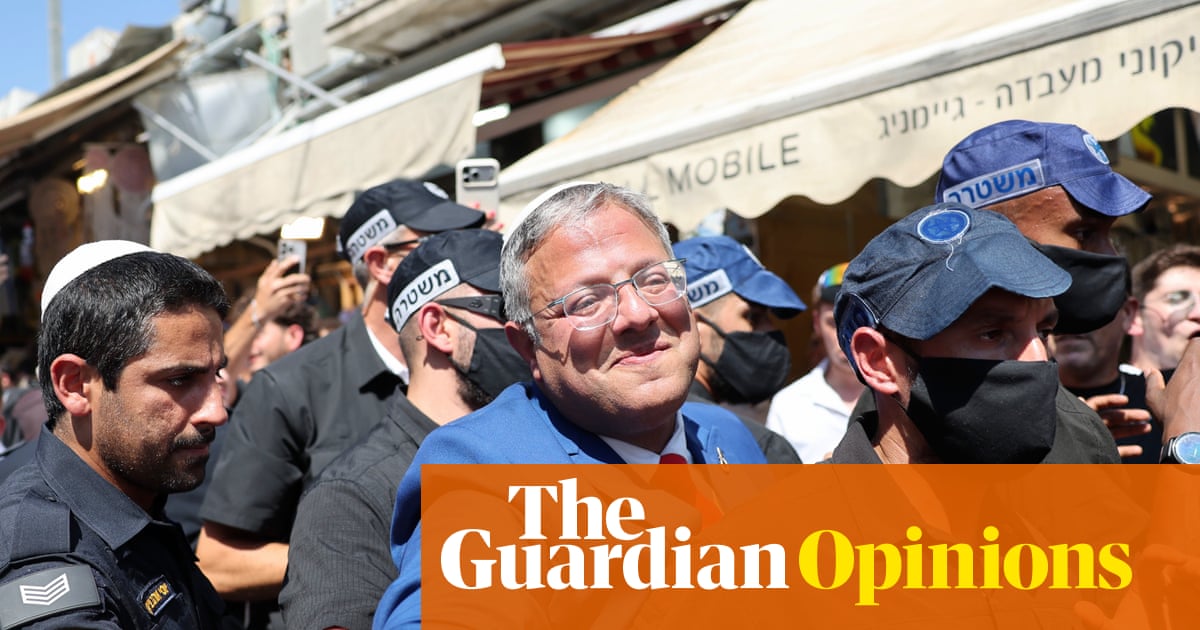
A sample from only the past few days. On Thursday, Israel’s far-right national security minister, Itamar Ben-Gvir, detailed a scheme for the illegal ethnic cleansing of all Palestinians from the Gaza Strip. He also posted an AI-generated video, now deleted, of Palestinian men entering a conveyor belt into detention, emerging emaciated and tearful. Also a few days ago, the defence minister, Israel Katz, stated that the country was “organised and prepared” to expel Palestinians from Gaza “by every way possible”.
This macabre theatre continues to unfold, its performances less plausible by the day. The Board of Peace promises Gaza will be “redeveloped for the benefit” of its people, while the notion that those same Palestinians in Gaza cannot be allowed to thrive is expressed by Israeli politicians with consistency and a frequency that makes a mockery of the declarations. Last month, the former head of Israel’s national security council, Giora Eiland, pointed out the fact that Israel’s acceptance of Donald Trump’s 15-point plan was a matter of temporary military tactics, rather than long-term peace. “Israel has no interest in Gaza being rebuilt, it’s better for us that it be destroyed for generations to come,” he said.
Moshe Feiglin, previously a “far-right outcast” according to the Times of Israel, is now within reach of a cabinet position as a result of an alliance with the finance minister Bezalel Smotrich’s Religious Zionist party. In a recent interview, Feiglin said that those who didn’t want to leave Gaza should be compelled to by “every way possible. We’ll shut off his water pipes, for example.”
This sort of talk, from within the very ranks of government, is often dismissed as unrepresentative of the Israeli state and, as there are elections ahead, is written off as the lurid but ultimately unserious rhetoric of electioneering. But people such as Ben-Gvir and Katz are not fringe voices, they are ministers with high-impact executive briefs – security and defence – that they have indeed used to push policy that matches their statements.
Ben-Gvir has reopened the underground Rakefet prison, one closed in the 1980s for being inhumane. He has successfully pushed for the death penalty for Palestinians convicted of terror attacks, and celebrated the legislation with a noose-themed cake. Torture and sexual abuse in Israeli prisons are widely documented, the latter earning Israel a spot on the UN’s sexual violence in war zones blacklist. As Ben-Gvir himself is fond of saying, “we promised, we delivered”.
Katz has approved the biggest settlement expansion in the West Bank in decades and justified the move on the grounds that it “prevents the establishment of a Palestinian state that would endanger Israel”; he recently advanced legalisation of outpost settlement farms in the West Bank, and instructed the IDF to hand over law enforcement in the West Bank to the Israeli police, which is a stealth move towards annexation.
As the Knesset member Ahmad Tibi wrote in Haaretz earlier this year, a fiction exists at the heart of Israeli politics, where politicians’ efforts to explain and justify policy to international opinion proceed as though “the racism and extremism now driving government policy exist only on the margins”. When really, it lies at the heart of the state.
And if some of the more extreme statements are just electioneering, what does that say about the parameters of discourse in the country if your campaign is mass ethnic cleansing? What does that say about not only the future of Gaza, but all Palestinians in occupied territories who are labouring under home demolitions, militant settlers and the de facto annexation of the West Bank?
Even if these figures are a minority, both in terms of the seats held in the Knesset and the relative number of people who have voted for them, they still hold the levers of power, there is no substantial domestic mobilisation against them, and the rest of the system is unable or unwilling to stop them. The distinctions around how big their constituency may be or how representative they are of Israelis in general matters not a jot to the fate of Palestinians over whom they have been given executive dominion.
The question now is, why are these people not being taken at their word? Why is there no sense of urgency and outrage. Why are these policies and stated goals from the Israeli state not taken seriously and met with appropriate sanctions, trade and arms embargos, and international censure? There is a wild asymmetry when it comes to the perceived potency of Israeli rhetoric and action. “From the river to sea”, for example, as expressed by Palestinians and their supporters has become stigmatised and its use censured. But the most extreme interpretation of that phrase, that it means only one sovereign people in the mentioned land, is commonplace in Israel.
skip past newsletter promotion
Sign up to Matters of Opinion
Guardian columnists and writers on what they’ve been debating, thinking about, reading, and more

after newsletter promotion
The founding charter of Benjamin Netanyahu’s Likud party states that “between the sea and the Jordan there will only be Israeli sovereignty”. Netanyahu himself last week attended a gathering at a religious-Zionist yeshiva, nodding along to a Kahanist song belted out by the attenders. “Remember me, please, give me strength just this time, O God, to take revenge, if only for one of my two eyes, on Palestine,” they sang, adding “May their name be erased!” “There are no more red lines,” was how a Haaretz writer described the scene.
The international community has averted its eyes as red lines are trampled over. This can only be a combination of cowardice and acceptance, barely obscured by feeble statements of condemnation here and there, and grounded in the belief or resignation that Palestinian lives shall be consigned to hell. The facts are clear and plentiful. The Israeli right has a plan and a sense of direction, one that it has nursed for a very long time, and now given nourishment by the 7 October attacks.
Some may not be realisable (ethnic cleansing of Palestinians in Gaza is limited by the fact there are no countries that can or will receive them), but much of it is. The direction of travel is clear and there have been some huge successes so far. There is a line connecting the hundreds of thousands of Palestinians expelled or forced to flee in 1948 and today. The security and carceral state that Palestinians exist in, the destruction of their homes and infrastructure, the settlement and fracturing of their territories, and the extension of Israeli sovereignty over them in ways that dehumanise and oppress, all serve to ensure that a future in which Palestinians are free, let alone thriving in self-governance, never emerges.