
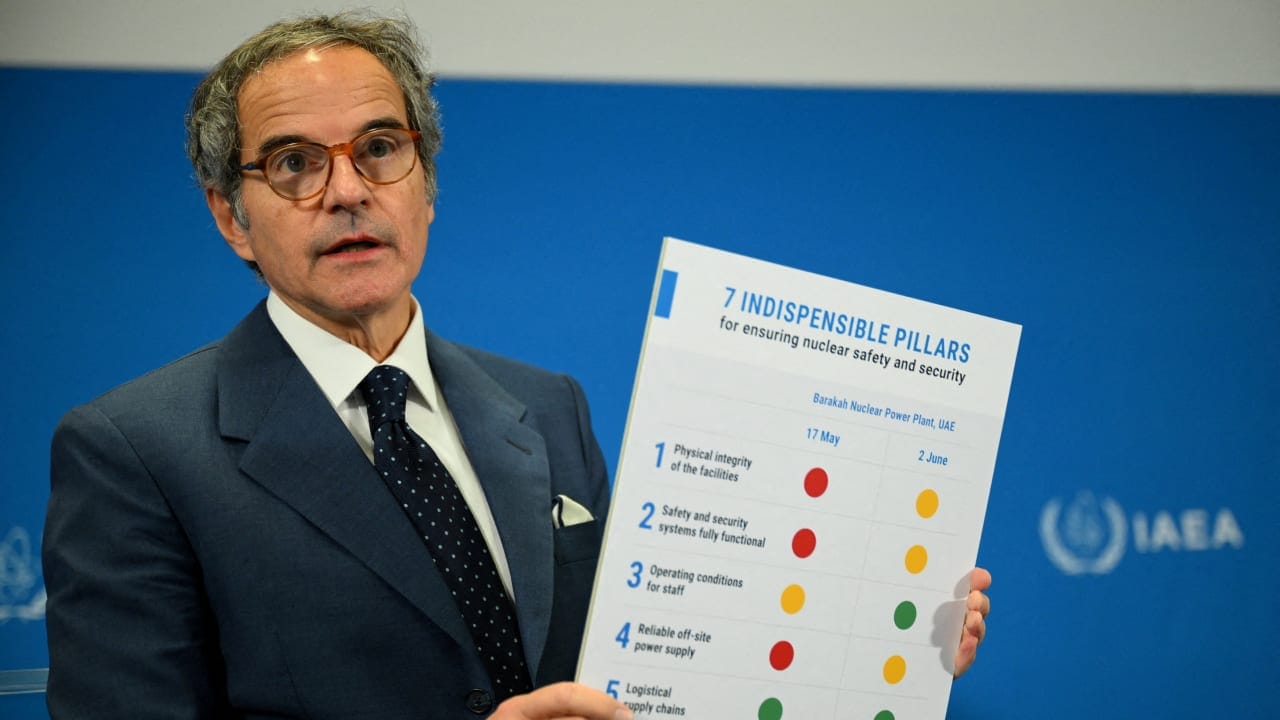
The International Atomic Energy Agency is completely blind regarding Iran’s nuclear program and has been since at least June 2025, IAEA Director-General Rafael Grossi said on Monday.
“As stated in the report, [the] agency has neither received information from Iran regarding the status of its declared nuclear material or facilities nor had access to any of those facilities to conduct in-field verification activities,” he told the Board of Governors. “Therefore, the agency was unable to discharge its safeguards responsibilities under the NPT [Non-Proliferation Treaty] Safeguards Agreement at declared nuclear facilities in Iran.”
“Consequently, we were not able to verify their status for safeguards purposes and the associated nuclear material, and as a result, I am also unable to report in relation to the implementation by Iran of relevant provisions of the UN Security Council resolutions or the board’s resolutions of November last year and June this year,” he added.
“It is more than a year since the agency lost continuity of knowledge in relation to the previously declared inventories of LEU [Low Enriched Uranium] and HEU [Highly Enriched Uranium] enriched up to 60% U-235 at the declared nuclear facilities affected by the military attacks of June 2025,” Grossi said, citing Israel’s war with Iran last year.
“The agency’s lack of information about these facilities and associated nuclear material and our inability to conduct verification activities at these facilities is a matter of serious proliferation concern,” he said. “The situation needs to be rectified with the utmost urgency.”

Grossi called on Iran “to engage with the agency constructively in order to make possible the full and effective implementation of agency safeguards in Iran and to fulfill its responsibilities under the NPT Safeguards Agreement.”
“A return to diplomacy and negotiations aimed at finding a solution to issues related to Iran’s nuclear program is imperative, and the agency stands ready to support such efforts,” he said. “The situation regarding Iran’s nuclear program has implications for the global nonproliferation regime.”
At a press conference following his speech to the board, while using diplomatic language, Grossi belittled explanations by Iran, Russia, and China that tried to claim Tehran has not allowed IAEA inspections out of concern for the inspectors’ security in a war zone.
Ukraine has been a worse and more constant war zone, he said, adding that inspectors have still managed to carry out inspections at nuclear facilities throughout the war between Russia and Ukraine.
The IAEA Board of Governors is expected to refer Iran to the UN Security Council for further condemnation or action.
Iran has threatened the IAEA and the West with severe consequences if such a referral is made, but it remains unclear what added pressures Tehran can bring against the other parties involved given its weakened state both in military and nuclear capabilities.
As such, Iran’s main card is to continue to block the Strait of Hormuz, which is a major source of leverage that it is already exercising.
Iran refuses access to IAEA inspectors since joint Israel-US attacks
Since Israel and the US attacked Iran in June 2025, Tehran has refused to grant the IAEA access to any of its nuclear facilities, saying the agency would pass on classified information to those who attacked it.
Grossi occasionally has said solving nuclear issues by the use of force is less productive than diplomacy, but Iran has viewed his stance on US and Israeli attacks on Iran’s nuclear program in 2025-2026 as too mild and was offended that he did not condemn the attacks more forcefully.
Grossi has complained that Iran has cut off IAEA access almost completely in 2025-2026, with the exception of a visit to the Bushehr nuclear facility, which has never presented any threat. Tehran began to significantly limit access to IAEA inspectors as early as 2021.
In November 2021, Grossi cited Iran’s violation of a supposed deal from September 12, 2021, to renew IAEA access to the critical Karaj nuclear site.
Tehran had reneged on the deal, he said, and the “lack of access to the Karaj workshop has meant that the restoration of surveillance and monitoring at all of Iran’s facilities and locations in relation to the JCPOA [Joint Comprehensive Plan of Action] could not be completed. This is seriously affecting the Agency’s ability to restore continuity of knowledge at the workshop, which has been widely recognized as essential in relation to a return to the JCPOA” 2015 nuclear deal.

Iran has accused the US of being the first to violate the 2015 Iran Nuclear Deal. US President Donald Trump pulled out of that deal in May 2018, during his first term in office.
When Trump pulled out, Grossi said, the Mossad had provided tens of thousands of files of evidence of Iranian lying and cheating relating to the deal from when it seized Iran’s nuclear archives in January 2018.
Although Iran was complying with some significant aspects of the deal, the archives proved that the regime was also systematically seeking to hide the weapons aspects of the nuclear program from the IAEA and the West.
Currently, neither Iran nor the US is pushing for IAEA involvement until they resolve their other ongoing standoff over the Strait of Hormuz.
Israel remains concerned that whatever is left of Iran’s nuclear program after the 2025-2026 airstrikes has not yet been closed down and is not being overseen by IAEA inspectors.