
President Donald Trump tied victory over Iran to rapidly falling oil and gasoline prices Monday night—just as renewed Houthi attacks on Saudi Arabia exposed how military success could still leave the region’s energy system under sustained pressure.
An escalating and broadening conflict in the Middle East will severely complicate Trump’s efforts to bring oil prices back down by coercing the Iranian regime into submission so it allows free and open access to the Strait of Hormuz, a choke point through which, in normal times, around a fifth of the world’s oil and gas supply flows.
In a Truth Social post, Trump said oil prices would fall “precipitously” when the U.S. wins the Iran war, predicting gasoline at $3 a gallon and eventually below $2, with the decline happening “quickly.” Oil prices spiked sharply when the U.S. and Israel launched the war in February to permanently prevent Iran from developing a nuclear weapon and end its threat to the region.
Read More on Analysis
The average price of gas in the U.S. is north of $4 a gallon, according to the AAA, and for diesel it is nearing $6. This presents an acute political problem for Trump and his Republican Party ahead of November’s midterms, where the cost of living is set to be the defining issue. It may cost Trump’s Republicans one or even both of their congressional majorities.
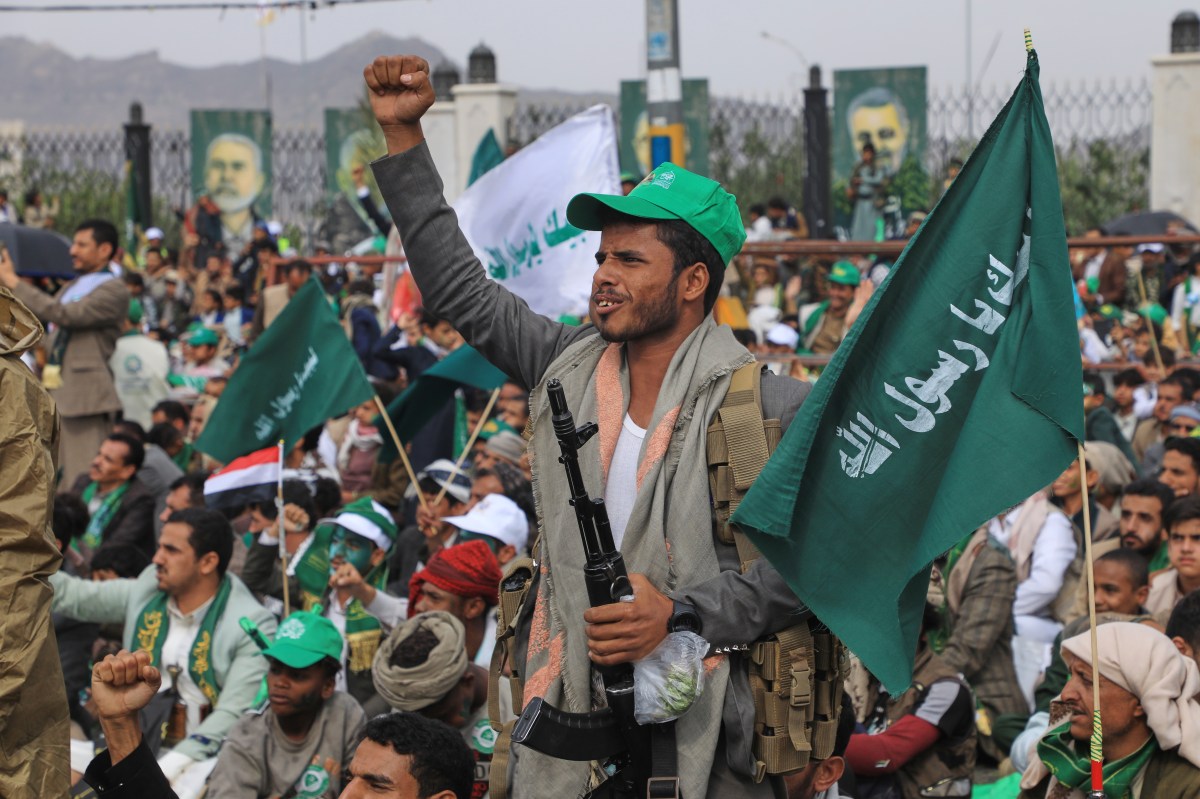
Around the same time as Trump’s post on Monday, the Saudi-led coalition said Houthi attacks hit civilian and economic facilities in southern Saudi Arabia and wounded 73 people. The Saudi Energy Ministry said fires broke out at several oil facilities and utilities, temporarily suspending operations. Officials are still assessing the damage.
Major General Turki al-Malki, a spokesperson for the Saudi-led coalition fighting in Yemen, said forces “will take all necessary operational measures to deter the terrorist Houthi militia with utmost resolve.”
Saudi Arabia is one of the world’s largest oil producers, and the biggest in the Middle East. It is an influential member of OPEC, a cartel of oil-producing countries. Houthi strikes on its infrastructure disrupt that production, affecting prices, but the rebel group also poses a threat to exports as they leave.
Saudi exports depend heavily on vulnerable regional shipping routes, particularly the Strait of Hormuz. Bab el-Mandeb provides an alternate route for some Saudi oil shipments, but similar to Hormuz, it faces security risks from the Iran-backed Houthis, who have repeatedly targeted commercial shipping in and around the Red Sea.
The Houthi threat has become more important to oil markets because Saudi Arabia has increasingly used the Red Sea to reduce its dependence on Hormuz.
The U.S. Energy Information Administration (EIA) estimates that crude oil and petroleum liquids moving through Bab el-Mandeb averaged 8.1 million barrels a day in the second quarter of 2026, up from 5.4 million in the final quarter of 2025, as Saudi Arabia rerouted crude through its East-West pipeline to the Red Sea port of Yanbu.
Pressure on Bab el-Mandeb therefore threatens part of the alternate route that was supposed to make Saudi exports less vulnerable to disruption in Hormuz.
Even the prospect of future supply disruption can itself create a risk premium in crude markets. Moreover, alternate routes around threatened Middle Eastern waterways take longer, cost more and have less capacity.
Lloyd’s List reported in August that Saudi-linked vessels were still able to obtain war-risk coverage, although at higher premiums because of reinsurers’ concerns about Houthi attacks. That gives the Houthis leverage over the cost of moving oil even when the barrels themselves continue to flow.
The timing of the Houthi attack also undercuts an argument U.S. Defense Secretary Pete Hegseth made on July 31. Hegseth said Houthis were absent from the Iran conflict because they had “felt the weight of American power” during the U.S. bombing campaign.
Hegseth was describing deterrence from participation in the Iran war, rather than claiming the Houthis had disappeared. Less than six weeks later, however, attacks on Saudi territory and energy sites test how far that deterrence extends beyond direct confrontation with Washington, as Houthi attacks bring consequences for Trump’s commitment to lower oil prices again.
The EIA said in August that oil prices would remain elevated until disrupted global flows normalize and inventories are replenished, pointing to both the Strait of Hormuz and Bab el-Mandeb as important pressure points for Saudi exports.
Brent crude rose 1.2 percent to $97.40 following the latest Houthi strike. The latest escalation is also bound up with renewed fighting between the Houthis and Saudi-backed Yemeni forces, which has broken a four-year truce. Attacks look set to continue after the Saudi-led coalition vowed to respond.
For Americans, costs from events like the above feed into a gasoline market that already has little room for another shock.
On September 4, the EIA said higher crude prices and unusually large refining margins were pushing up pump prices, while global gasoline supplies had tightened after refinery disruptions in Russia, China and the Middle East. U.S. gasoline imports since March were 32 percent below their five-year average.
The result is direct transmission from Middle Eastern insecurity to American household costs. Persistent risk around Saudi production and shipping can keep global crude and fuel prices elevated even without a further loss of output.
Trump may eventually win the war with Iran, but his $2 gasoline promise requires something even harder to achieve—namely regional conditions that allow energy markets to behave as though the conflict is over and return to normal.