

Renoir was a master of finding beauty in the every daypublished at 14:54 BST
14:54 BST
Emily Atkinson
Live editor
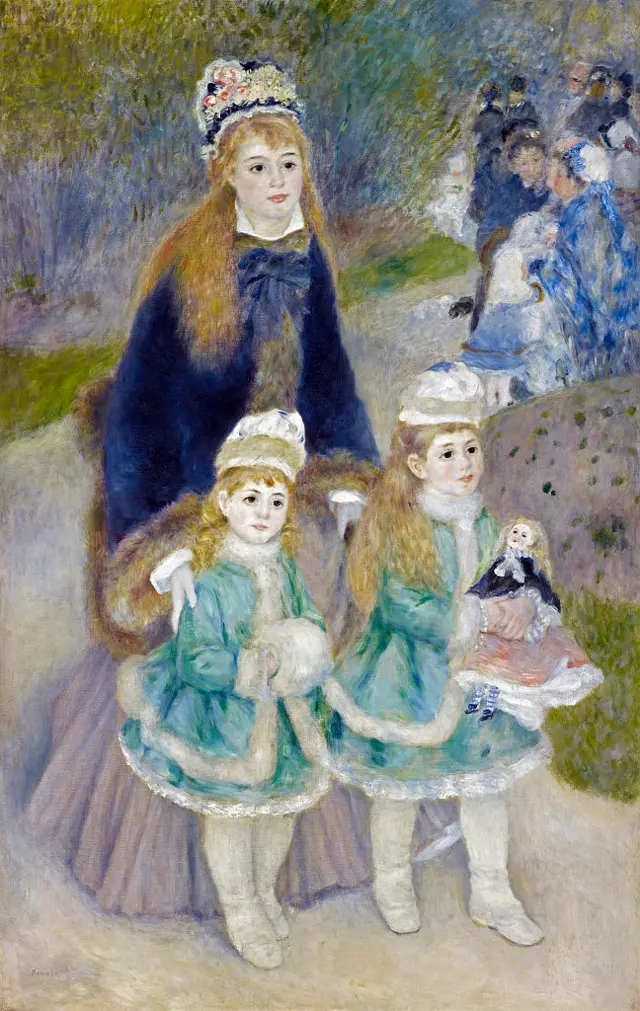 Image source, Getty ImagesImage caption,
Mother and Children (also known as La Promenade) by Pierre-Auguste Renoir
It was in New York, 3,600 miles away and nearly 150 years on, that I fell in love with Renoir’s Paris.
The Frick Collection had been moved temporarily to 945 Madison Avenue; an angular concrete fortress designed in the mid-60s. Vermeers, Rembrandts and Titians lined the warren of grey, low-lit and ceilinged rooms.
So, magpie that I am, I can hardly be blamed for spending the majority of my visit at the foot of La Promenade (c.1875); a shimmering, full-length painting typical of Renoir.
A young woman ushers two young girls – dressed in identical turquoise skirts and fur-trimmed jackets – through a park.
All three have flowing, unruly hair, wind-flushed cheeks and doe-eyes.
The fabrics are luxe, the greenery lush, their faces plump and angelic.
They and a cluster of figures in the distance are haloed by the afternoon light.
It is achingly beautiful, almost frivolously so.
Renoir is often criticised for idealising; accused of ignoring the harshness and upheaval of the period in which he was painting.
But it is impossible not to be beguiled; to linger in his world for just a moment longer.
In our own age of uncertainty, why not allow ourselves some escapism? Indeed, it’s the moments of beauty, wonder and hope in our every day that keep us going.