
The SEC filed an amended complaint in its federal lawsuit against LSU on Tuesday, noting that conference CEOs will meet Thursday to “decide whether to terminate Louisiana State University (‘LSU’) as an SEC member institution.”
As part of the amended complaint, the SEC is requesting a temporary restraining order to ensure that neither LSU nor anyone working with the school or on its behalf can take any action to block or interfere with the meeting or the conference’s First Amendment rights.
“Today, the Southeastern Conference, headquartered in Birmingham, Alabama, filed a request for a temporary restraining order in the United States District Court for the Northern District of Alabama to protect the right of the Conference and its member institutions to govern themselves,” the league said in a statement. “The SEC and its member universities have the right to establish, through agreed-upon governance procedures, the rules under which they voluntarily compete and to expect those rules to be followed. A commitment to those rules, and to the core principles of the Southeastern Conference, is an essential element of SEC membership. Today’s filing is necessary to defend that right and preserve the Conference’s ability to govern competition among its members.”
The LSU athletic department declined to comment.
The SEC initially filed its federal lawsuit against LSU, coach Lane Kiffin and university administrators last week on First Amendment grounds related to the ongoing eligibility standoff over LSU potentially rostering former professional football players. The SEC is seeking a preliminary and permanent injunction prohibiting LSU from playing athletes who signed NFL contracts, arguing that doing so would violate the conference’s First Amendment rights by associating the SEC with actions that undermine its rules and core values.
Ahead of Thursday’s meeting, the degree of support within the SEC for following through and kicking LSU out of the conference is not immediately clear. But the fact that the league has even called such a meeting, and done so publicly and formally in a legal complaint, is an extraordinary rebuke of one of the SEC’s flagship members and biggest brands. For a conference that has increasingly discussed its interest in self-governance, the situation underscores how seriously the SEC is treating its ability to enforce rules and sanctions — as well as how much animosity Kiffin and LSU have spawned with this saga.
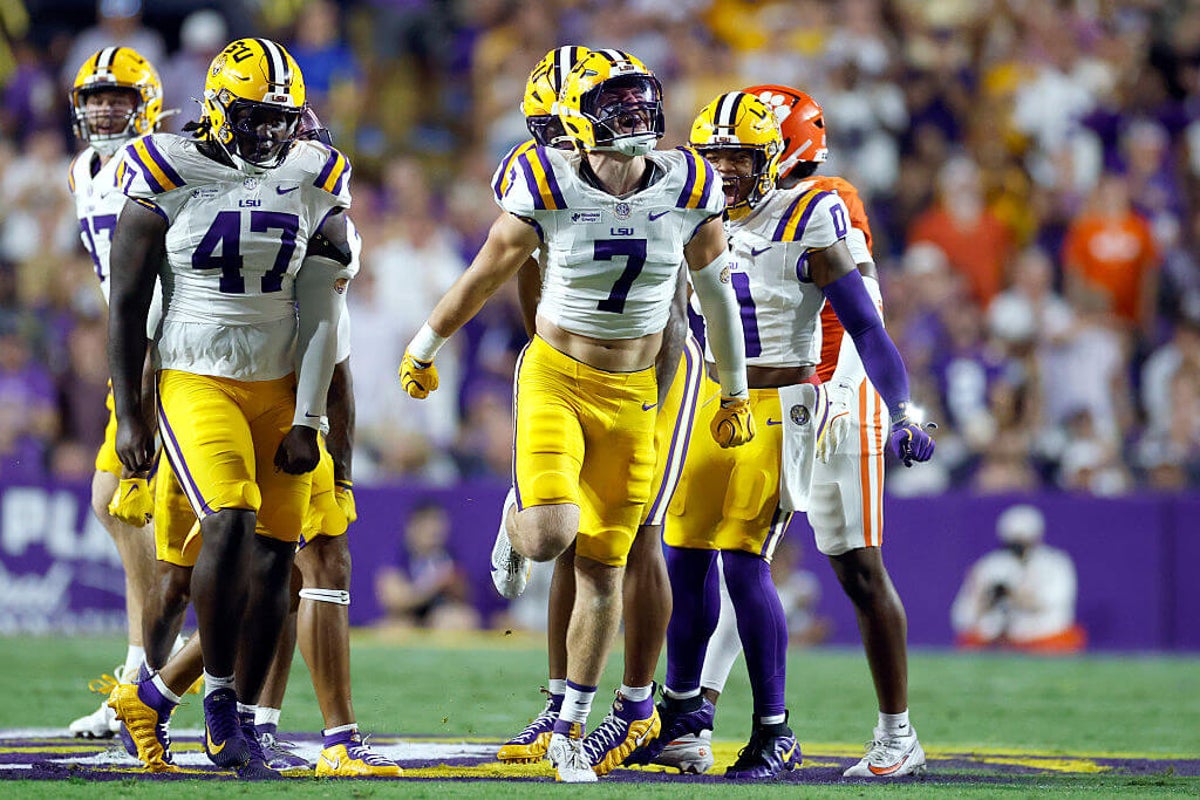
Last week, a Louisiana state court cleared the way for roughly 40 former college athletes to return to college with immediate eligibility, including tight end Dae’Quan Wright and defensive tackle Zxavian Harris, who previously played for Kiffin at Ole Miss. Both signed NFL contracts as undrafted free agents this offseason. The Louisiana ruling prevented the NCAA, SEC and LSU from taking action that would adversely affect the athletes. LSU ultimately decided not to roster those players for Saturday’s win over Clemson, but both players are enrolled at the school and can be added to the roster at a later date.
When Kiffin was asked during his weekly news conference Monday whether he had a timeline to update the players’ status, he said: “I don’t have anything on that. Sorry.”
The SEC’s amended complaint noted an “informal meeting” between the other 15 conference CEOs (not including LSU) this past Friday, before LSU submitted a finalized roster for Week 1. According to SEC bylaws, a school’s membership can be terminated involuntarily at a meeting of conference CEOs if at least two-thirds vote in favor of termination.
“Although no official action was taken at the September 4 meeting, the consensus of the CEOs was and continues to be that LSU’s continued membership in the Conference would be inconsistent with the publicly stated values and principles of the Conference and its remaining member institutions,” the complaint reads, “whether or not LSU ever includes Harris, Wright, or other football players who are ineligible under the Professionalism Rules on its football team roster.”
During that Friday meeting, according to the amended complaint, the 15 conference CEOs “expressed great concern” that Kiffin was working with the counsel for the athletes in the Louisiana lawsuit, with support and involvement from Louisiana Attorney General Elizabeth Murrill and Louisiana Gov. Jeff Landry, and that the LSU administration has “no meaningful control” over Kiffin or the LSU football program. The amended complaint adds Murrill as a defendant in the lawsuit.
Although no penalties were agreed to or imposed as a result of the Friday meeting, and even though LSU did not roster the players for Saturday’s game, the consensus was that the actions of Kiffin and LSU “made it imperative for a meeting to be called to consider the termination of LSU’s membership,” according to the complaint.
The complaint even noted Kiffin’s comments Saturday at halftime of LSU’s blowout win, when the coach quipped to ESPN sideline reporter Holly Rowe, “Imagine if we had pro players.”
SEC commissioner Greg Sankey, who included a detailed, formal declaration with the league’s amended complaint, also testified on behalf of the SEC for more than three hours at a hearing in Baton Rouge in the Louisiana state case this past Thursday.
The NCAA recently simplified its eligibility rules, essentially giving every athlete five years to play five seasons. The change did not, however, apply to fourth-year seniors who had just completed their eligibility. That led to a wave of lawsuits from recruits in the 2022 high school class seeking an extra year, including the Louisiana suit that covers Wright, Harris and others.
The SEC recently clarified its adherence to an NCAA rule that prevents athletes who have signed professional contracts from returning to play in college football — a decision LSU voted in favor of. The school abstained from a vote on stricter penalties, which include suspending the head coach for half the season, fines and the loss of voting privileges on conference matters.