
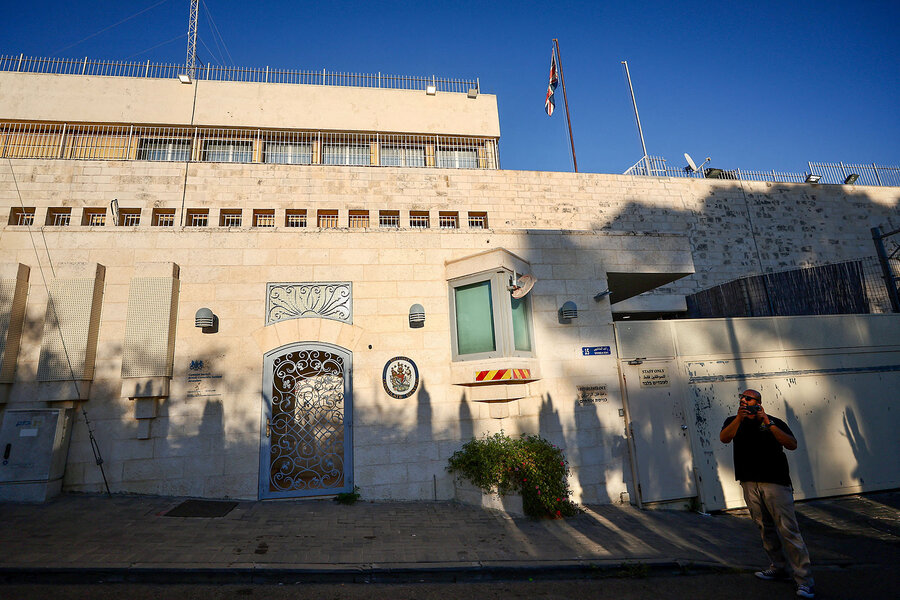
A European backlash against Israeli settlement policy triggered a sharp diplomatic confrontation Tuesday, as Britain moved to restrict trade with West Bank settlements and Israel ordered the British Consulate in East Jerusalem closed in retaliation.
Foreign Minister Gideon Sa’ar called the British ban on imported goods from settlements in the occupied West Bank “hostile” and “anti-Israel.” In addition to the closure of the consulate, Mr. Sa’ar said the Israeli government would expel British representatives from the International Gaza Support Center in southern Israel and a Palestinian police training program in the West Bank, and impose entry bans on 12 British nationals, including members of Parliament.
“The British move is morally distorted and constitutes blatant interference in the affairs of a sovereign state and in its electoral process,” Mr. Sa’ar said in a statement.
Why We Wrote This
After the United Kingdom unveiled a new package of sanctions aimed at Israeli settlements in the West Bank, the government in Israel escalated the diplomatic dispute by saying it would take a few retaliatory steps, including closing the British Consulate in Jerusalem.
Britain said its measure against products from West Bank settlements was a response to what it described as ethnic cleansing of parts of the territory “perpetrated by settler terrorists.” Canada and 10 other European countries issued statements committing to restrict trade in goods from the settlements, which most countries consider illegal under international law and a major obstacle to peace with the Palestinians.
The announcement from British Foreign Secretary Ed Miliband in the House of Commons on Tuesday amounted to one of the most strident steps against Israeli settlements in recent years. Mr. Miliband mentioned longstanding British policy in support of a two-state solution for Israel and the Palestinians.

Britain’s Foreign Secretary Ed Miliband speaks at the House of Commons in London, Sept. 8, 2026.
“We will never have stability in the Middle East without a two-state solution,” he said.
The British government’s move follows a surge in settler violence against Palestinians in the West Bank, and the rapid expansion of dozens of wildcat outposts across the territory over the past year. Prime Minister Benjamin Netanyahu’s government has taken few serious steps to curb settler vigilantism. Two weeks ago he praised the settlement movement for “preparing the ground for a major immigration that will come.”
Last month, Israel published the first batch of construction tenders for a new Jewish settlement in an area of the West Bank called E1, which would effectively bisect the territory and – experts say – make the creation of a viable Palestinian state impossible. Foreign governments, including the U.K. and the European Union, had long warned the Israeli government against settlement expansion in E1.
In his address to lawmakers on Tuesday, Mr. Miliband said Britain would “take action against specific companies and individuals who provide services such as construction, infrastructure, financing, or real estate for settlement expansion.”
U.K. imports from Israel totaled £2.4 billion in 2025 (about $3.2 billion), according to British trade statistics, but it’s unclear what percentage of that amount derives from the settlements.
“So to those who finance or facilitate illegal settlements, let me say this, you will face the full force of U.K. sanctions,” Miliband said.
Earlier this summer, around 140 British MPs petitioned Mr. Miliband to ban trade with Jewish settlements in the West Bank, where around 450,000 Israelis live alongside 2.7 million Palestinians.