
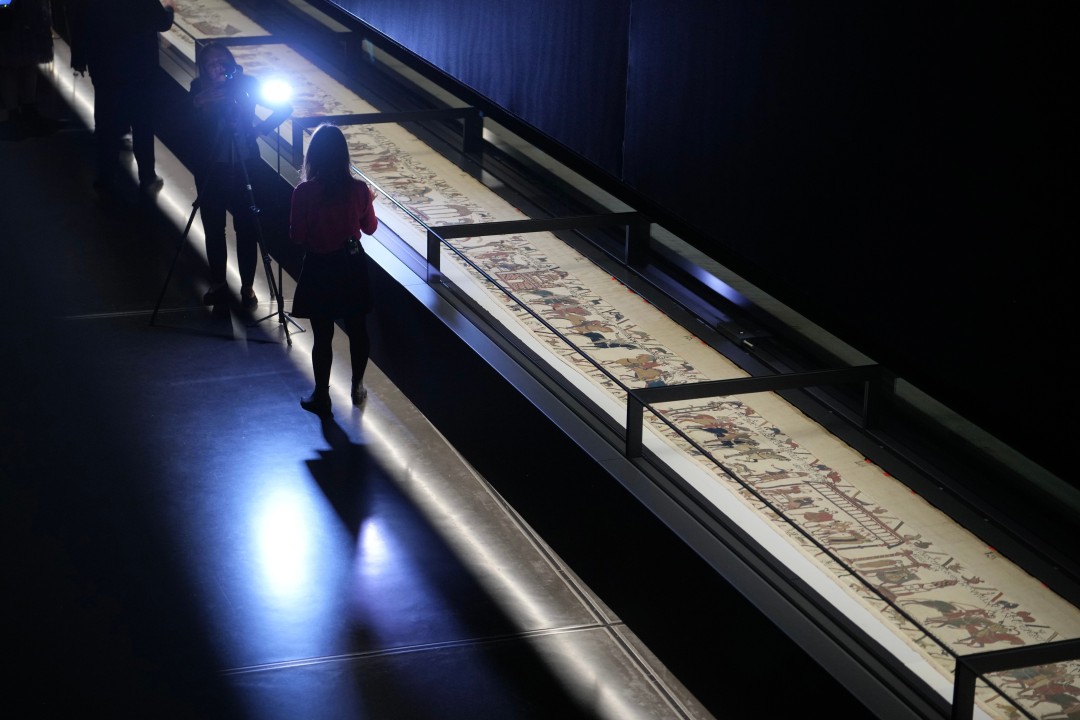
After a wait of almost 1,000 years and a journey of hundreds of miles, the Bayeux Tapestry’s big moment is here. The embroidered panorama depicting the last successful invasion of England goes on public display at the British Museum this week, reports the AP, back on British soil for the first time since the 11th century. Tickets are sold out for months, and the museum expects 1 million visitors to see the tapestry before the exhibition ends in July 2027. Schoolchildren across the UK will get special history lessons on it. King Charles III and French President Emmanuel Macron have already had a private viewing. It’s an extraordinary level of excitement for what Prime Minister Andy Burnham jokingly called a 230-foot “reminder of one of Britain’s biggest defeats.”
Like a medieval comic strip, the tapestry tells a vivid tale of betrayal, bloodshed, suffering, and conquest, depicting a pivotal moment in European history: the Norman conquest of England in 1066. It illustrates events leading up to the Battle of Hastings, when William, Duke of Normandy, defeated King Harold’s Anglo-Saxon army. The invasion made William the first Norman king of England, brought the French language and French settlers to England and forever intertwined the two countries’ fates. Exhibition curator Michael Lewis said at a preview Monday that “1066 is the most important event in English history,” and there is a “propaganda element” stitched into the tapestry. It was designed to tell English people that “The status quo has completely changed now. William is king and you need to kind of accept the new reality.”
The tapestry’s 58 scenes begin with English nobleman Harold Godwinson traveling to France, where he swears an oath to William. But when English ruler Edward the Confessor dies, Harold is crowned king, leading William to assemble a fleet and set sail for England. The final sections depict climactic battle: archers with longbows, charging cavalry, sword-wielding knights, hand-to-hand combat, and mutilated bodies. Brutal violence sits alongside domestic detail. Soldiers steal livestock, cook dinner, eat using their shields as plates, and burn down an English house as a woman and child flee. Margins at the top and bottom of the fabric brim with people, fish, dogs, and winged beasts, sometimes acting as ironic commentary on the main action.
It remains remarkably vivid, and would have been even more powerful for its 11th-century viewers, Lewis said. “Maybe they would even have tried to pick out themselves in the story of these events,” he said. For historians, the tapestry is an invaluable source of insight into 11th-century life: shipbuilding, fashion, cuisine, architecture, armor, even astronomy. At one point Halley’s comet streaks across the sky, as it really did in 1066. Scholars still debate its mysteries. Was the arrow that hits Harold in the eye, killing him, a later addition? A final scene, possibly depicting William’s coronation, is missing. Historians even argue about the exact number of equine and human penises on display—either 93 or 94. Leonie Hicks, professor of medieval studies at Canterbury Christ Church University, says one reason the tapestry remains so famous is because its vivid, childlike illustrations are “very meme-able.”