
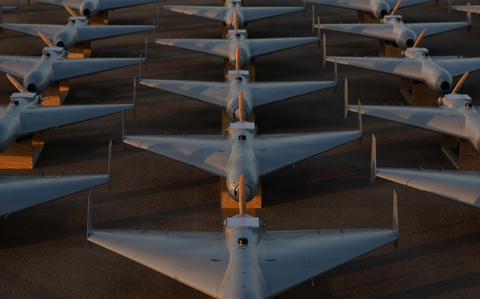
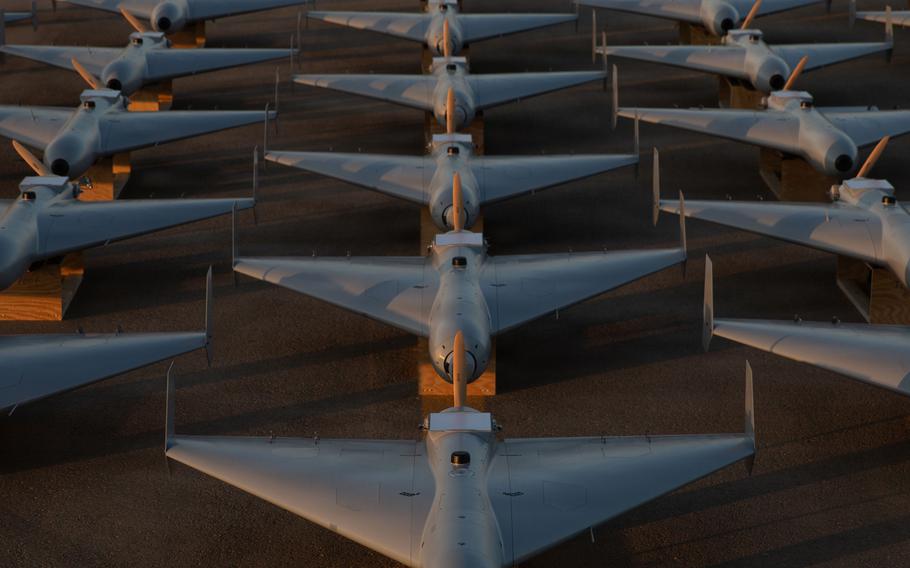
Low-cost Unmanned Combat Attack System drones sit in rows at an undisclosed base in the U.S. Central Command area Nov. 23, 2025. A new Hudson Institute assessment argues that Iran can assemble drones and mixed strike packages faster and more cheaply than the United States and its allies can replace the interceptors fired to stop them. (U.S. Navy)
Iran’s ability to rebuild its battered drone arsenal is calling into question whether large U.S. bases that have long anchored American military power in the Middle East remain viable in an era of sustained attacks.
A new Hudson Institute assessment concludes that while U.S. and allied attacks have inflicted severe losses on Iran’s long-range strike forces, Tehran retains the industrial know-how and foreign supply networks to regenerate drones that are difficult and costly to defend against.
The findings come as retired Army Gen. David Petraeus, a former U.S. Central Command chief, has argued that Iran’s attacks have already rendered some American bases around the Persian Gulf obsolete.
“First and foremost, to our former basing arrangements, those are no longer viable,” Petraeus said in an interview with The Cipher Brief last month.
Petraeus highlighted Al Udeid Air Base in Qatar, home to CENTCOM’s forward headquarters he himself helped formally open in 2009, as an example of an arrangement no longer workable.
Large bases such as Al Udeid, Naval Support Activity Bahrain and other installations around the Gulf were built when the United States could operate in the region with relatively little threat from sustained precision strikes.
Their vulnerability has since been exposed during the war with Iran, which has launched repeated attacks on those facilities, casting doubt on their future role for U.S. forces in the region.
In a report issued Friday, Hudson nonresident senior fellow Can Kasapoglu argued that one of the major problems facing the United States, and by extension its bases in the region, is the resilience of Iran’s drone program.
During the conflict, the U.S. military has severely damaged Iran’s military, including its navy and ballistic missile network.
U.S. and allied aircraft have destroyed missile launchers, production facilities and specialized equipment, according to the report, which noted that American aircraft have sometimes followed mobile missile launchers back to storage areas before attacking them.
But Iran’s drone enterprise presents a different problem, the report said.
Shahed-type drones use commercially available components that can easily be acquired through foreign suppliers such as China. Production can also be dispersed among smaller facilities that are harder to find and destroy than missile factories.
“Tehran’s decentralized drone ecosystem can regenerate more rapidly,” the Hudson report said.
The aircraft themselves require little infrastructure to launch, and Iran uses simple launch rails and even pickup trucks, allowing drone units to disperse and move in ways that large ballistic missile launchers cannot, the report noted.
Future drone attacks also could become more sophisticated, with Iran mixing large numbers of inexpensive propeller-driven drones with faster weapons intended to suppress air defenses, the report said.
For example, the Hadid-110, a jet-powered Iranian drone capable of speeds exceeding 300 miles per hour, could be used against radars, command centers and air defenses ahead of slower drones, the report said.
Such a scenario raises questions about whether the U.S. will be able to repair and reconstitute operations at bases already damaged in the region or will have to shift to a lighter footprint in the future that would leave U.S. troops less exposed.
Petraeus described the current setup as “obviously not one that is sustainable” given a cost mismatch that favors Iran’s affordable attack arsenal over multi-million dollar interceptors used to counter it.
“This is a result of the Iranians having capabilities they didn’t have before in terms of the numbers of drones and the numbers of missiles with the range required to hold our facilities at risk and to strike them and to kill our soldiers and wound them and also to do the same to the most important energy infrastructure in the world,” Petraeus said.
Petraeus also noted that the situation U.S. forces have faced in the Middle East so far pales in comparison with the scale of drone warfare in Ukraine, suggesting that things could get worse if Iran can further expand its drone operations.
While Iran has launched roughly 10,000 drones during the six-month conflict, Ukraine is firing that number daily, Petraeus said.
“We have a lot of learning to do, and what we see in Iran is just a small indicator of the threat of the future of warfare,” said Petraeus, who called for “urgent revolutionary institutional military changes.”