
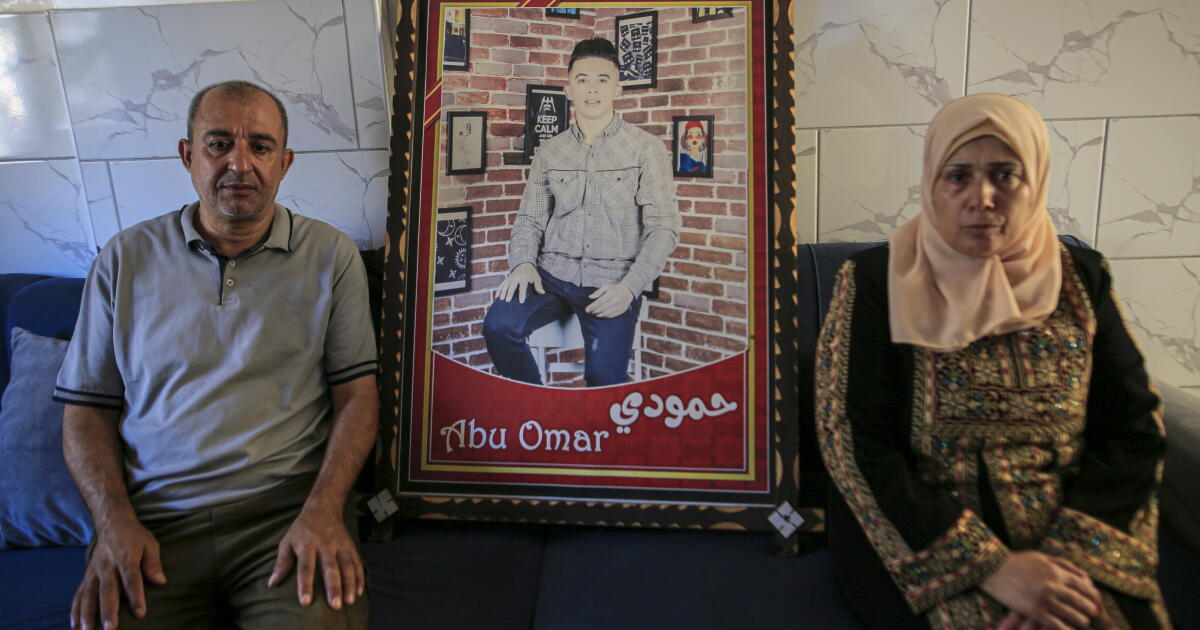
BEIRUT — It had been one year, eight months and 27 days since Atallah al-Drimly said goodbye to his son that Saturday morning in 2024, when Mahmoud insisted he could no longer stay away from the home he had fled and started walking north toward Gaza City. It was the last anyone saw of him.
But on July 28 — after fruitless searches in hospital morgues and clinics; repeated entreaties to rights groups and the Red Cross; and the constant browsing through photos of Gaza’s many unidentified dead — there was Mahmoud in a picture that had gone viral on social media, detained in an unnamed site with two Israeli soldiers posing beside him.
In the picture, Mahmoud sits on the floor flanked by the soldiers, looking diminutive, younger than his 22 years. Though the slender man in the picture is bound and blindfolded, Al-Drimly insists he could still recognize his son.
“I was scrolling and the photo showed up on my Facebook. I knew it was Mahmoud, 100%,” Al-Drimly said in a phone interview.
The picture shocked Al-Drimly, triggering emotions he was still parsing.
“I felt sadness, happiness, it was all jumbled. Words aren’t enough to describe how I felt,” he said.
Still, Al-Drimly could count himself lucky; he at least had received some word of his son.
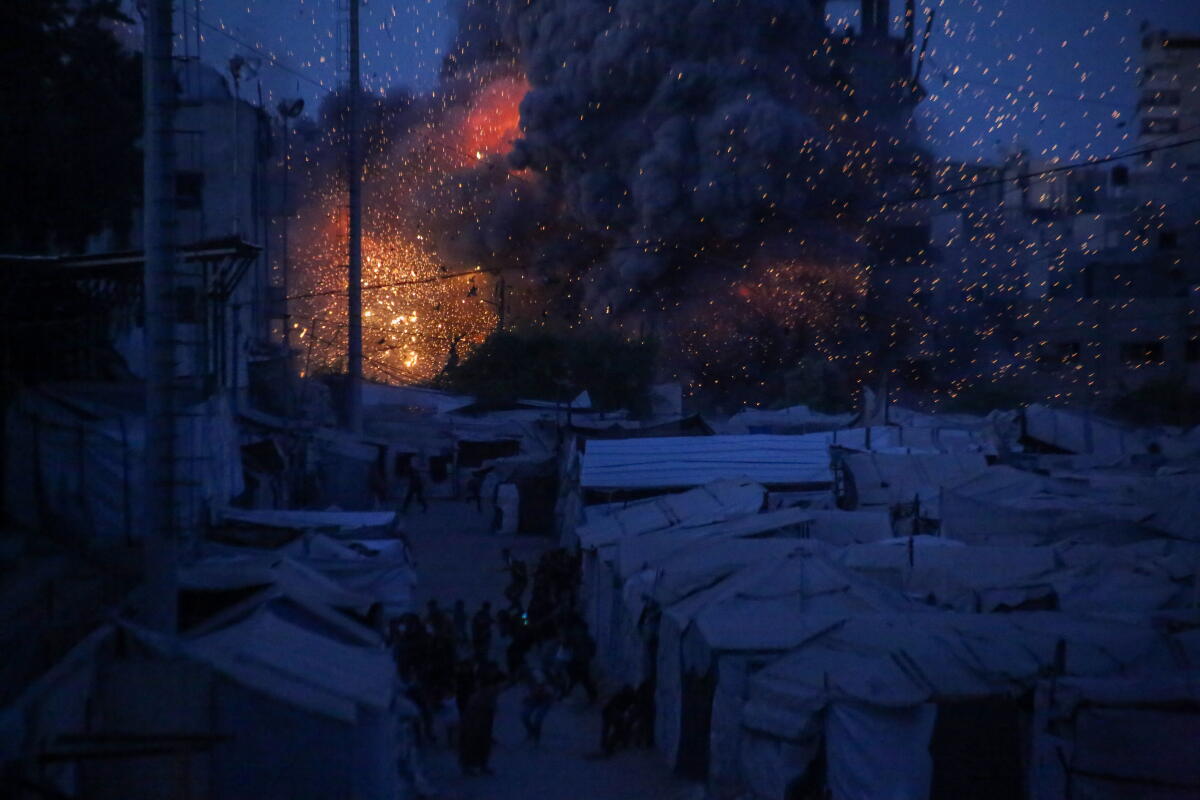
An explosion seen after an Israeli attack on July 28 in Gaza City. Gaza health authorities say Israeli strikes, which were launched in retaliation of Hamas’ attack on Israel in 2023, have left more than 73,000 people dead.
(Ahmad Hasaballah / Getty Images)
Of the thousands who like Mahmoud went missing during the Hamas-Israel war, the crushing majority remain unaccounted for, disappeared in the death-stalked bedlam of Gaza, no hint as to whether they’re dead or alive. For their loved ones, it’s a pain that seems suspended in time, like a broken clock.
Mahmoud’s case, otherwise unremarkable had it not received social media traction, is one of the more hidden consequences of Israel’s campaign on Gaza, which has killed some 73,658 people — most of them civilians — and wounded more than twice that number, according to health authorities in the enclave. That includes the more than 1,350 people killed by Israeli fire since a national ceasefire was signed in October.
Although the Health Ministry in Gaza does not differentiate between civilians and combatants, its figures are considered accurate, including by the Israeli military.
Mahmoud is no fighter, his parents said. Before the war he worked as a blacksmith, they said, and neither he nor anyone else in the family has a political affiliation, whether to Hamas or any other militant groups.
Yet there were no lack of ways for civilians to be ensnared in the killing machine in Gaza since Israel began pummeling the region in October 2023, after operatives from the Palestinian militant group Hamas launched an attack on southern Israel, killing roughly 1,200 people and kidnapping some 250 others.
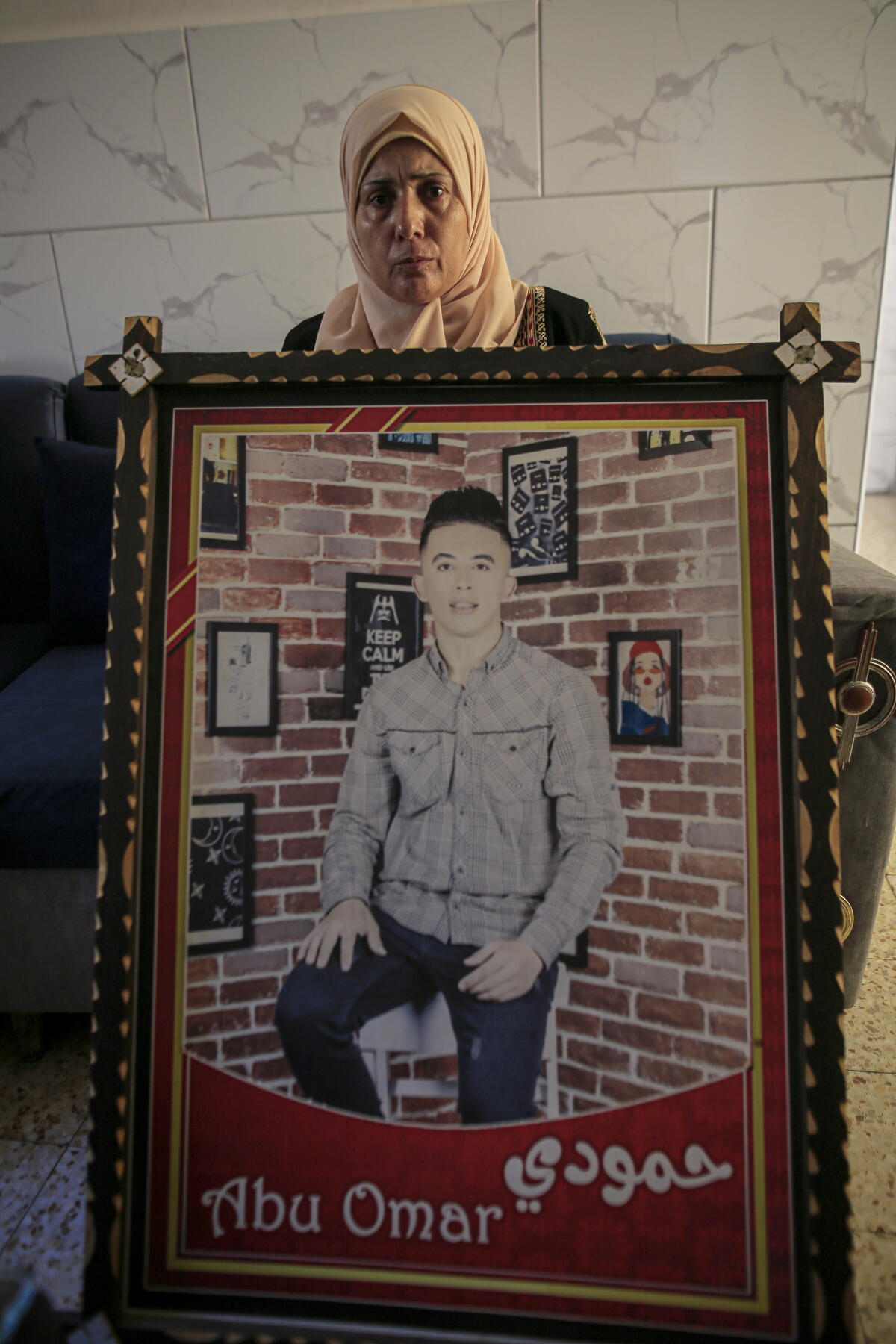
Aida al-Drimly, 50, holds a photograph of her son, Mahmoud al-Drimly. The Al-Drimly family says he was pictured in a photograph posted online by an Israeli soldier.
(Saeed Jaras / For The Times)
Mahmoud could have been a victim of an airstrike that collapsed a building over him, like the estimated 10,000 people authorities in Gaza believe are still buried under rubble.
He could also be among the 1,300 people from Gaza detained in Israeli prisons under the designation of “unlawful combatants” by Israeli authorities — a figure that does not include those held by the Israeli military. Another possibility: He could be among the corpses of 1,700 Palestinians — most of them from Gaza — being held by Israel, according to Israeli media reports.
The International Community for the Red Cross, the primary international rights group involved in tracking down missing persons in the enclave, says it is dealing with roughly 5,000 to 6,000 open tracing requests in Gaza. But its work in Gaza is curtailed, officials say.
One issue is Gaza authorities’ woefully reduced resources to search and retrieve bodies from the rubble. With Israel barring the entry of earth-moving equipment into the Gaza Strip, recovery operations for corpses have relied on bare hands and rudimentary tools, or have to wait for the precious few times when the Red Cross is able to bring in heavy machinery.
The Red Cross says it has trained some 100 forensic practitioners in search, recovery and documentation, but with the enclave’s health system and cold storage facilities all but obliterated by Israeli attack, there are no laboratories that can handle forensic analysis.
Another major roadblock is that after Oct. 7, 2023, Israeli authorities have barred the Red Cross from visiting Israeli detention centers.
“It’s a black hole in our knowledge,” said Pat Griffiths, spokesperson for the Red Cross in Jerusalem. “If we were able to gain access to detention tomorrow, and forensic authorities had access to the equipment to exercise their full ability, you would see a big reduction in caseload.”
Israeli authorities have also become less cooperative with Palestinian prisoner associations, delaying responses to queries if they are holding individuals, and slow-rolling notifications to families and prisoner commissions on those who died in Israeli custody, according to Sahar Francis, a lawyer who was the executive director of Addameer, a Palestinian prisoner advocacy group that was recently banned by Israel. (The U.S. accuses Addameer of “supporting terrorism.”)
“If you don’t get an answer, you don’t know what to say to the families,” she said. Even those who are told their loved ones are not in Israeli custody often don’t accept the response.
That Mahmoud showed up at all was a fluke.
The family had fled their home in Gaza City soon after the war began, crammed into a tent in the enclave’s south. But a year into their displacement, Mahmoud couldn’t take being away from his home any longer.
“He kept saying he wanted to go back, that he couldn’t do anything where he was. And then one day he did it,” Al-Drimly said.
After he disappeared on Nov. 2, 2024, his family approached any prisoner rights groups it could find, filing trace requests with the Red Cross and other organizations. Any time Al-Drimly heard of attacks in nearby Khan Yunis or Deir al Balah, he would go to check. He talked to prisoners and detainees who were released, desperate to get any word of Mahmoud.
“We got nothing, neither good news or bad news,” Al-Drimly said.
That changed on July 28, when Nikol Stelmashvski, an Israeli who recently finished her mandatory military service, posted a 20-photo carousel on her Instagram account, including the image of herself smiling alongside Mahmoud.
The photos triggered a wave of condemnation, then spread across many social media platforms. (After the image went viral, Stelmashvski deleted the photo and made her account private; she later appeared to have deleted her account entirely.)
“Two years of hearing nothing, and suddenly people are swarming us and congratulating me and Mahmoud’s mother that our son is still alive,” Al-Drimly said.
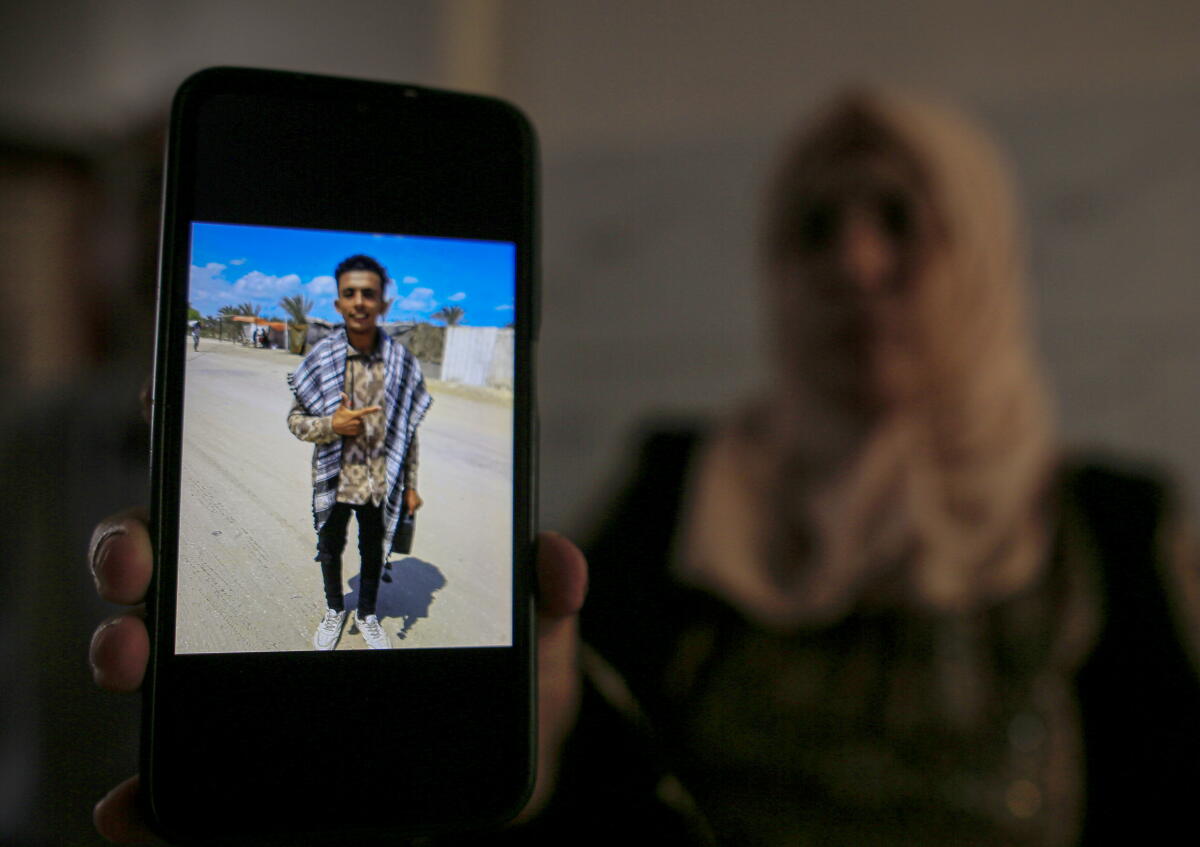
Mahmoud al-Drimly, pictured on a phone screen, disappeared on Nov. 2, 2024, while attempting to return to Gaza City after being displaced to the southern Gaza Strip. His family has had no information about his whereabouts since then.
(Saeed Jaras / For The Times)
The opacity from Israeli prison authorities has been accompanied by a ramping-up of harsh treatment of Palestinian detainees, according to released prisoners, Palestinian and Israeli and international rights groups, and the U.N. (Israel has repeatedly denied allegations of torture and abuse and says the Israeli military acts in accordance with regulations.)
Earlier this year, an investigation by the U.N.’s Special Rapporteur on Torture tallied 52 cases of torture and a further 33 cases of sexual torture and sexualized ill-treatment in Israeli detention centers. The rapporteur accused Israel of “gross disregard” of its duty to treat all detainees humanely and without discrimination. She also counted 94 deaths of Palestinians in Israeli custody; other Palestinian groups say the real figure is significantly higher.
“Since Oct. 7, there is no mechanism for guaranteeing the well-being of Palestinian citizens,” said Issam Younes, head of Al Mezan Center for Human Rights, a Palestinian rights organization.
“The key word here is ‘accountability.’ We’ve long said that the lack of that accountability for Israel would lead to worse outcomes, and this is where we are now.”
For the Al-Drimly family, the spark of hope triggered by the photo hasn’t resulted in anything concrete. Though the family renewed its inquiries on Mahmoud’s whereabouts, the answers have not been encouraging: Both the Israeli Prison Service and the Israeli military denied he was in their custody.
“We’ve talked to everyone we can,” Al-Drimly said, his voice weary.
“No one has helped us find him.”