
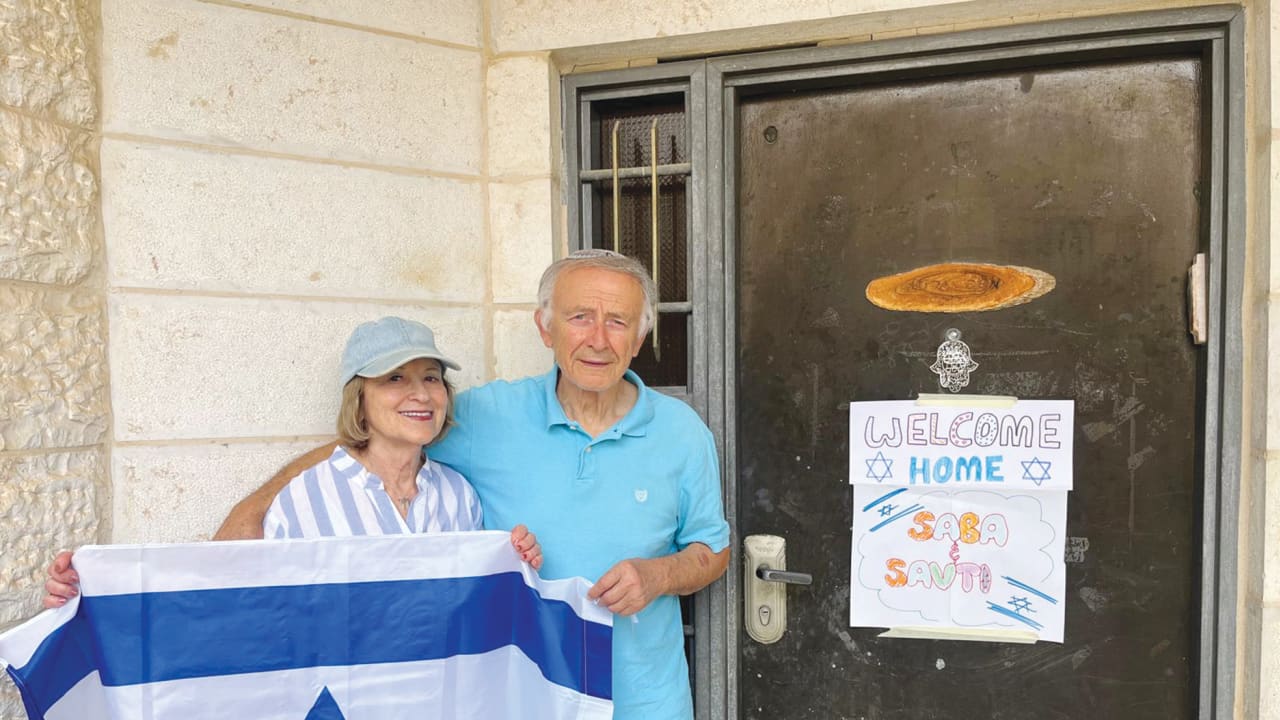
Morton Pancer, 86, and his wife, Carole, 82, spent 57 years of marriage building a life together in Maryland. This week, after decades in the United States, they decided it was finally time to move home to Israel.
On August 25, the couple arrived on an El Al flight and officially made aliyah with Nefesh B’Nefesh, moving to Israel to be closer to their family and begin a new chapter of their lives.
One of their daughters, Jessica Gertel, made aliyah with her family in the early 2000s, while another, Shoshana Lerner, made aliyah this year with her family, giving them even more incentive to join them in the Jewish state.
For Morton, a Holocaust survivor born in Poland in 1939, whose immediate family survived the war after fleeing to Siberia, the decision to come to Israel is deeply rooted in Judaism.
“We’re Jewish,” he told The Jerusalem Post. “Aliyah – this is the place for the Jews, our own country that we didn’t have for many centuries. It seems like a good thing to do is to come home.”
The Pancers’ move comes as North American immigration reached record levels in August. The Post reported that more than 1,100 North Americans made aliyah through Nefesh B’Nefesh last month, marking a new monthly record for the organization.
The idea of making aliyah had been on their minds for years. Looking back, Morton wonders why they waited so long.
“I don’t understand why we didn’t come right away,” he said.
Carole said she believes Israel is the natural home of the Jewish people – and that Jews who have the opportunity to come should do so.
“I think every Jew should be here. It’s our own homeland,” she said.
Just one week into their new life, Carole said she already knows they made the right choice.
“We’d like to help Israel and contribute in any way we can to the country,” she said. “I think we made the right decision. I can say that even after a week.”
The move also brings the Pancers closer to most of their family. Eight of their 12 grandchildren and seven of their great-grandchildren already live in Israel, while four grandchildren remain in the United States; Carole believes the other four will eventually join them here in Israel.
A life built in America
Carole grew up in Harrisburg, Pennsylvania, in a family with several generations of roots in the United States. Her parents were born in the US, while her grandparents came from Lithuania and Russia in the early 20th century.
After graduating from the Art Institute of Pittsburgh, she moved to Baltimore after being offered a job as a fashion illustrator.
She worked for a department store, drawing clothing that was featured in newspaper advertisements, and later as a freelance artist producing illustrations for ads.
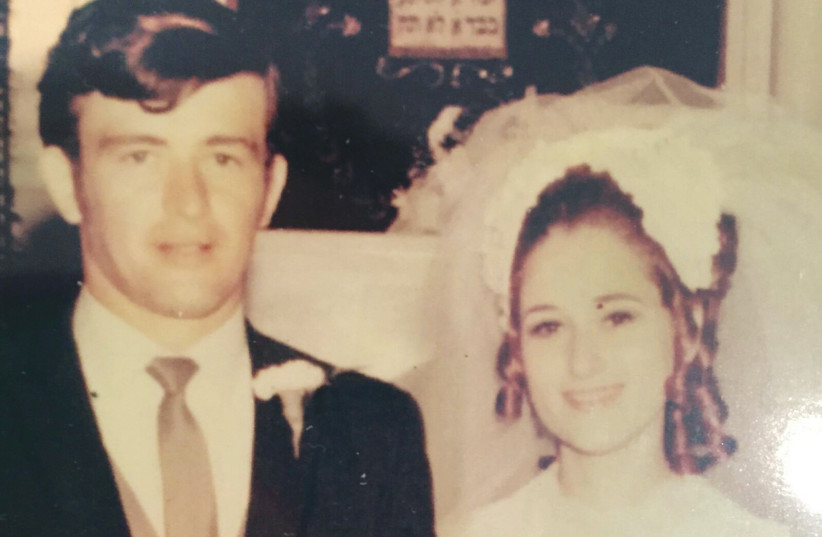
In Baltimore, she met Morton on a blind date arranged by a mutual friend. The two married and spent the next 57 years together in Maryland, including 29 years in Silver Spring.
Now Carole hopes to bring her artistic talents to her new home. “I’m an artist, so I’d like to capture Israel on my canvas,” she said.
Carole enjoys painting portraits and nature. She also wants to attend an ulpan to learn Hebrew, volunteer, spend time with her family, make new friends, and have fun in her new surroundings.
Morton spent most of his professional life working for the US government, including at the IRS. Then spent about 25 years working on financial management systems for various branches of the US armed forces. He retired in 1998.
America became the country where the couple built their life. But Morton said that Israel remained the homeland of the Jewish people.
“It’s the land that we all belong to,” he said.
A Holocaust survivor’s journey
Morton was born in Tomaszów Lubelski, Poland, in 1939, shortly before the outbreak of World War II. He was only seven months old when his family fled the town. His parents and older brother escaped toward the Russian side of Poland, while Morton was initially left with his grandmother.
An uncle eventually reunited the family and helped smuggle the infant through the woods along the German-Soviet border.
Soon afterward, the family was transported to Ukraine and then deep into Siberia, where they remained for about five years.
“The Russians saved us,” Morton said.
During their grueling time in Siberia, his father was sent to a slave-labor camp, while his mother struggled to keep the family alive under terrible conditions. Food was scarce, and Morton remembers that at times only one loaf of bread fed the entire family.
His mother sold items on the black market to obtain food.
“If it weren’t for my mother, we would have never survived,” Morton said. “She was one tough lady.”
The decision to flee Tomaszów Lubelski would ultimately save Morton’s life, he and his family believe.
German forces heavily bombed the town in September 1939. Records indicate its Jewish population numbered more than 5,600 at the beginning of the war. The Nazis later established a ghetto there before deporting the town’s Jews to the Belzec extermination camp, where they were murdered.
Had Morton remained in the town, his family believes he would have been killed either in the bombing or during the subsequent destruction of the Jewish community.
When the war ended, Morton was about six years old. The Russians allowed the family to return to Poland, where they hoped to discover who had survived.
Instead, they encountered devastation and found no survivors.
Morton remembers the journey back on wooden cattle cars. Jewish partisans would greet the trains and tell the Jews they would protect them, but the journey remained dangerous, with attacks against Jews returning to Poland. Amid the fear and uncertainty, he distinctly remembers huddling around a stove inside the cattle car for warmth.
“It took several months to get back to Poland,” he said. “I don’t know how we survived. I was scared.”
After the war, Zionist groups sought to send Morton and his older brother to what was then British-mandated Palestine. However, his mother refused to send the children away on their own.
The family remained in Poland for about a year before moving to Austria and then Germany, where they lived in a displaced persons camp under the care of the US Army.
Eventually, a relative in the United States, Rabbi Moshe Boehm, sponsored the family’s immigration.
In 1951, they boarded the USS Hershey for the journey to America.
For Morton, America represented safety and opportunity.
“Everyone wanted to go to the US,” he recalled. “They claimed the streets were paved out of gold.”
The US ultimately became the country where Morton built his career, and where he and Carole raised their family.
From protecting Germany to protecting Israel
After graduating from high school in Baltimore, Morton joined the US Army at age 18. He was sent to Germany for two years with the 3rd Armored Division’s 15th Infantry Battalion.
The assignment struck him as deeply ironic.
“They sent me to Germany for two years, protecting the Germans against the Russians who saved us,” he said. “If that’s not irony, I don’t know what is.”
Morton said he wasn’t happy about the assignment but had no choice.
Decades later, after building a life in Maryland, Morton and Carole made another journey.
This time, they were not fleeing. They were coming home.
Morton said he had always wanted to live in Israel and had returned over the years to support Sar-El, an organization that enables volunteers to support the IDF. During his visits, he worked on army tanks.
The couple currently lives with one of their daughters in Gush Etzion while they search for a more permanent place to live, potentially in an apartment or an independent-living community.
For Morton, his new life in Israel comes with a sense of responsibility.
He said he has always tried to help Israel from the United States, but now wants to contribute from within the country. “It’s the land that we all belong to,” he said. “We have to make sure it grows and prospers.”
He also believes Jews have a responsibility to ensure that Israel remains strong and secure.
“We’ve gone through a lot,” he said. “The Jewish people, for thousands of years, we didn’t have a country. Now that we have a country, we have to make sure we do the right thing and make sure it’s strong and secure.”
His own history gives that belief a deeply personal meaning.
“What happened in the past should never happen again,” Morton said. “We have to make sure this never happens again – the Holocaust.”
Carole, meanwhile, is looking forward to her new life as an artist, wife, mother, grandmother, and great-grandmother in Israel.
For now, she is taking in the experience of finally being here.
And she has a message for other American Jews who may be considering the same journey.
“Now is the chance to come home to Israel before things get worse,” she said. “Every Jew should be here.”