
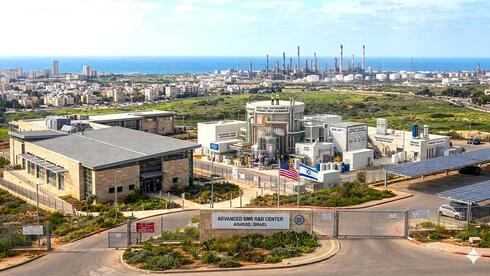
“If you and I stepped into a time machine right now and traveled 20 years into the future, we would see the State of Israel powered by nuclear energy, with data centers everywhere,” Ezra Gardner told the Energya website. “Do you think we would look back and ask, ‘How did no one see this coming?’ Of course we can see it coming. What would be shocking is if Israel still had no nuclear energy 20 years from now.”
Jewish businessman and investor Ezra Gardner is a fascinating figure by any measure. He is the founder and partner of Varana Capital, which has invested more than $500 million in 21 Israeli startups to date. He is also behind the Chai Fund, which raised $50 million for emergency investments that supported Israel during and after the war.
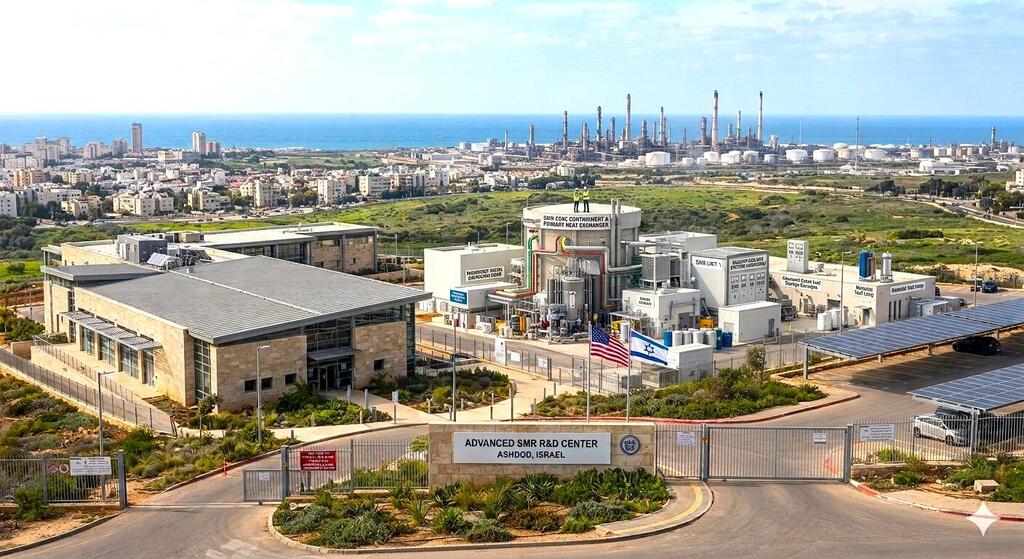
Nuclear reactor in Israel
(Illustration: AI)
Gardner is a strong believer in taking companies public through special purpose acquisition companies, or SPACs. He founded Gesher I Acquisition Corp. and merged it with Israeli freight and shipping startup Freightos. Another of his SPACs, Gesher II Acquisition Corp., is searching for a promising company to merge with. Through Varana Capital, he was also among the early investors in Canadian small modular reactor company Terrestrial Energy, which has since merged with a publicly traded U.S. company and signed an agreement with the U.S. Department of Energy to establish Project TETRA, which will include a 380-megawatt nuclear power plant.
All this helps explain why Gardner is among the most prominent entrepreneurs seeking to bring small modular nuclear reactors, or SMRs, to Israel. For him, it represents a combination of fervent Zionist conviction that this is Israel’s path to economic and energy independence and his own business interests.
Data centers have an insatiable appetite for electricity. Israel currently operates small data centers that consume about 20 to 30 megawatts. Hyperscale data centers in the United States can reach 300 megawatts. The data center campuses being built by U.S. technology giants exceed 500 megawatts, roughly equivalent to the electricity consumption of Tel Aviv. The Stargate project announced by President Donald Trump at the beginning of his term is expected to reach 1 gigawatt.
According to Gardner, Israel has everything it needs to become a leader alongside the United States: excellent international connectivity, strong human capital, a developed technology ecosystem and a leading semiconductor industry. Global giants such as Nvidia, Google, Microsoft and Amazon also operate in the country.
The problem is that Israel’s power grids simply cannot supply electricity on that scale. This could open the door to privately operated nuclear reactors. Gardner argues that the only solution that would allow Israel to realize its technological potential and secure its economic growth for the next century is a rapid transition to nuclear energy through small modular reactors.
SMRs are currently considered one of the greatest technological and potentially commercial opportunities in the energy sector. They generate only a quarter or a third of the power produced by massive conventional nuclear reactors, but use lower-enriched nuclear fuel, incorporate multiple protective layers designed to prevent leaks, produce no carbon emissions during operation and can be connected directly to data centers. Several dozen companies around the world are developing the technology, with the first operational reactors expected within a year or two.
“The fact is that Israel needs electricity and SMRs are the solution. Israel should be a global capital of data centers and that encapsulates all the requirements. The energy density is there and it will come in a safer, cleaner and less-enriched package,” Gardner said.
Israel has plenty of natural gas and abundant sunshine. Shouldn’t that be enough?
“The government recently imposed restrictions on allocating electricity to data centers. Israel is saying as clearly as possible: ‘We do not have the electricity reserves required for massive data center infrastructure from our natural gas reserves.’ The country must preserve its domestic natural gas and direct it toward population growth and ongoing household consumption. If the United States and the technology giants want to see advanced data centers here, they simply cannot be powered by gas reserves or renewable energy.”
“Solar energy simply does not meet the basic requirements of data centers. The global data center industry uses the term ‘five nines,’ meaning you must guarantee 99.999% continuity of supply to support server farms. Solar power does not come close to that level of reliability and battery storage technologies remain outrageously expensive. Solar and wind are useful additions, but they are not tools for managing grid loads.”
Gardner is not content merely to present his idea in the media. He is in direct contact with government ministers and recently returned from a meeting with Energy and Infrastructure Minister Eli Cohen. What he was told there has not been disclosed, but Gardner remains highly optimistic that small nuclear reactors will find their way to Israel.

Ezra Gardner
(Photo: Michal Sela)
Several obstacles remain. Officially, Israel is barred from building nuclear reactors, small or otherwise, because it is not a signatory to the Nuclear Non-Proliferation Treaty. Israel is one of only five countries in the world that are not parties to the treaty, alongside India, Pakistan, North Korea and South Sudan. As a result, treaty members are prohibited from selling Israel nuclear reactors or nuclear fuel. SMRs fall under this restriction even though they cannot be used to produce nuclear weapons. Trump, for example, agreed to Saudi Arabia’s request to build a nuclear reactor on its territory but rejected similar Israeli requests.
Nevertheless, the Israeli government has a contingency plan to build a nuclear power plant, possibly using SMRs, and the proposal has already reached the strategic planning stage. The Energy and Infrastructure Ministry has published a plan under which all electricity in Israel would be generated from solar, wind and nuclear power by 2050.
According to the proposals, a large nuclear reactor would be built near Shivta in the Negev, alternatively in the Rogem, or Givat Hayil, area of the Negev or deep offshore west of central Israel. The government, which would need to approve the nuclear program as a national project, has yet to discuss the matter.
Progress has been made on the American side. Trump has declared a policy of distributing SMR technology to U.S. allies and recently reached an agreement with Saudi Arabia on a project to build an American SMR on its territory.
That project is the first product of an agreement known as Pax Silica, signed in Washington in February by the United States, Saudi Arabia, India, Australia, Japan, South Korea, Britain, Singapore and Israel.
The agreement is intended to protect the entire value chain involved in developing and manufacturing advanced technology. Israel is clearly well suited to participate, with one complication: it insists on maintaining ambiguity over its offensive nuclear capabilities.
This is where Project Spire, part of Pax Silica, comes in. It could resolve the difficulty: Israel would allocate approximately 16,000 dunams, or 4,000 acres, of land in the Negev and lease it to the United States for 99 years. A secured base with the protection level of a U.S. military facility would be built on the site, hosting research and development on the scale of Silicon Valley.
The American facility, called Fort Foundry, would develop advanced semiconductors and operate massive data centers, training facilities for large AI models and independent energy infrastructure powered by an SMR nuclear plant. The land would remain under Israeli sovereignty but be managed by the United States, with American and Israeli companies operating there. The full plan is now before the government and could proceed to final signing if approved.
Gardner claims Israel is afraid to sign.
“You can ask yourself why this document has not been signed. We happen to know why. The Israeli government believes it will lose control once the agreement is signed. It wants guarantees about exactly how the United States will use the complex. The fear, or concern, is that it will be used for something more basic, such as research and development, rather than electricity generation. But there is no reason to worry about that.”
Gardner likes to draw historical analogies to current events. His example is the 99-year agreement between Britain and China over the small fishing port of Hong Kong, which answered Britain’s demand for a deep-water port.
“Could you imagine them acquiring the port of Hong Kong and doing nothing with it? They built a port there and around it a city that became a modern financial mecca, the most powerful city in all of Asia,” he said.
For Gardner, the parallel is clear: “Do you think that if this document is signed, the United States will say, ‘This looks nice. Maybe we’ll just do a little research and development?’ Come on.”
What do you expect to happen in the near future?
“I expect you will continue to see, and I may be part of what you see, a public discussion surrounding the political debate. People like me ultimately use political tools to say publicly what government officials do not want to say. But eventually, the real negotiations take place.”
Even if an agreement is signed and construction of a new nuclear reactor begins in Israel, no one can guarantee that it will be an SMR rather than a large-scale reactor.
“Let’s be clear. Nuclear power already works extremely well around the world, even before SMRs become available. Large reactors such as the Westinghouse AP1000 generate electricity on the gigawatt scale and the United States will run out of energy before it has enough SMRs to power everything.
“The advantage of SMR systems is that they do not need to be connected to the power grid. They are small enough to supply 100, 200 or 300 megawatts and can operate in ‘island mode,’ meaning they can be activated before a complete grid management system is in place. You can build a data center that needs 100 megawatts and give it the full generating capacity of one of these SMRs. The technology is ready.”
Gardner estimates that regulatory approvals could arrive much sooner than prevailing market forecasts suggest. While many expect U.S. safety approvals for small reactors to take another three years, a dramatic development points to an accelerating timetable: leading SMR companies, including Bill Gates-backed TerraPower, have already begun physically constructing nuclear power plants before receiving final approval to load nuclear fuel.
According to Gardner, this multibillion-dollar gamble by major technology companies is based on the expectation that the U.S. administration will fast-track approval of these technologies within the next year. The availability of low-enriched uranium and high-assay low-enriched uranium, known as LEU and HALEU, together with the use of existing supply chains, will make it possible to bring these reactors online within a relatively short period.
Gardner believes economic pressure and enormous demand for computing power will ultimately force the issue, with an Israeli government decision now closer than ever. Clear demand is shaping reality and the question is no longer whether Israel will adopt civilian nuclear power, but how quickly it will sign the agreements and begin building the reactors that could drive the economy’s next engine of growth.