

A raw and biting — or at least vigorously gumming — showbiz character study about a faded Black actress whose entire adult life has been shaped by the peaks and valleys of living in a place that often seems flat on the surface, Chris Rock’s “Misty Green” is preoccupied with the relationship between feast and famine from the moment it starts, and by the Los Angeles-specific tendency for those two conditions to remain worlds apart even when they overlap.
Even when they walk right past each other on Hollywood Blvd., or audition for the same role on a studio lot. Fortune is a fickle thing: One day you’re winning some award on TV, and the next day, a short 18 years later, you’re being evicted from your dead sugar daddy’s beachside pied-à-tierre because he left it to his wife in his will. That’s la la land for ya.

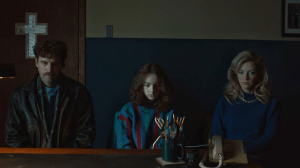
As Rock takes pains to remind us in the photo montage that opens his latest and most serrated film (a film that shares its setting’s lack of subtlety), L.A. is a city where world-class museums are just down the block from Skid Row, where the Oscars are hosted inside of a hideous shopping mall, and where the paparazzi thoughtlessly climb over homeless people to snap photos of starlets like Lindsay Lohan (to name the first of several celebrities this movie catches with a random stray). How is anyone supposed to stop chasing the bag when it feels like, even at their lowest ebb, they’re still always close enough to reach out and grab it? By the same token, how is anyone supposed to have the bag when there’s almost no degree of success that can ensure they’ll let you keep it?
If such a degree of success even exists, it’s certainly not available to a woman like Misty. Played to wearily ferocious perfection by “Slow Horses” powerhouse Rosalind Eleazar in what should be a star-making performance (but you never know in this town!), the almost 40-year-old Misty has developed a full script of excuses for the downward spiral she’s been on since winning an Emmy for a TV show called “Red Eye” in 2008.
“Too Black to be with Leo, not Black enough to be with Damson, not a nepo baby or a Brit.” She lays it out with a battle-worn intensity that deflects attention from what she’s trying hard not to say; we think “it’s a funny meta-joke that Eleazar is a Brit,” and “is Damson Idris really famous enough to belong in that sentence?,” and not “what has Misty done for the last two decades besides making excuses for herself and getting cozy with some old guy who let her live in his spare apartment?”
We get a partial answer to that question after she bumps into Jordan, the director whose “Cinderella” remake was going to launch Misty into the stratosphere until she got coked up out of control and punched him in the face on set (Rock plays the part himself, wise and resigned in a role that warmly reflects how the onetime firebrand has softened with age). She’s so deeply internalized Hollywood’s treatment of Black women that she can’t even give herself a break. So yeah, it’s true that Misty is a complicated person in a business that’s still painfully simple in its approach to race, age, and second chances, but it’s also true that her inestimable talents as an actress are equaled by her gift for self-sabotage. It’s never just one or the other in her adopted city — it’s always both right on top of each other.
It’s Misty Green having seven days to move her shit out of her sugar dead-dy’s apartment at the same time as Jordan offers her the chance to audition for a Tarantino-level career rebound: The lead role in an Oscar-bound remake of “Dreamgirls.” (Jordan’s success as a studio director seems contingent on a willingness to fridge his creative ambitions in favor of overseeing palatably Black IP.) One minute she’s bounced out of her apartment and left for dead, and the next she’s being considered for immortality.
But Rock’s unkempt script — its “Magnolia”-sized ambitions curtailed by a too-tight five million dollar budget and the visual dexterity of a stand-up comedian — isn’t satisfied with the vertigo created by those concurrent extremes, so it compounds the dizziness by dumping some more shit into Misty’s lap. Enter: her vaguely troubled brother Jay (Daniel Kaluuya, another Brit), who’s released from a psychiatric hospital in the middle of this mess. He loves his sister unconditionally, and vice-versa, but he’s also an anchor around her neck.
Back on screen for the first time since “Nope” in 2022, Kaluuya is still one of the most dynamic actors alive, still capable of changing the energy of a room just by narrowing his eyes, but he’s severely under-served by a script that reduces Jay’s mental illness to a strange cocktail of narratively convenient symptoms. Sometimes, those symptoms come at the direct expense of the movie’s sociopolitical valence; I’m not sure that Jay’s running gag about a plastic spider, which pays off in a confrontation that feels like a deleted scene from “Crash,” is explained by anything you’d find about Bipolar Disorder in the DSM-5.
Adam Driver, on the other hand, has no such issues, as his character is plainly Satan incarnate. The kind of slicked-haired scenester who lurks in the shadows of Los Angeles’ entertainment industry and thrives on the hidden side hustles that have always propped up the innocent corporate fantasia it exports to every screen on Earth, “Zach” is the devil perched on Misty’s shoulder. He’s the guy who lures her into a nightclub bathroom stall on the eve of her “Dreamgirls” audition, and plies her with all the drugs and dick she would ever need to self-justify not getting the part.
Why bother prostrating yourself before a business that doesn’t even want you, Zach asks Misty, when he can get her $300,000 for a single night with a skeezy billionaire in Dubai? It’s a question that “Misty Green” takes more seriously than you might expect, and one that — per the rest of this movie’s polyphonic approach to concurrent realities — Rock answers with a climax that’s as honest to Misty as it is degrading to some of the other actresses she meets on her misadventures. The film’s worst and most provocative scene literalizes “getting the bag” with a bluntness that comes off less “wry showbiz commentary” than it does “women will go feral for a free accessory,” a moment that briefly sours the whole both things live side-by-side ethos with the sense that Rock is just having his cake and eating it too.
A funnier movie might have been able to pull that off, but “Misty Green” is naturally both a drama and a comedy, much as Rock strains to transcend such genre definitions — and the broadness of his own sensibilities — in favor of a Cassavetes-esque character piece that’s fringed with errant traces of Black entertainment history (the “Dreamgirls” soundtrack is complemented by Bobby Womack’s version of “California Dreamin,” in addition to a hot purple title treatment that bridges the gap between Rosalind Eleazar and Pam Grier).
It’s a good thing the movie is so focused on its heroine, as Rock, despite his singularly dynamic experience navigating the “Hollywood shuffle,” doesn’t offer a ton of fresh insight into how things work behind the scenes for Black creatives or anyone else. This is a movie that calls in a lot of favors that nobody else could, only for it to depict Misty’s agent, played by an unctuous Topher Grace, with all the nuance of a guy who just got off the phone with Vinny Chase. Rock isn’t at all disconnected from the stuff of Misty’s struggle (I was amused by his recent insistence that he still “lives on a normal block” on both coasts, even if the sentiment rings true), he just doesn’t always know how to dramatize it for the masses.
But if “Misty Green,” for all of its messiness, never comes apart at the seams, that’s because Eleazar simply won’t let it, and because Rock wouldn’t forgive himself if she did. His deficiencies as a storyteller have always been outweighed by his profound understanding of people, and even the clumsiest aspects of his latest film — like its telegraphed final grace note, and its running background chatter about the murder of a local white college girl — are appropriately flattened into the mix by Eleazar’s sheer force of will.
It doesn’t matter if Misty is going full “Shame” as she belts out a slow and beautiful cover of Radiohead’s “Creep” at a cocktail lounge, or if she’s helping her best friend (Anna Kendrick) try to reconcile her lust for Black men with her engagement to a very white one (Rich Sommer), or if she’s trying to hold back her vomit as she records her umpteenth self-tape audition for the kind of painfully stereotypical role that she needs but prays she doesn’t get, Eleazar’s performance unfailingly burns with the self-defeating fire of a woman who’s looking for freedom in all the wrong places.
Or, perhaps more accurately, a woman who’s looking for freedom from all the wrong things. Misty has devoted her life to a town that runs on external validation, but in a place where “making it” has always been an empty promise, a place where failure and success can be indistinguishable from each other when seen through a wide enough lens, her only shot at a lasting sense of self-worth might have less to do with the profile of her next job than it does the terms of being cast in the part. This is a movie fueled by the rapid oscillation between Los Angeles’ ups and downs, a movie that gets more traction from being good and bad than it would from being a little more of either, but the prevailing irony that holds “Misty Green” together is that Rosalid Eleazar is never anything less than great.
Grade: B-
“Misty Green” premiered at the 2026 Toronto International Film Festival. A24 will release it in theaters on Friday, October 9.