

Exit polls show Sweden’s centre-left parties with an early lead of 51.3 percent in Sunday’s general election.
Published On 13 Sep 202613 Sep 2026
Swedish Social Democratic Party leader Magdalena Andersson has told supporters that the opposition coalition is leading the polls, and if the results stand, “Sweden will get a new government”.
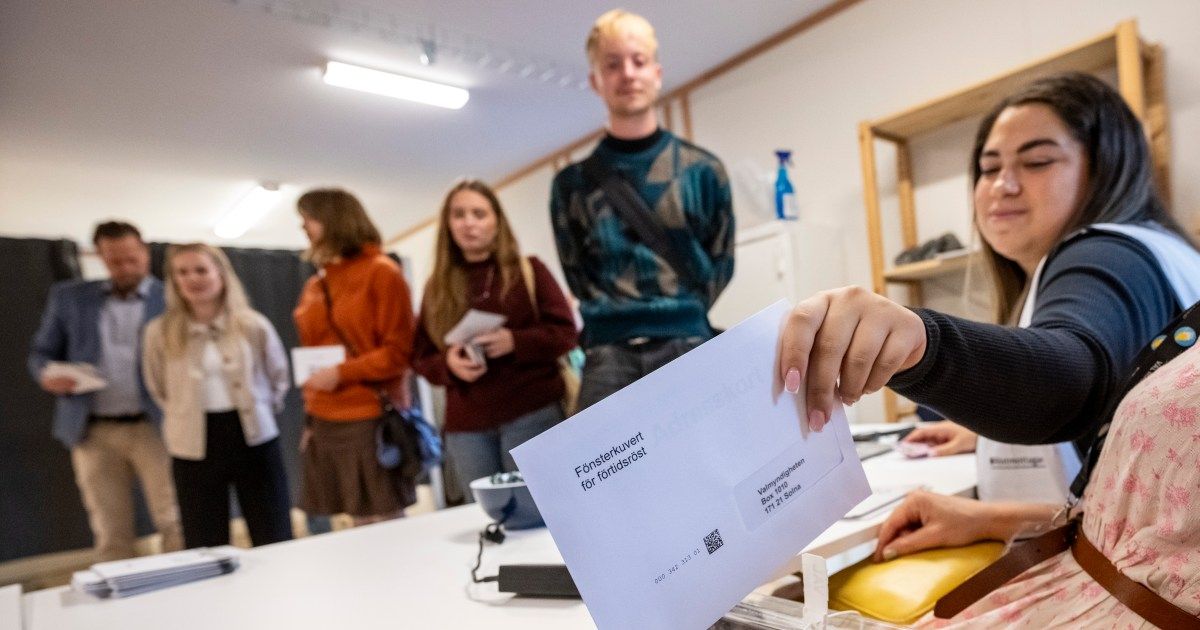
Voting in Sweden’s election ended at 18:00 GMT on Sunday, and officials are counting the results.
Recommended Stories list of 3 itemsend of list
The centre-left opposition was expected to win 175 seats in the 349-seat parliament, the Swedish Election Authority said, based on votes from 4,853 of Sweden’s 6,312 election districts.
The right-wing governing bloc was projected to win 174 seats.
Swedish Prime Minister Ulf Kristersson, who leads the ruling coalition, said on Monday that he would contact other party leaders after the elections, adding that it remains an open question who will govern Sweden in the coming years.
The centre-left opposition coalition was projected to win 51.3 percent of the vote, ahead of the right-wing bloc’s 46.8 percent, according to an exit poll by public broadcaster SVT.
A separate election-day poll conducted by broadcaster TV4 also showed the centre-left in the lead.
Swedish exit polls, while often indicative of the outcome, have not always proven accurate. In 2022, for example, a poll projected that Andersson’s centre-left bloc would prevail, but a right-wing coalition led by Kristersson ultimately won.
Earlier in this campaign, Sweden’s left-wing bloc appeared headed for a comfortable victory over Kristersson’s four-party alliance, which includes the nationalist Sweden Democrats. But the race tightened steadily in the final weeks of the campaign, turning what had looked like a relatively predictable election into a much closer contest.
Earlier in the year, polls had given the opposition bloc led by Andersson’s Social Democrats a lead of about 10 percentage points. By the final weeks of the campaign, that advantage had collapsed to just two to three points.
A victory for Andersson would provide some respite for left-leaning parties across Europe, where right-wing and far-right parties have been gaining ground. Just last week, Alternative for Germany (AfD) won 44 percent of the vote in a key state election, putting a far-right party within reach of power at the state level in Germany for the first time since World War II.
If the early exit polls are wrong, however, Sweden’s election could instead bring the far-right Sweden Democrats into government for the first time. A party with roots in the neo-Nazi movement, it won 20.5 percent of the vote in the 2022 election, becoming the largest party on the right and a crucial source of parliamentary support for Kristersson’s minority government.
Until now, however, the Sweden Democrats have remained outside government. Kristersson announced in April that his conservative Moderates would be prepared to bring the party into a governing coalition if the right secured a majority, which would give the Sweden Democrats cabinet positions for the first time.
But if the exit-poll lead is confirmed, the Sweden Democrats would be less likely to enter government.