
After the opening weekend of this season, the Premier League trumpeted a record of 100 per cent accuracy in key decisions made by match officials.
Across the first 10 games, it listed 21 key match incidents (KMIs), ranging from penalty appeals and potential red-card challenges to goals being double-checked for possible offside. The league’s KMI panel agreed that the on-field match officials had made correct decisions in 18 of those 21 cases — and that “following VAR intervention, 100 per cent of decisions were deemed correct”.
But that wasn’t quite the case. The exception was an unsuccessful Brighton & Hove Albion penalty appeal in their 4-0 victory over Aston Villa. Four of the five panel members felt Brighton should have been awarded a penalty for a challenge by John McGinn on Ibrahim Osman, which referee Peter Bankes missed. But the panel’s majority verdict (three to two) was that, even if it should have been a penalty, it was not such a “clear and obvious error” that it merited a VAR intervention.
It probably helped that Brighton were already 4-0 up — nobody was going to lose sleep over an incident in that context — but it was almost as blatant a foul as you are likely to see. That Bankes missed McGinn’s lunge in real time was excusable, but what was bizarre was that one member of the KMI panel (made up each week of a Premier League representative, a refereeing representative and three “independent” panellists, drawn from former players or managers) felt Bankes had got it right.
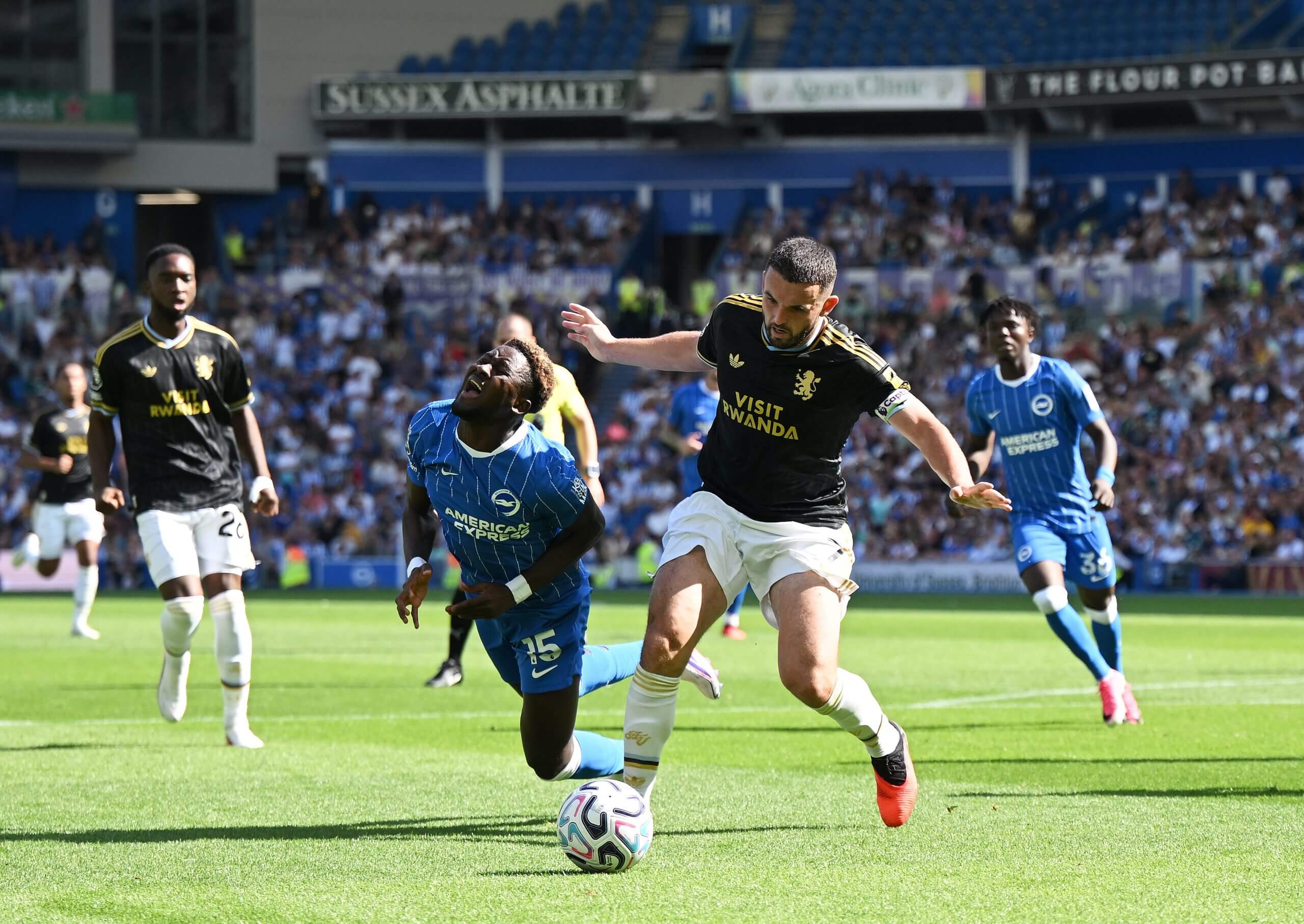
John McGinn’s unpunished challenge on Ibrahim Osman (Mike Hewitt/Getty Images)
Still, there is so often a grey area in these incidents. And there is a higher bar these days when it comes to VAR interventions for subjective decisions. It is why, even if four of them felt it should have been a penalty, three of the five members of the KMI panel felt VAR Matt Donohue was right to allow the on-pitch referee’s call to stand.
There were a couple of similar incidents in week two. The KMI panel felt referee Sam Barrott was wrong to award Nottingham Forest a penalty at Liverpool for a challenge by Alisson on Neco Williams… but not so wildly wrong that VAR Michael Oliver should have sent Barrott to the screen. Likewise, referee Tony Harrington’s failure to award Brentford a penalty at Leeds United after Jayden Bogle’s challenge on Kevin Schade: wrong, said the KMI panel, but not a “clear and obvious” error.
Some readers will bristle at such a contradiction, but it does at least come from a reasonable standpoint: that the threshold for VAR intervention should be high and that the “referee’s call” should stand unless, in the VAR’s opinion, a mistake is clear and obvious.
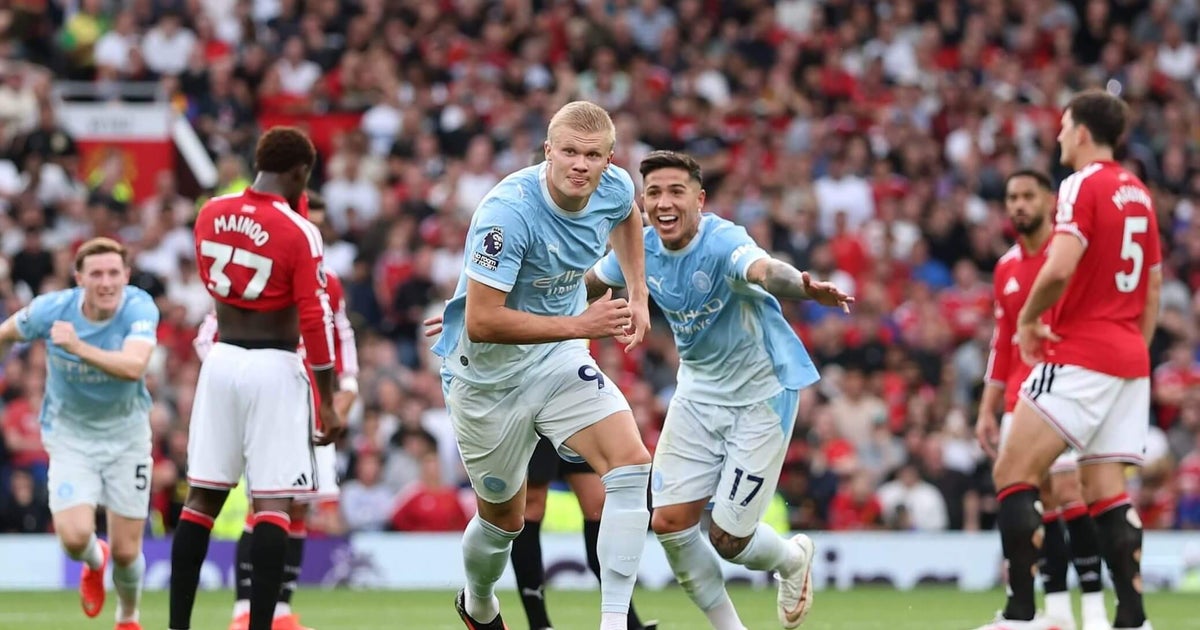
All of which brings us to Old Trafford on Sunday afternoon and the biggest refereeing controversy of the new Premier League season. Manchester City deserved their victory over Manchester United, but the only goal of the game, scored by Erling Haaland on the hour, should not have stood — not because of offside against Haaland, as was initially flagged by the referee’s assistant, but against his team-mate Enzo Fernandez.
It could have been one of those rare triumphs for VAR and semi-automated offside technology, which determined that Haaland, contrary to the impression given by television replays, had been played onside by United full-back Patrick Dorgu. But Fernandez was clearly offside and, by challenging for the ball, was interfering with play. The goal should have been disallowed and yet, after a VAR check lasting two and a half minutes, it was allowed to stand.
By 9.15pm on Sunday, Pro Ref, the professional referees’ body in English football, was issuing a statement confirming that the VAR had not recognised “the likely impact” of Fernandez’s positioning and “should have recommended an on-field review”. Pro Ref promised to review the incident fully and said contact had been made with Manchester United “to acknowledge what we deem is an error of judgement”.
Arsenal manager Mikel Arteta appears to be expecting a similar communication over the penalty Sunderland were awarded against his team at the Stadium of Light on Saturday. Arteta called that decision “unacceptable”, feeling that Sunderland’s Dan Ballard had fouled Ezri Konsa rather than the other way around. There is an understandable sense of bemusement at Arsenal over the initial explanation via the Premier League’s Match Centre, which reported referee John Brooks as saying Konsa was “all over him (Ballard) at the near post, facing the wrong way”, and VAR Stuart Attwell saying he was “happy that it’s a holding offence”.
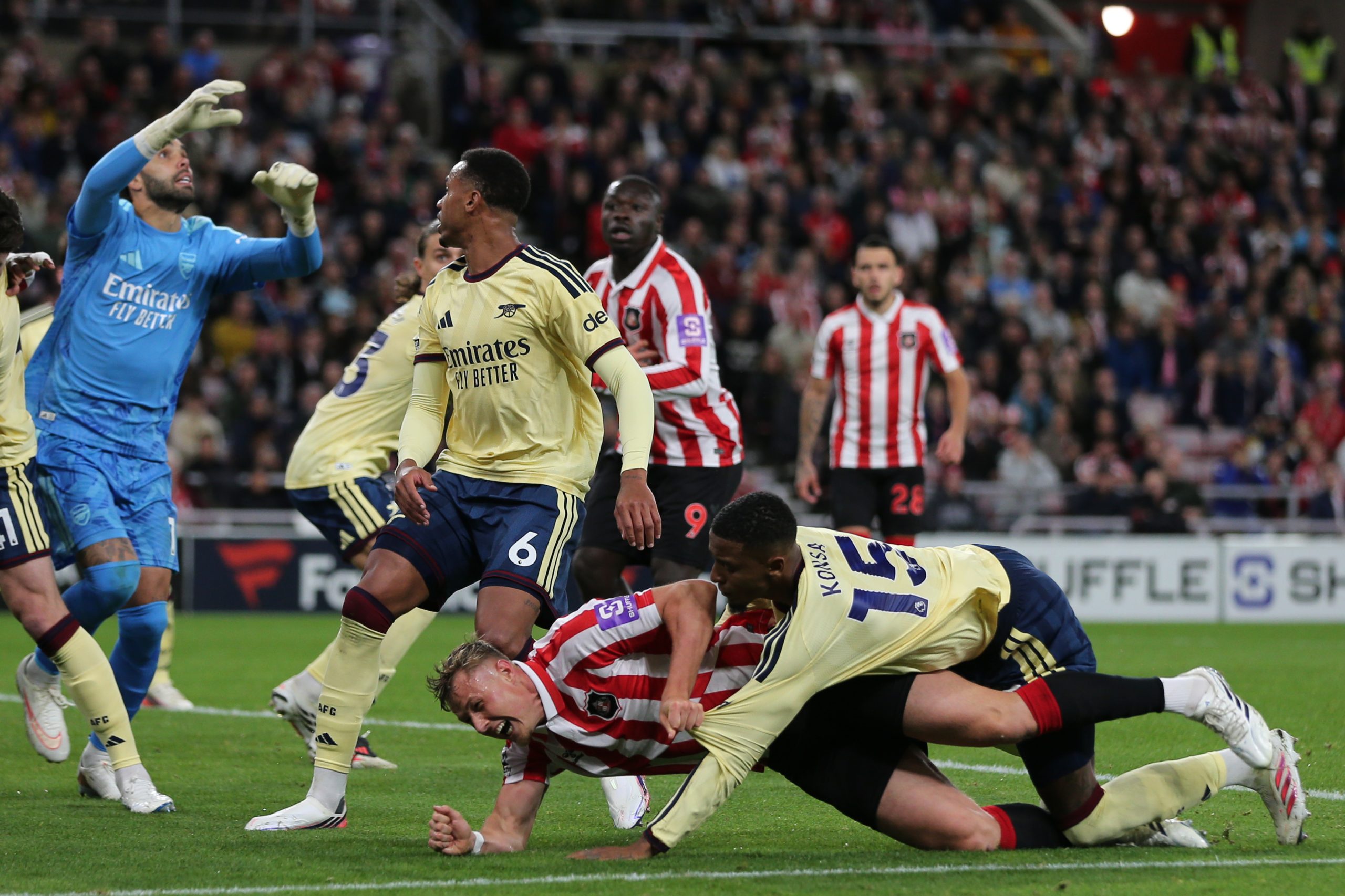
A penalty was given against Arsenal’s Ezri Konsa for this tangle with Sunderland’s Dan Ballard (Michael Driver/MI News/NurPhoto via Getty Images)
But you only had to see Sky Sports News’ Ref Watch feature on Monday morning to see former Premier League referee Dermot Gallagher saying that such a penalty award would “never get overturned” due to the higher threshold insisted upon. An incorrect decision? Many of us would say so. But a clear and obvious error that had to be overturned? That, at least, is open to debate.
All in all, after a relatively smooth start to the season, it was a difficult weekend for match officials. That Sunderland-Arsenal game was played at a physical intensity that was thrilling for spectators but which looked extremely difficult to referee, hence the number of grievances on both sides. The Manchester derby was similar; even the relatively straightforward decision to send off City’s Phil Foden for kicking out at Bruno Fernandes was controversial, given that Foden’s violent retaliation was first triggered and then exaggerated by the United captain. Even former United midfielder Nicky Butt, on his podcast, said it should have been two red cards or none.
But it is the controversial Haaland goal — or rather the officials’ failure to recognise the part Fernandez played in it — that will rumble on. Why? Because it was not about a subjective decision. It was about a failure of process, which is presumed to be why the two VARs, Donohue and Blake Antrobus, have not been allocated any duties for a Premier League game this weekend.
Gallagher’s view in the Sky Sports studio was that the VARs must have found themselves so bogged down in studying a) whether Haaland was offside and b) whether Fernandez had touched the ball that they had “lost focus”, specifically on the rule that states that “a player will be penalised if they are clearly attempting to play a ball that is close when this action impacts on an opponent or on the ability of an opponent to play the ball”.
Mistakes happen. Goodness knows there were enough of them in the build-up to that goal: Dorgu lost the ball and then, in an attempt to atone for the error, ended up drifting from left-back to right-back, which is why United ended up outnumbered at the far post; no United midfielder showed the slightest interest in tracking the Fernandez run, even before he ended up in an offside position; Lisandro Martinez appeared to know Fernandez was offside but still found himself drawn to his Argentina team-mate at the last moment, fatally neglecting Haaland at the far post.
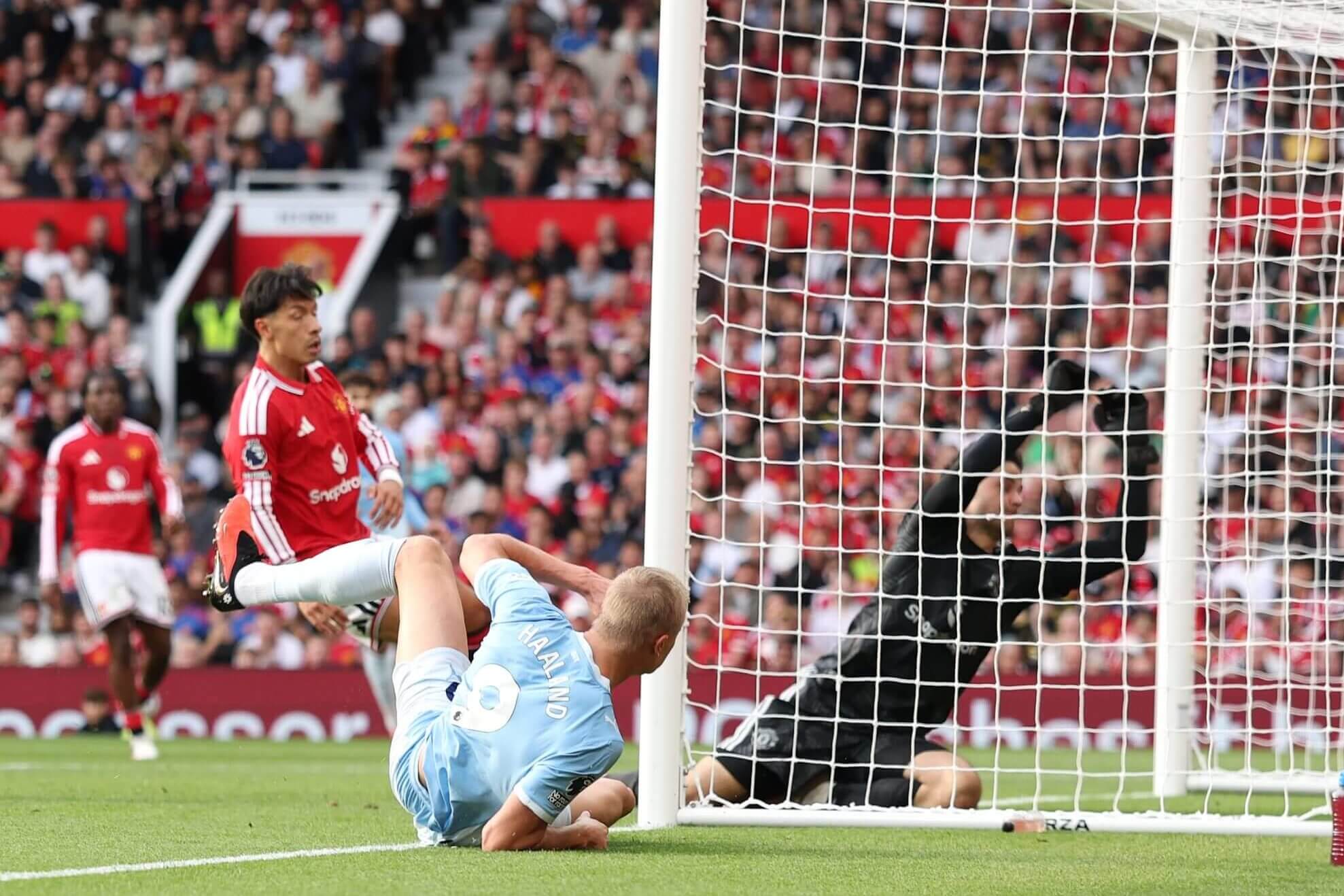
Erling Haaland bundles the ball home against Manchester United (Michael Regan/Getty Images)
Anyone expecting perfect decisions from referees and their assistants — presiding over what has become a semi-contact sport, with ambiguous rules, played at high speed and frequently in the spirit of deception — should ask themselves just how often they see perfect decision-making from players.
But while fallibility can and must be excused when it comes to referees and their assistants on the touchline, it is so much harder to accept from those in the VAR suite. To spend two and a half minutes studying that goal so forensically, and then seemingly lose sight of how Fernandez, from an offside position, distracted Martinez and goalkeeper Senne Lammens, is the worst of both worlds.
If they had taken two and a half minutes just to confirm the offside decision, it might have been a hard sell. But to lose two and a half minutes to a VAR check, only to end up with what was so clearly the wrong decision? That is alarming. Coming in the Manchester derby, in front of a huge global television audience, doesn’t mean that it mattered more than in any of the other 379 games in a Premier League season, but it certainly made it more embarrassing.
How Carrick’s tactical change made Manchester United worse
Jon Mackenzie
There is no doubt this one will be chalked up as an incorrect decision in the eyes of the KMI panel. The Foden/Fernandes flashpoint? The Sunderland penalty against Arsenal (and indeed various other controversies at the Stadium of Light on Saturday evening)? Less likely, perhaps, not least because even a suboptimal outcome can be dressed up as a correct decision if three of the five panellists feel the VAR was right not to get involved.
The Premier League is yet to publish its breakdown of those key match incidents from week three or beyond, but it listed 47 KMIs across the first two gameweeks. Eight of them were deemed to have been ruled wrongly by the on-field officials, seven of them were either corrected on the advice of the VAR or (as in the case of the penalty awarded for Forest at Liverpool, or those not awarded for Brighton and Brentford against Villa and Leeds) were considered marginal enough for the on-field decision to be upheld.
The only exception in those first two rounds of games was a penalty that Arsenal were denied in stoppage time during their 1-0 victory at Aston Villa, when Ian Maatsen clattered Bruno Guimaraes. All five KMI panel members felt it was such a clear error that the VAR should have intervened. Had Arsenal not ended up winning that game regardless — and likewise at Sunderland on Saturday, when the penalty awarded against them was saved brilliantly by David Raya — the fallout would have been greater.
So it comes back to the percentages. How many mistakes are too many? One? Two? Let’s not be unrealistic.
But the whole point of VAR was to eliminate the relatively small number of serious mistakes — the howlers, as they are often referred to. There is already a feeling among many supporters that the time spent poring over marginal decisions — all those interminable stoppages for decisions that are going to cause dissatisfaction, whatever the outcome — is far too much.
That dissatisfaction is so much greater when time is spent analysing an incident in microscopic detail, only for a “clear and obvious” error to be upheld — or worse, in the case of Haaland’s goal on Sunday, for a goal that had correctly been flagged offside to be wrongly given the green light.
Everyone wants better decisions, particularly when their own team is on the wrong end of an injustice, minor or major. But at what cost to our enjoyment of the game? The VAR process outlined by former Premier League referee Graham Scott is so painstaking that it leaves you wondering just how football ended up here. If it takes two minutes to get to the right decision, is it still the right decision? And what if, from time to time — like after two and a half minutes at Old Trafford on Sunday — the right decision ends up being replaced by the wrong one?
Football was never meant to be like this. The offside rule certainly wasn’t meant to come down to forensics. But the VAR system has turned it into that and, in doing so, has created a world in which human error — particularly from those with the technology at their disposal — seems so much less tolerable than it used to be.
There are fewer mistakes, of course, but are they few enough to justify the disruptions, the delays and this endless pursuit of flawlessness in a sport that never seemed to have been designed with perfection in mind?