
The Denver Broncos subtly changed their rotations: Denver adjusted how they rotate running backs, wide receivers and tight ends from last season, which might leave them without any fantasy starters.
Introducing the NEW PFF Pro subscription: PFF Pro includes everything in PFF+, plus an upgraded Premium Stats Pro experience, higher base access to Guru AI, revamped player and team pages, enhanced data and visualizations, an improved interface and programmatic data access for modeling. Click here to subscribe.

PFF’s fantasy football recap focuses on player usage and stats, breaking down all the vital information you need to achieve fantasy success in 2026.
For fantasy players looking for additional data and tools, PFF+ provides access to fantasy and betting resources, the Mock Draft Simulator and more for $9.99 per month or $99.99 per year. Those who want to dive even deeper can sign up for PFF Pro, which comes with an upgraded Premium Stats Pro experience, revamped player and team pages, enhanced data and visualizations and programmatic data access for modeling.
Denver Broncos @ Kansas City Chiefs
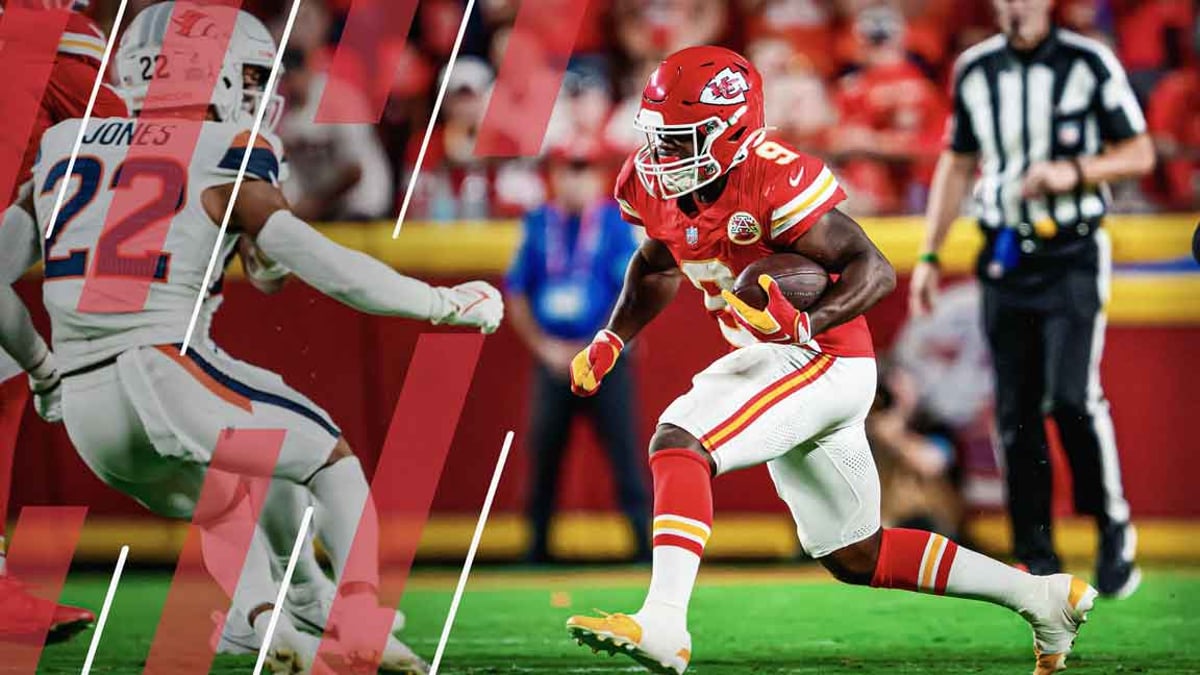
The Broncos’ two-man backfield: The Broncos simplified their rotation relative to last season.
The Broncos started last season with a three-man running back rotation, with J.K. Dobbins as the lead back, RJ Harvey as the backup and Tyler Badie as the third-down back. Dobbins missed the second half of the season, allowing Harvey to take on more of the lead role. Denver spent a fourth-round pick on Jonah Coleman, which seemed to complicate the running back room further. All three running backs are capable of playing in all three situations, and Sean Payton has a long history of using a committee in the backfield. That meant any combination would not have been a surprise heading into the game.
Denver used a two-man rotation throughout the game, with Coleman not in the mix. Dobbins was the early-down back, seeing a largely similar role to last season. Harvey was the backup, as well as the third-down and two-minute-drill back. This meant Harvey largely took on both his role and Badie’s role from early last season.
The one exception was short-yardage situations, where Harvey took those snaps. Dobbins handled 68.9% of the short-yardage snaps and 77.4% of the goal-line snaps last season. This brings the fantasy value of the two running backs very close together, but the early-down role trumps all other roles combined for a fantasy running back, so Dobbins has more value in the short term. However, Harvey was more effective with the ball in his hands, so it wouldn’t be surprising if he eventually earns more playing time.
This also makes it unlikely Coleman becomes a factor on offense anytime soon. The best-case scenario is that Coleman slowly but surely works his way into the rotation, outplays the other two backs and eventually earns more playing time. There is no guarantee that happens this season. In leagues with shallower benches, Coleman is someone to consider dropping for a player who had a more promising Week 1.
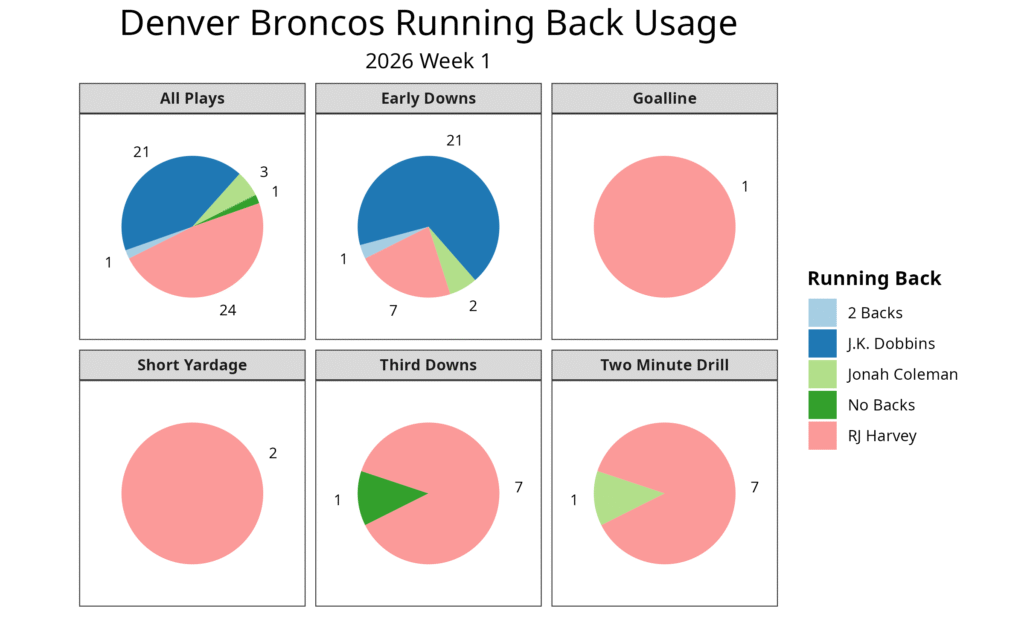
Denver adjusts its wide receiver rotation: Three wide receivers emerged from Denver’s usual rotation.
Since Sean Payton became head coach of the Broncos, Courtland Sutton has been their X receiver and the only player to consistently see the playing time of a typical starter. Several young receivers, along with the occasional veteran who specialized in run blocking, rotated through the other spots. Last season, that included Marvin Mims Jr., Troy Franklin, Pat Bryant and Lil’Jordan Humphrey. Denver kept all of those receivers throughout the offseason but traded a first-round pick for Jaylen Waddle. This placed Waddle at the top of the depth chart and complicated the fantasy value of everyone else. Earlier today, Denver released Humphrey, which at least meant the Broncos would use a five-man rotation instead of six.
Sutton remained the top receiver on the depth chart in terms of playing time, but Waddle played more than Denver’s second receiver did last season, and Bryant also played more than Denver’s second receiver did last season. This left Franklin and Mims rarely seeing the field. When the Broncos ran 11 personnel, it was mostly their top three receivers, but they rotated more in two- and one-wide receiver sets. Sutton was primarily the X receiver, as usual. Bryant was the Z more often than not, with Waddle in the slot, but Bryant and Waddle frequently switched where they lined up.
In terms of targets, Bryant was surprisingly their top option. At the end of the third quarter, Sutton and Waddle had combined for three catches for 13 yards, compared to four receptions for 42 yards by Bryant. While it wouldn’t be surprising if Bryant surpasses Sutton in receiving production this season, it would be surprising if he finishes ahead of Waddle. In most seasons, Payton has had one clear top receiver, from Marques Colston to Michael Thomas to Sutton. The most likely scenario is a frustrating wide receiver room where a different one of the three players has a big game each week. However, Bryant is worth picking up off the waiver wire in case he follows in the footsteps of Colston, Thomas and Sutton.
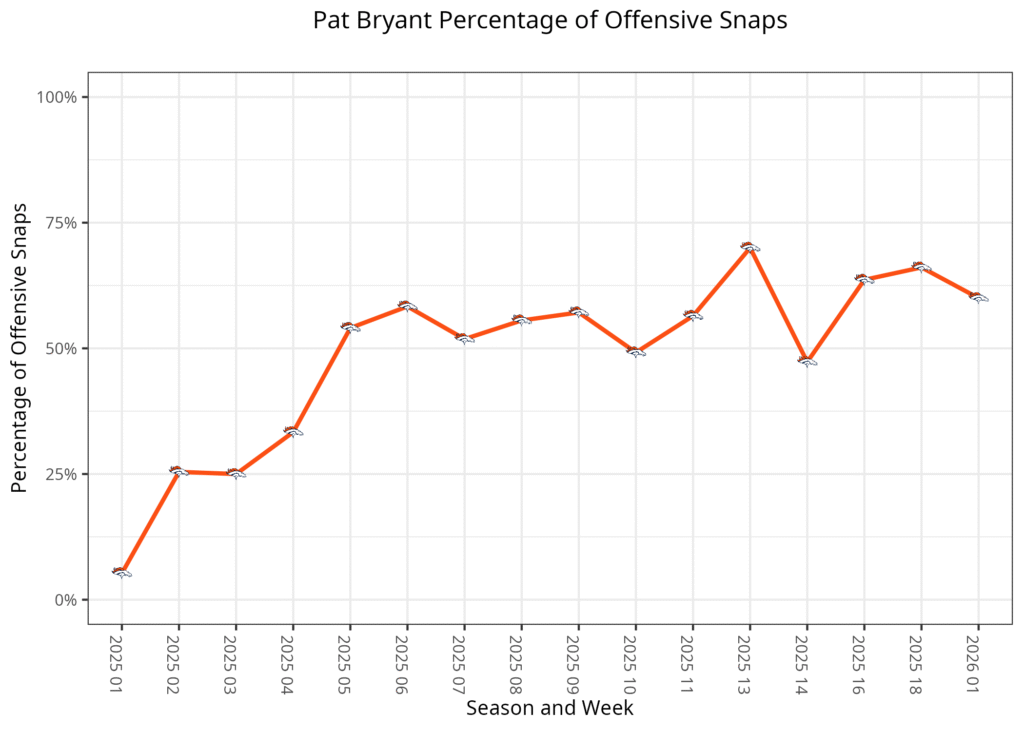
Evan Engram becomes more involved: Engram scored an early touchdown for Denver and received more playing time than he typically did last season.
The Broncos added Evan Engram last offseason, but he was used in a heavy rotation last season, preventing him from having much fantasy value. He played 37.4% of the early-down snaps in single-receiver sets, 61.9% on third downs and 33.3% of the snaps in two-tight-end sets. He played in 12 personnel much more frequently with the starters during the preseason, suggesting he would see a larger role. He has the same competition for playing time in run blocker Adam Trautman and backup Nate Adkins, but he has a new offensive coordinator in Davis Webb. Webb and Engram were both part of the New York Giants 2017 rookie class.
Engram’s playing time was up across the board, including playing the majority of early-down snaps in 11 personnel and the majority of snaps in 12 personnel. This added up to a higher route participation rate. He ended up leading the team in receiving yards with 43 on four receptions. His route participation rate in this game was good enough to make him a mid-range TE2, but his target rate was a little lower than ideal. If Engram starts seeing a higher target rate or becomes a consistent red-zone target, he could become a solid bye-week replacement once bye weeks begin.
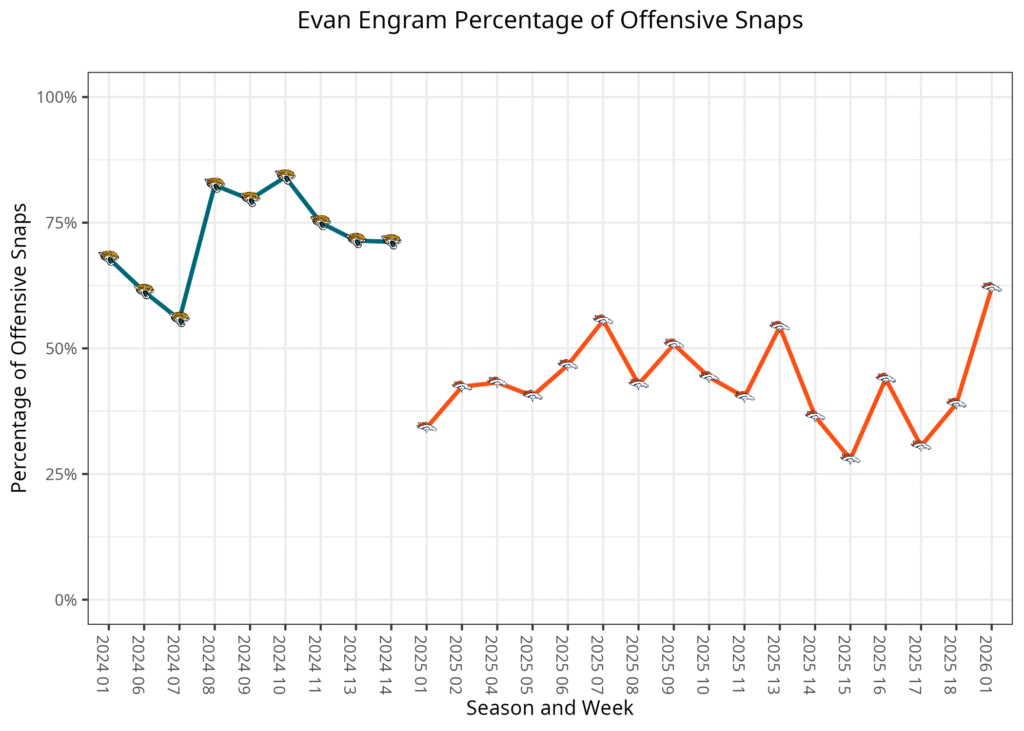
Kenneth Walker takes over Kansas City’s offense: The Chiefs gave the former Super Bowl MVP the ball early and often.
The Chiefs completely reworked their running back room this offseason, moving on from Isiah Pacheco and Kareem Hunt and instead signing Kenneth Walker to a long-term contract and drafting Emmett Johnson in the fifth round. The only returning player was 2025 seventh-round back Brashard Smith, who was a situational receiving back last season.
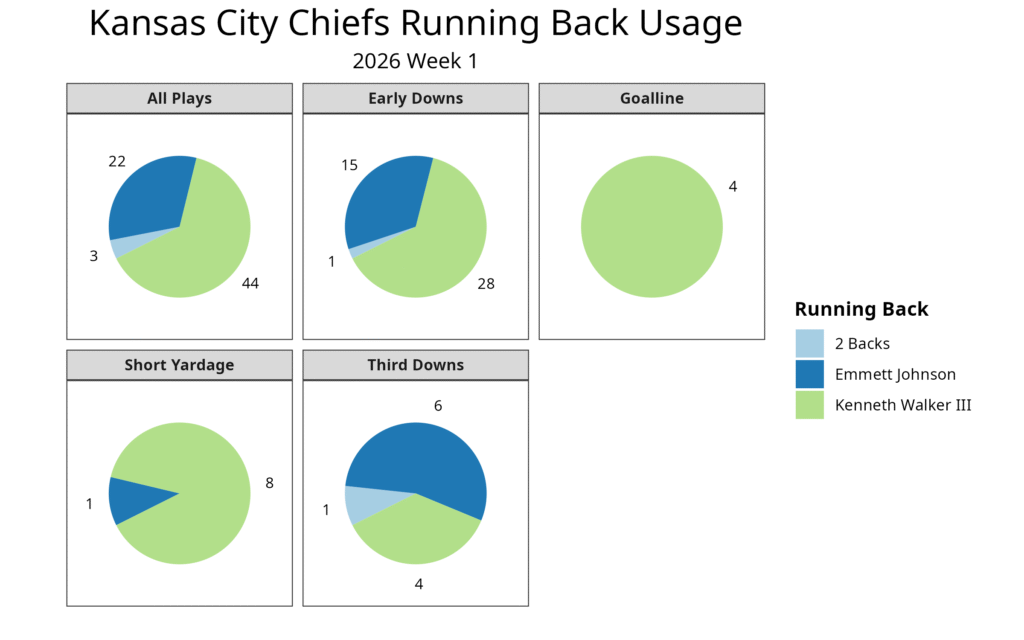
Walker started the game, and Kansas City consistently gave him the ball on the opening drive. He received 14 carries in the first half, broke a 60-yard touchdown run early in the third quarter and scored a second touchdown later in the half. Johnson was the backup, as expected. While Kansas City has a history of using a specific back on third downs, the two running backs were used interchangeably. Walker would take several plays in a row, followed by Johnson for a few plays.
This game largely confirmed what we already believed heading into the season: Walker is a must-start player, and Johnson is a handcuff worth rostering in case Walker suffers an injury.
Kansas City consolidates its wide receiver room: The Chiefs’ five-man wide receiver rotation from recent seasons has turned into a three-man rotation.
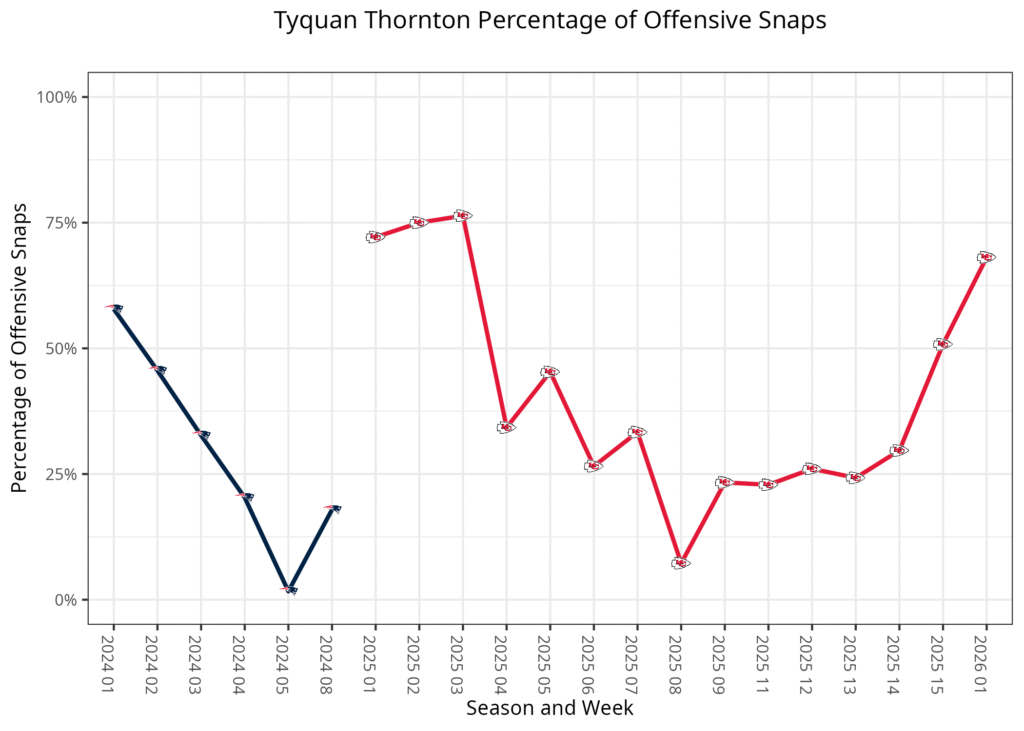
Kansas City used a five-man wide receiver rotation last season, with Tyquan Thornton as a deep threat, Xavier Worthy and Hollywood Brown as intermediate threats, and Rashee Rice and JuJu Smith-Schuster as short targets. Rice was the only one who was fantasy-relevant in his role, although Worthy dealt with a shoulder injury all season, hurting his fantasy value. Kansas City didn’t bring back Brown or Smith-Schuster and instead chose to go with 2025 fourth-round receiver Jalen Royals and 2026 fifth-round rookie Cyrus Allen as the backups. The Chiefs also changed offensive coordinators, turning to Eric Bieniemy, which was expected to impact the receiver rotation. In a small preseason sample, Worthy played more in the slot compared to last season, while Rice played there less.
Kansas City stopped rotating its wide receivers nearly as much as it had over the past few seasons, with Rice, Worthy and Thornton playing almost all of the three-receiver sets together. Worthy was almost always on the field in two-receiver sets, with Rice playing more than Thornton. In single-receiver sets, either Thornton or Rice was on the field. This is generally good news for the fantasy value of all three receivers but bad news for a potential Allen breakout this season.
Some tendencies from last season continued, with all three receivers playing in the slot but Rice remaining the primary slot receiver. Thornton remained the only deep threat, while everyone else on the roster maintained relatively low average target depths. The first big change was that Kansas City ran the ball much more in this game than in the past, which limited passing plays and hurt all the receivers. Kansas City also stopped force-feeding Rice the ball. Rice’s targets-per-route rate was 27% or better in all but one game last season, with his worst game coming at 22.6%. He finished this game at 6.9%. If this continues, Rice will no longer be a must-start option.
Miscellaneous Notes
Both teams elevated fullbacks from the practice squad for this game. The Broncos elevated Adam Prentice, while the Chiefs elevated Ben VanSumeren.
Travis Kelce’s snap rate was a little lower than usual, but it has become normal for Kelce to have lower snap rates early in the season before ramping up as the year goes on.
Table Notes
• Snaps include plays called back due to penalties, including offensive holding or defensive pass interference. The other three stats exclude these plays.
• Targets may differ from official NFL sources. The most likely discrepancy will be from a clear thrown-away pass, where the NFL may assign the target to the nearest receiver while this data will not.
• Carries are only on designed plays. Quarterback scrambles won’t count for the total number of carries in the game.