
News
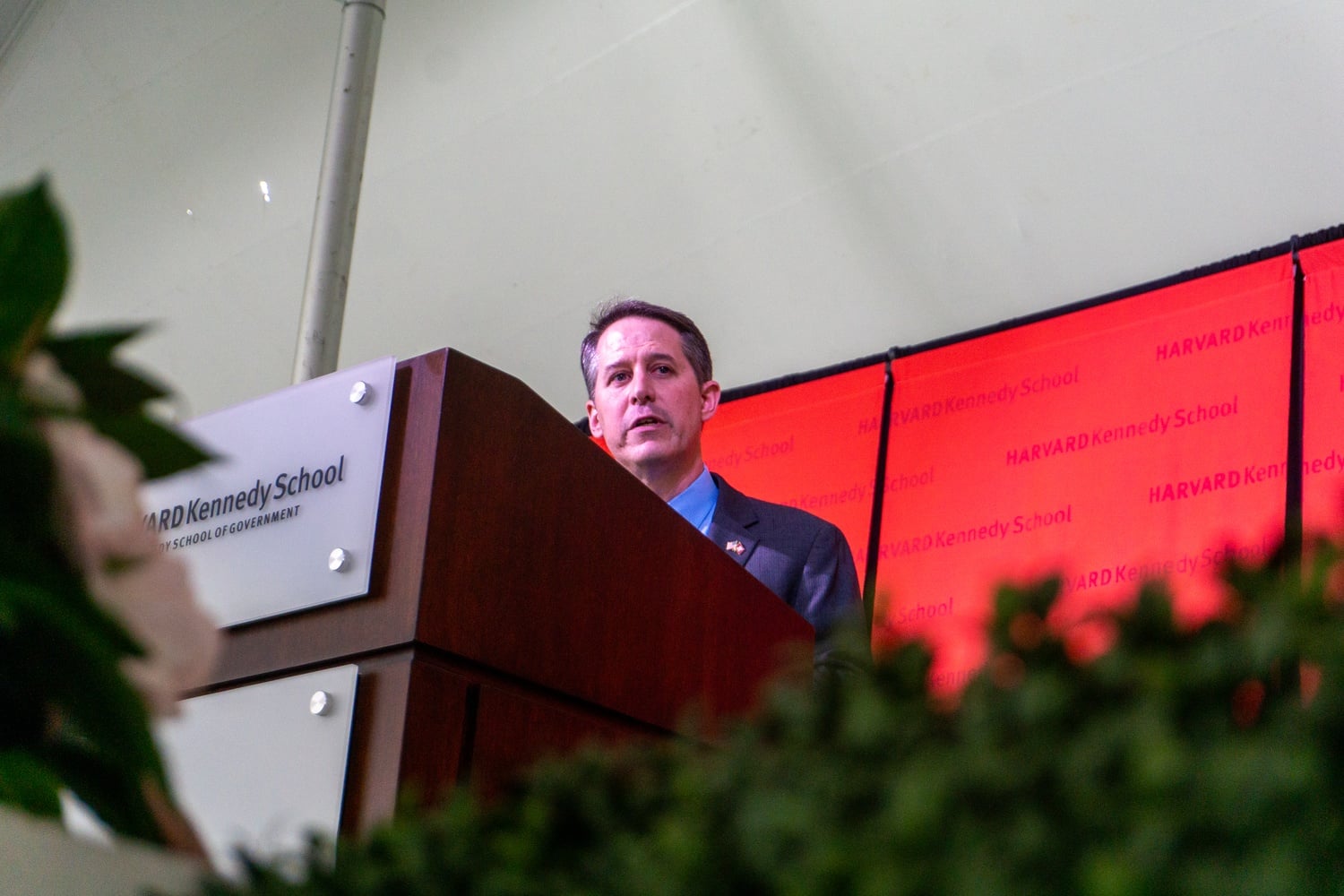
Harvard Kennedy School Dean Jeremy M. Weinstein has refused to strip New York Times columnist Nicholas Kristof of an endowed lecture honor, writing that withdrawing the invitation would call into question the Kennedy School’s “very commitment to free speech,” according to letters obtained by The Crimson.
The exchange, which spans three letters over ten days, has left Weinstein and the Harvard Jewish Alumni Alliance at an impasse three days before Kristof is scheduled to deliver the Malcolm H. Wiener Lecture on Friday.
HJAA opened the exchange on Aug. 28 with three requests: that the school withdraw the honor, that it publish its criteria for Wiener honorees, and that Weinstein’s office meet with the group before the lecture. It asked for a reply by Sept. 4.
Weinstein answered on Sept. 6, two days late, and granted none of the three.
“To withdraw such an invitation, however, calls into question our very commitment to free speech and to fostering an environment in which controversial positions can be heard, engaged with, and publicly scrutinized,” he wrote.
An invitation to deliver an endowed lecture “does not suggest institutional agreement with the views a guest has espoused,” he added.
HJAA wrote back the next day to say Weinstein had answered the wrong question.
“We did not question Mr. Kristof’s right to speak; our letter said so explicitly,” HJAA president Adrian D. Ashkenazy ’96 wrote. “An endowed lecture is an honor, and conferring one is an exercise of institutional judgment.”
The group renewed all three requests and set a new deadline of last Friday, Sept. 11. Ashkenazy said the group has received no response.
The dispute centers on a May 11 column — “The Silence That Meets the Rape of Palestinians” — in which Kristof described allegations of widespread sexual abuse of Palestinian detainees by Israeli guards, soldiers, and interrogators.
Get The Crimson in your inbox.
Israeli Prime Minister Benjamin Netanyahu threatened legal action against the New York Times, accusing it of having perpetuated “one of the most hideous and distorted lies ever published against the State of Israel in the modern press.”
The Times said any such claim would be “without merit,” and after reviewing challenges to the column, said it found no errors.
Times Opinion editor Kathleen Kingsbury defended the column weeks later in a joint question-and-answer piece with Kristof, saying his reporting had been fact-checked and that editors found no errors afterward.
“Before publication, Nick’s reporting underwent a rigorous vetting process by Opinion’s fact-checking department to ensure that every testimony and anecdote he personally reported was supported by independent sources, as is the case with all sensitive pieces,” she said.
HJAA’s objection rests on a different Times editor. Executive Editor Joseph Kahn has said the paper’s newsroom would not have run the piece, the basis for Ashkenazy’s charge that the column was built on sourcing which “his own Executive Editor would not fully stand behind.”
HKS extended the invitation on March 10, two months before the column appeared.
HJAA pointed to earlier episodes in Kristof’s career. It wrote that he named a government scientist as a likely anthrax suspect in 2002 and apologized years after the FBI cleared him; that he expressed regret in 2014 after evidence emerged that accounts from women central to his trafficking reporting were false or embellished; and that the Times opened a review in June of his columns for undisclosed ties to campaign donors, appending editors’ notes to nine of them.
“Three decades, one pattern: credulity first, contrition years afterward,” Ashkenazy wrote.
Weinstein wrote that HKS hosts hundreds of speakers each year representing “a wide variety of views, backgrounds, political ideologies and policy prescriptions.”
He acknowledged that speakers’ reputations have prompted calls for cancellation before, but wrote that withdrawing an invitation under pressure “sends an unmistakable message not only to this speaker but to potential speakers in the future and to our community.”
“Instead, we believe the answer is more speech, not less, which is why we host so many speakers featuring such varied perspectives,” he wrote.
HKS faced a similar demand two years ago and reached the same conclusion. In February 2024, pro-Israel critics called on HKS to retract an invitation to Dalal Saeb Iriqat, a Palestinian professor who had described the Oct. 7 attack on social media as a “normal struggle 4 #Freedom.”
HKS did not withdraw it and Iriqat spoke that March as part of a dialogue series run by Kennedy School professor Tarek E. Masoud.
But then-Dean Douglas W. Elmendorf paired that decision with a public judgment of her views, saying he personally found her comments “abhorrent” and that they “justify and normalize the horrific terrorist attack by Hamas.” HKS said at the time that “an invitation to speak at the Kennedy School never implies an endorsement of a speaker’s views,” nearly the same formulation Weinstein used last week.
Weinstein’s letter offered no comparable assessment of Kristof’s column.
HKS has also gone the other way, and reversed itself. In January 2023, former Human Rights Watch executive director Kenneth Roth said Elmendorf had blocked him from a year-long fellowship over his criticism of Israel.
After hundreds of Harvard affiliates called for Elmendorf’s resignation, he reversed course and appointed Roth, writing that he had “made an error.”
HJAA wrote that it would accept Kristof speaking in another format. If HKS still wanted him on campus, Ashkenazy wrote, “it may choose any format that lets students and experts question and challenge him directly.”
“What it may not do is call that platform an honor,” he wrote.
A spokesperson for the Harvard Kennedy School declined to comment directly on the exchange, instead referring to Weinstein’s original response.
The lecture was originally scheduled for Sept. 17, the date both of HJAA’s letters reference. It was pushed back a day because of a scheduling conflict for Kristof, according to a person familiar with the matter.
Weinstein’s letter did not address the group’s requests that HKS publish its selection criteria or meet before the lecture. Previous Wiener honorees include former British Prime Minister Gordon Brown, Nobel laureate Muhammad Yunus, and economist Gita Gopinath.
—Staff writer Alexa M. Schmitt can be reached at [email protected] or Signal at alexaschmitt.15. Follow her on X at @alexa_m15_s.