
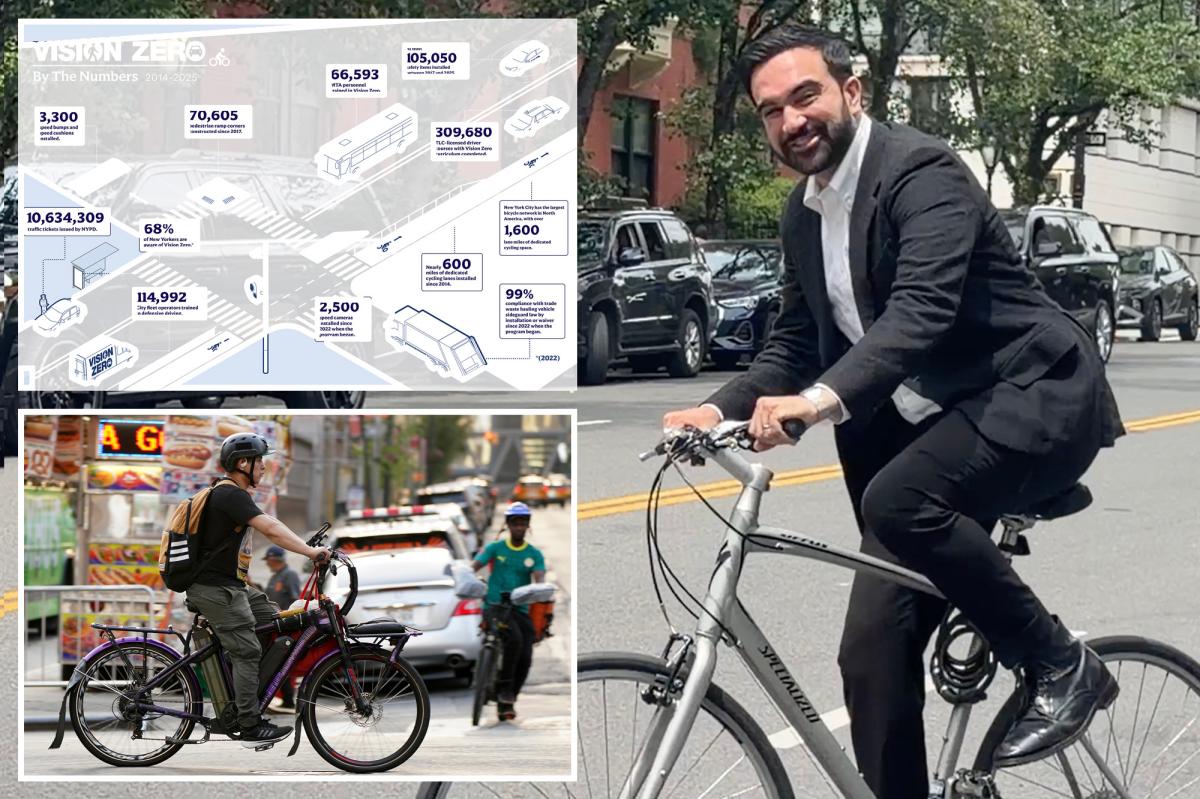
Mayor Zohran Mamdani on Tuesday unveiled “Vision Zero Reimagined,” a wide-ranging plan to eliminate traffic deaths within 10 years — including by boosting “pedestrian-only” zones across the city.
The 105-page blueprint, however, offers few concrete details on the no-car zones, such as where they would be located or how much of the city would be turned into “pedestrian-priority districts.”
“Vision Zero Reimagined puts forward the bold measures and practical fixes we need to make preventable tragedy no longer a part of everyday life in New York City,” Mamdani said.
Mayor Zohran Mamdani on his bicycle outside Gracie Mansion in New York on Sunday, May 31, 2026. Lone Pine Press for NY Post
“Vision Zero Reimagined” aims to eliminate traffic deaths in NYC within 10 years. Office of the Mayor
The plan also vaguely vows to institute 20 mph speed limits across “entire neighborhoods” and to look into instituting higher tolls for oversized passenger cars.
The city will be “providing disincentives to private automobile trips, ownership and on-street storage,” the report states.
Some of the few tangible actions — among dozens of initiatives outlined in the plan — include:
Expanding 15 mph limits to 2,300 school zones. The Mamdani administration previously vowed to do this in 800 school zones this year, though just 200 so far have been implemented, city officials admitted.
Make safety improvements at 1,000 intersections across the city, including by removing visual obstructions (daylighting), adding physical barriers and more.
Establishing an “Office of Curb Management” within the Department of Transportation to decide how the city’s curb space is used. The plan mentions expanding loading zones for deliveries and cracking down on double parking and cars sitting in bike and bus lanes.
The plan claims it will expand bike lanes to “all communities citywide,” punting details to a 2026 Streets plan to come out “later this year.”
The city already has a legal mandate to build 50 miles of protected bike lanes a year under the NYC Streets Plan legislation passed by the City Council in 2019. But it currently is not hitting that goal, with DOT completing just 18.2 miles of protected bike lanes in 2025 and 29.3 miles in 2024.
The report also touts a “first-ever Super Speeder” program, though that was established through a state law passed in Albany earlier this year.
The plan is a revamp of former Mayor Bill de Blasio’s original “Vision Zero,” which he unveiled in early 2014 after the city saw nearly 300 traffic deaths the previous year, including 184 pedestrians.
A person rides an e-bike in New York, NY, on Thursday, July 2, 2026. Christopher Sadowski for NY Post
De Blasio’s plan promised to bring the tragic tally down to zero within 10 years — though there were still about 250 traffic deaths reported in 2024.
New York City has seen 135 traffic fatalities so far this year, through September 6 — down from 141 in the same period last year, according to NYPD’s weekly TrafficStat report, which includes pedestrians, bicyclists, e-bikers and car and motorcyclist occupants.
“We mourn these New Yorkers but we also know our grief is not enough,” said Mamdani, who announced the plan at a DOT facility in Maspeth, Queens, joined by advocates from non-profits Families for Safe Streets and Transportation Alternatives.
“Only action can honor their legacies and only action can ensure that no more of our neighbors are taken from us,” he said.
Transportation Alternatives — which aims to “reclaim New York City from cars,” according to its website — staged a “die-in” over the summer demanding that Mamdani provide an update to de Blasio’s blueprint.
The newly announced plan suggests subsidizing Citi Bike, which is owned by Lyft — the ride-share company that’s appeared on Transportation Alternatives’ donor list each year since 2019, giving at least $400,000.
The plan also said the city would “explore” four new categories of traffic camera enforcement — parking violations, failure to yield, speed cameras on highways and distracted driving — a potential windfall for camera vendor Verra Mobility.
The Arizona-based company holds a city contract worth $998 million and has given Transportation Alternatives at least $500,000 since 2019, records show.
— Additional reporting by Kevin Sheehan